Christopher Clark’s Revolutionary Spring: Europe’s Tumultuous Year
Revolutionary Spring by Christopher Clark: Quick Answer
- Revolutionary Spring by Christopher Clark offers a deep dive into the complex events of 1848 across Europe, focusing on the interconnectedness of revolutions and their underlying causes.
- It is a scholarly yet accessible account for readers interested in detailed historical analysis of this pivotal year.
- The book excels in its nuanced exploration of motivations and outcomes, providing a comprehensive understanding of the period’s volatility.
Who This Is For
- Readers with a strong interest in 19th-century European history, particularly the mid-century revolutionary movements.
- Students and academics seeking a detailed, well-researched narrative that synthesizes multiple perspectives on the 1848 uprisings.
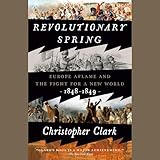
- Audible Audiobook
- Christopher Clark (Author) - Christopher Clark (Narrator)
- English (Publication Language)
- 06/13/2023 (Publication Date) - Random House Audio (Publisher)
What to Check First
Before diving into Revolutionary Spring, consider these points to gauge its suitability for your reading goals:
- Author’s Previous Work: Christopher Clark is known for his meticulous research and comprehensive approach, evident in books like The Sleepwalkers. Familiarity with his style can set expectations.
- Scope of Coverage: The book covers a vast geographical area (Europe) and a specific, tumultuous year. Ensure this broad scope aligns with your desired level of detail.
- Historical Context: A basic understanding of the preceding decades in Europe, including the Napoleonic era’s aftermath and the rise of nationalism, will enhance comprehension.
- Narrative Style: Clark’s prose is academic but engaging. If you prefer fast-paced, plot-driven narratives, this detailed historical analysis may require a different reading approach.
Revolutionary Spring by Christopher Clark: A Deep Dive
Christopher Clark’s Revolutionary Spring: Europe’s Year of Upheaval provides a granular examination of the continent-wide revolts that swept across Europe in 1848. Clark meticulously reconstructs the events, moving beyond a simple chronological account to explore the intricate web of causes, actors, and consequences. He emphasizes that 1848 was not a series of isolated incidents but a connected phenomenon, fueled by shared grievances, ideological currents, and the very interconnectedness of European societies.
One of the book’s unique strengths is its detailed portrayal of the individuals involved, from monarchs and ministers to revolutionaries and ordinary citizens. Clark avoids presenting a monolithic “people” rising up, instead highlighting the diverse motivations and often conflicting aims of various groups. For instance, he contrasts the liberal demands of the bourgeoisie with the social and economic aspirations of urban workers, demonstrating how these differing objectives contributed to the eventual fragmentation of revolutionary movements. This nuanced approach challenges simplistic interpretations of the era.
A Comparative Framework for Understanding 1848
To better understand the scope and analytical depth of Revolutionary Spring, consider how it compares to other historical accounts of the period.
| Feature | Revolutionary Spring by Christopher Clark | Other General European Histories | Focused National Histories |
|---|---|---|---|
| Geographic Scope | Pan-European, interconnected | Often continent-wide, but less emphasis on direct links | Primarily one nation |
| Analytical Depth | High; focus on causality, interconnectedness, individual agency | Moderate; may focus on broad trends | High for specific national context |
| Narrative Focus | Micro-level events, motivations, and consequences | Macro-level political and social shifts | Detailed national events and figures |
| Readability | Scholarly yet accessible | Varies widely | Varies widely |
A key takeaway from this comparison is Clark’s ability to weave together a vast array of specific events into a coherent, overarching narrative of interconnected upheaval.
Step-by-Step Plan for Engaging with Revolutionary Spring
To fully appreciate the depth of Revolutionary Spring, consider this approach to reading:
1. Read the Introduction Carefully: Pay close attention to Clark’s thesis regarding the interconnectedness of the 1848 revolutions and his methodology. Look for: Clear articulation of the book’s central arguments. Mistake: Skimming the introduction and missing the foundational premise.
2. Follow the Geographic Flow: Clark often moves between different regions to illustrate connections. Look for: How events in one country (e.g., France) directly influenced or mirrored those in another (e.g., Austria or Prussia). Mistake: Treating each chapter as an isolated national history without seeking cross-connections.
3. Identify Key Actors and Their Motivations: Clark excels at characterization. Look for: The specific goals and limitations of rulers, ministers, intellectuals, and popular leaders. Mistake: Overlooking the agency and conflicting interests of individuals, leading to a generalized view of the “revolutionaries.”
4. Note the Role of Ideology and Social Factors: Beyond politics, Clark examines the underlying social and economic pressures. Look for: How ideas like liberalism, nationalism, and socialism played out in practice, and how economic hardship fueled unrest. Mistake: Focusing solely on political decrees and ignoring the deeper societal currents.
5. Track the Unintended Consequences: The book highlights how revolutionary aims often clashed with outcomes. Look for: Instances where attempts at reform led to unexpected results or further instability. Mistake: Assuming revolutionary movements achieved their stated objectives without significant compromise or failure.
6. Consider the “Why Now?” Question: Clark implicitly addresses why 1848 was a tipping point. Look for: The confluence of factors—demographic shifts, communication advancements, and pre-existing political structures—that made this year so explosive. Mistake: Viewing 1848 as a spontaneous event without understanding the decades of build-up.
7. Engage with the Conclusion: Clark offers a synthesis of the year’s legacy. Look for: His assessment of what 1848 ultimately achieved or failed to achieve in the long term. Mistake: Ending the reading experience after the final revolt is suppressed, without considering its lasting impact.
Common Mistakes to Avoid When Reading
- Mistake: Treating 1848 as a unified, single revolution.
- Why it matters: This overlooks the diverse national contexts, conflicting agendas, and eventual fragmentation of revolutionary forces.
- Fix: Actively look for the distinctions between the French, German, Italian, and Austrian revolutions, noting how they influenced and diverged from each other.
- Mistake: Focusing only on the immediate outcomes.
- Why it matters: The long-term consequences and the ways in which 1848 shaped subsequent European history are crucial to understanding its significance.
- Fix: Pay attention to Clark’s discussions of the aftermath and how the failed revolutions paved the way for future political developments.
- Mistake: Underestimating the role of individual agency.
- Why it matters: Clark emphasizes that historical events are shaped by the decisions and actions of individuals, not just abstract forces.
- Fix: Note the specific actions and choices of key figures, both leaders and ordinary participants, and how these impacted events.
- Mistake: Neglecting the economic and social underpinnings.
- Why it matters: Economic hardship, food shortages, and class tensions were significant drivers of the unrest, often intertwined with political demands.
- Fix: Identify passages that discuss harvest failures, unemployment, and the grievances of different social strata.
- Mistake: Assuming a clear victory for either revolutionaries or established powers.
- Why it matters: The year was characterized by a complex interplay of gains and losses for all sides, with many outcomes being temporary or partial.
- Fix: Look for the nuances in how power shifted, how concessions were made and retracted, and the mixed legacies of the uprisings.
Decision Rules
- If reliability is your top priority for Revolutionary Spring by Christopher Clark, choose the option with the strongest long-term track record and support.
- If value matters most, compare total ownership cost instead of headline price alone.
- If your use case is specific, prioritize fit-for-purpose features over generic ‘best overall’ claims.
FAQ
- Q: Is Revolutionary Spring suitable for someone new to European history?
A: While well-written, the book assumes a certain familiarity with the historical context of early 19th-century Europe. Readers new to the period might benefit from reading a general overview of European history from the Napoleonic era up to 1848 beforehand.
- Q: How does Revolutionary Spring differ from other books about 1848?
A: Clark’s primary contribution is his emphasis on the interconnectedness of the revolutions across the continent. He meticulously traces how events in one nation directly impacted and inspired others, offering a more holistic and less nationally siloed perspective than many earlier works.
- Q: What is the main argument Christopher Clark makes about the 1848 revolutions?
A: Clark argues that the 1848 revolutions were a single, interconnected wave of upheaval driven by a complex mix of liberal aspirations, nationalist sentiments, and social discontent. He stresses that while they largely failed in their immediate aims, they fundamentally altered the political landscape of Europe.
- Q: Does the book focus more on political events or social history?
A: The book offers a balanced approach, integrating detailed political analysis with an exploration of the social and economic conditions that fueled the revolutions. Clark examines both the actions of leaders and the experiences of ordinary people.