The Definitive Biography of Hitler by Ian Kershaw
Ian Kershaw’s Hitler stands as a cornerstone of 20th-century historical scholarship. This review provides a concise evaluation of its scope, strengths, and limitations for readers seeking to understand Adolf Hitler and the Third Reich.
Quick Answer
- For dedicated students of history: Kershaw’s Hitler is an unparalleled, deeply researched, and authoritative biography essential for comprehending the dictator and his era.
- For general readers: The extensive detail and academic rigor require commitment; it is best suited for those prioritizing a nuanced, in-depth understanding over a brief overview.
- Core Value: The biography excels at situating Hitler within his historical context, analyzing the complex interplay of his personality, ideology, and the forces that shaped his rise and actions.
Who This Is For
- Scholars and serious amateur historians: Individuals requiring a definitive, meticulously documented account that synthesizes vast primary and secondary sources.
- Readers interested in the dynamics of totalitarianism and historical causation: Those seeking to understand not just Hitler’s actions, but the societal and political conditions that facilitated his ascent and reign.
What to Check First
Before engaging with Kershaw’s Hitler, consider the following:
- Prior historical knowledge: A foundational understanding of World War I and the Weimar Republic will significantly enhance comprehension, though Kershaw provides context.
- Reading commitment: This is a dense, scholarly work requiring sustained attention to its extensive analysis and detailed footnotes.
- Research objective: Determine if your goal is a broad overview or a deep exploration of Hitler’s psychological and political drivers; Kershaw’s work leans heavily toward the latter.
- Edition: Ensure you are using a complete, unabridged edition. The standard reference is the two-volume set: Hitler 1889-1936: Hubris and Hitler 1936-1945: Nemesis.
Step-by-Step Plan for Engaging with Hitler by Ian Kershaw
Approaching a biography of this magnitude benefits from a structured method to ensure thorough comprehension.
1. Initiate with Volume I (Hubris):
- Action: Read the first volume, concentrating on Hitler’s formative years, his ascent to power, and the consolidation of his authority.
- What to look for: The influences that shaped him, the evolution of his ideology, and the specific political and social conditions enabling his rise.
- Mistake to avoid: Overlooking the detailed analysis of the Weimar Republic’s collapse, as it is critical for understanding the opportunities Hitler seized.
2. Analyze the establishment of dictatorship:
- Action: Focus on the chapters detailing the events of 1933-1934.
- What to look for: The legal and political mechanisms employed to dismantle democratic structures and establish a one-party state.
- Mistake to avoid: Underestimating the complicity of opportunistic politicians and societal indifference in facilitating Hitler’s absolute control.
3. Proceed to Volume II (Nemesis):
- Action: Read the second volume, which covers Hitler’s wartime leadership, World War II, and the Holocaust.
- What to look for: The decision-making processes leading to war, the escalating radicalization of policy, and the implementation of genocidal programs.
- Mistake to avoid: Perceiving Hitler as solely a rational actor; Kershaw emphasizes the profound influence of irrational belief and ideological fanaticism.
4. Examine Kershaw’s thesis on Hitler’s agency:
- Action: Consider Kershaw’s arguments regarding the extent of Hitler’s direct control and influence over historical events.
- What to look for: Evidence supporting or challenging the “intentionalist” versus “structuralist” debate within Holocaust historiography.
- Mistake to avoid: Attributing all Nazi actions exclusively to Hitler’s direct orders, neglecting the bureaucratic and societal systems that enabled them.
5. Integrate external historical context:
- Action: Consult other reputable sources on interwar Germany and World War II periodically.
- What to look for: How Kershaw’s interpretations compare with or diverge from established historical consensus.
- Mistake to avoid: Treating Kershaw’s biography as the sole authority, disregarding the broader historiographical landscape.
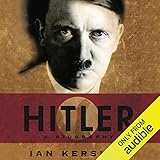
- Audible Audiobook
- Ian Kershaw (Author) - Alan Robertson (Narrator)
- English (Publication Language)
- 06/11/2013 (Publication Date) - Audible Studios (Publisher)
6. Review the concluding assessments:
- Action: Re-read Kershaw’s final remarks and evaluations of Hitler’s legacy.
- What to look for: The author’s ultimate judgment on Hitler’s impact and the enduring lessons derived from his life and regime.
- Mistake to avoid: Failing to connect the historical narrative to contemporary relevance or the ongoing study of political extremism.
Understanding Hitler by Ian Kershaw: The Historiographical Debate
Kershaw’s monumental biography, Hitler, has profoundly influenced the historical understanding of the Nazi dictator. A central theme in scholarly discourse concerns the degree to which Hitler was a singular force driving events (“intentionalist”) versus a figure shaped by his environment (“structuralist”). Kershaw advocates for a balanced perspective, positing that Hitler’s ideological fanaticism and personal will interacted dynamically with the political and social conditions of the Third Reich.
This nuanced approach moves beyond simplistic portrayals of Hitler as either an omnipotent architect of evil or a mere pawn of larger forces. Kershaw meticulously demonstrates how Hitler’s charisma, his ability to amplify existing societal anxieties, and his decisive, often ruthless, decision-making created the conditions for his regime’s atrocities.
Common Myths Addressed
- Myth: Hitler was a reluctant leader, pressured into dictatorial actions by his military or party officials.
- Why it matters: This misconception diminishes Hitler’s personal agency and the radical nature of his ideological objectives.
- Fix: Kershaw presents substantial evidence of Hitler’s proactive role in policy formulation, the initiation of radical measures, and the suppression of internal opposition, particularly concerning racial policy and the path to war. His decisions were often fueled by deeply held, fanatical beliefs rather than mere pragmatism.
- Myth: The Holocaust was a precisely planned, step-by-step operation from its inception, solely orchestrated by Hitler.
- Why it matters: This oversimplification can obscure the complex evolution of Nazi policy and the roles of various actors in its execution.
- Fix: While Hitler’s antisemitism was constant, Kershaw illustrates how the “Final Solution” evolved over time, influenced by wartime pressures, bureaucratic initiatives, and a climate of extreme radicalization. The process involved a degree of improvisation and departmental competition, always within the framework of Hitler’s ultimate approval and ideological imperative.
Expert Tips for Reading Hitler by Ian Kershaw
To fully grasp the depth and complexity of Kershaw’s biography, consider these practical recommendations.
- Tip 1: Analyze Kershaw’s “intentionalist” vs. “structuralist” synthesis.
- Action: As you read, actively identify instances where Kershaw attributes Hitler’s decisions to both his personal beliefs and the broader socio-political context.
- Common mistake to avoid: Assuming Kershaw attributes causality solely to Hitler’s personality or solely to historical circumstances; his significant contribution lies in integrating these explanatory frameworks.
- Tip 2: Leverage the footnotes and bibliography.
- Action: Do not bypass the extensive endnotes. They provide critical evidence, archival references, and engagement with other historical scholarship.
- Common mistake to avoid: Treating the main text as a self-contained narrative without consulting the scholarly apparatus that substantiates Kershaw’s arguments. The footnotes are essential for detailed evidence.
- Tip 3: Understand the two-volume structure.
- Action: Recognize that Hubris (Volume I) focuses on Hitler’s rise and consolidation of power, while Nemesis (Volume II) addresses his wartime leadership and the regime’s destruction.
- Common mistake to avoid: Drawing conclusions about Hitler’s wartime policies solely from Volume I, or assessing his path to power only through the lens of his ultimate defeat. The sequential structure is deliberate and thematic.
BLOCKQUOTE_0
Frequently Asked Questions About Hitler by Ian Kershaw
Q1: Is Ian Kershaw’s Hitler suitable for a reader with no prior knowledge of World War II?
A1: While Kershaw provides historical context, the biography’s extensive research and academic analysis may prove challenging for a complete beginner. It is best suited for readers who possess at least a basic understanding of the interwar period and the origins of World War II. For a more accessible introduction, consider other biographies before engaging with Kershaw’s definitive work.
Q2: How does Kershaw’s biography of Hitler differ from other major works on the subject?
A2: Kershaw’s primary contribution is his synthesis of the “intentionalist” and “structuralist” historical debates. He moves beyond a chronological recounting of events to deeply analyze Hitler’s motivations, ideology, and decision-making processes, while rigorously contextualizing them within the specific historical and political landscape of Germany. His work is distinguished by its exhaustive research and balanced, yet critical, assessment.
Q3: Is Hitler by Ian Kershaw primarily a political or a psychological biography?
A3: It is fundamentally a political biography that integrates psychological analysis. Kershaw examines Hitler’s political actions, ideology, and leadership style, but he also delves into his personality, beliefs, and the psychological factors driving his actions. The biography seeks to explain how a specific personality, operating within a particular historical context, could lead to such devastating outcomes.
Q4: What is the significance of Kershaw’s work in the broader field of Hitler studies?
A4: Ian Kershaw’s Hitler is widely regarded as the definitive modern biography. It has
Quick Comparison
| Option | Best for | Pros | Watch out |
|---|---|---|---|
| Quick Answer | General use | For dedicated students of history: Kershaw’s Hitler is an unparalleled, dee… | Mistake to avoid: Overlooking the detailed analysis of the Weimar Republic’s… |
| Who This Is For | General use | For general readers: The extensive detail and academic rigor require commitme… | Mistake to avoid: Underestimating the complicity of opportunistic politicians… |
| What to Check First | General use | Core Value: The biography excels at situating Hitler within his historical co… | Mistake to avoid: Perceiving Hitler as solely a rational actor; Kershaw empha… |
| Step-by-Step Plan for Engaging with Hitler by Ian Kershaw | General use | Scholars and serious amateur historians: Individuals requiring a definitive,… | Mistake to avoid: Attributing all Nazi actions exclusively to Hitler’s direct… |
Decision Rules
- If reliability is your top priority for Hitler by Ian Kershaw, choose the option with the strongest long-term track record and support.
- If value matters most, compare total ownership cost instead of headline price alone.
- If your use case is specific, prioritize fit-for-purpose features over generic ‘best overall’ claims.