Yuval Noah Harari’s Sapiens: A Brief History
Quick Answer
- Sapiens by Yuval Noah Harari offers a sweeping, interdisciplinary narrative of human history, focusing on the power of shared fictions.
- Its strength lies in connecting diverse fields to present a cohesive, thought-provoking argument about human uniqueness and societal development.
- Approach this book as an interpretive work designed to challenge assumptions, rather than a purely factual chronicle, due to its broad generalizations.
Who This Is For
- Individuals interested in a philosophical and interdisciplinary exploration of human history that deliberately challenges conventional wisdom.
- Readers who appreciate grand narratives and are comfortable with broad historical interpretations that prioritize thematic coherence over granular detail.
What to Check First
- Harari’s Central Thesis: Understand that the book’s core argument revolves around the idea that Homo sapiens‘ ability to create and believe in “imagined orders” (e.g., gods, nations, money) is the key to its dominance.
- Scope and Method: Recognize that Sapiens synthesizes information from biology, anthropology, history, and economics, aiming for a macro-level perspective.
- Key Revolutions: Pay close attention to Harari’s analysis of the Cognitive, Agricultural, and Scientific Revolutions, as these are presented as fundamental turning points.
- Interpretive Nature: Be aware that the book is a work of interpretation, not a straightforward historical account. Harari’s conclusions are often speculative and designed to provoke thought.
If you’re looking for a book that offers a sweeping, interdisciplinary narrative of human history and challenges conventional wisdom, Yuval Noah Harari’s ‘Sapiens’ is an excellent choice. It masterfully connects diverse fields to present a thought-provoking argument about human uniqueness and societal development.
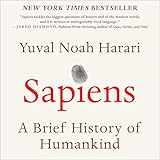
- Audible Audiobook
- Yuval Noah Harari (Author) - Derek Perkins (Narrator)
- English (Publication Language)
- 08/15/2017 (Publication Date) - Harper (Publisher)
Step-by-Step Plan for Engaging with Sapiens by Yuval Noah Harari
1. Understand the Cognitive Revolution:
- Action: Read Part One, focusing on Harari’s assertion that Homo sapiens‘ unique ability to create and believe in shared fictions enabled large-scale cooperation and ultimately led to its dominance over other human species.
- What to Look For: Examples of abstract concepts (e.g., spirits, myths, laws) that allowed for coordination beyond small, intimate groups.
- Mistake: Accepting this cognitive advantage as solely a matter of brain size without considering the crucial role of shared belief systems in organizing societies.
2. Analyze the Agricultural Revolution:
- Action: Engage with Part Two, where Harari controversially frames the Agricultural Revolution not as progress, but as a “trap” that led to increased human suffering, disease, and labor for the average individual, despite enabling population growth.
- What to Look For: The trade-offs Harari highlights between settled life, diet diversity, disease transmission, and social stratification.
- Mistake: Viewing the Agricultural Revolution solely through the lens of increased food production and technological advancement, without considering Harari’s critique of its impact on individual well-being.
3. Grasp the Unification of Humankind:
- Action: Review Part Three, which examines how universal orders like money, empires, and religion have progressively unified disparate human groups into larger, more complex global societies.
- What to Look For: How these abstract systems, born from shared fictions, facilitate trade, governance, and cultural exchange across vast distances.
- Mistake: Dismissing these “imagined orders” as mere social constructs without acknowledging their tangible power to shape human behavior, economies, and political structures.
4. Explore the Scientific Revolution:
- Action: Read Part Four, focusing on Harari’s argument that the Scientific Revolution is distinct because it is driven by the admission of ignorance and the pursuit of new knowledge, often intertwined with imperialism and capitalism.
- What to Look For: The relationship Harari posits between scientific discovery, European expansion, and the development of modern economic systems.
- Mistake: Isolating scientific advancement from its historical, political, and economic contexts, which Harari argues are inseparable.
5. Consider the Future of Sapiens:
- Action: Engage with the concluding sections that speculate on the future of Homo sapiens, particularly concerning technological advancements like genetic engineering and artificial intelligence, and the potential for humanity to transcend its biological limitations or engineer its own obsolescence.
- What to Look For: Harari’s concerns about humanity’s ability to manage its newfound powers and the ethical implications of altering our species.
- Mistake: Treating these future scenarios as definitive predictions rather than thought experiments exploring the potential consequences of current trajectories.
Common Myths About Sapiens
- Myth: Sapiens provides a definitive, fact-based historical account.
- Why it Matters: This misconception can lead readers to accept Harari’s interpretations as unquestionable historical truth, overlooking the book’s interpretive and speculative nature.
- Fix: Understand that Sapiens is a work of synthesis and interpretation, designed to provoke thought and challenge assumptions. Its strength lies in its narrative sweep and argumentative framework, not in providing a comprehensive, granular historical record.
- Myth: Harari’s critique of agriculture suggests a rejection of human progress.
- Why it Matters: This can lead to misinterpreting his arguments as anti-human or nihilistic, when in fact, he is questioning the cost of certain forms of progress for individual well-being.
- Fix: Recognize that Harari’s focus is on the trade-offs and unintended consequences of historical developments. His critique of agriculture is about the decline in quality of life for many individuals, not a rejection of human advancement itself.
Expert Tips for Reading Sapiens
- Tip: Understand the power of “imagined orders.”
- Actionable Step: Identify three examples of “imagined orders” in your daily life (e.g., national borders, currency, legal systems) and analyze how they influence your decisions and interactions, even though they are not tangible realities.
- Common Mistake to Avoid: Dismissing these concepts as mere philosophical abstractions; their tangible impact on global cooperation and conflict is precisely what Harari emphasizes.
- Tip: Engage critically with Harari’s “history of the future.”
- Actionable Step: When reading the book’s concluding chapters on future possibilities, frame them as explorations of potential scenarios based on current trends and technological trajectories, rather than as direct predictions.
- Common Mistake to Avoid: Accepting Harari’s speculations about bioengineering, AI, or post-humanism as definitive forecasts; they are designed to prompt consideration of ethical and existential questions.
- Tip: Seek out counterpoints to Harari’s central arguments.
- Actionable Step: After reading Harari’s perspective on a key event, such as the Agricultural Revolution or the role of religion, consult other historical or anthropological works that offer alternative interpretations or emphasize different factors.
- Common Mistake to Avoid: Accepting Harari’s interpretations as the sole or definitive understanding of complex historical phenomena without considering other scholarly perspectives.
Sapiens by Yuval Noah Harari: A Framework for Understanding
Sapiens by Yuval Noah Harari is structured around a series of transformative revolutions that have shaped Homo sapiens‘ trajectory. The book is divided into four main parts, each focusing on a critical period:
| Part | Title | Key Focus |
|---|---|---|
| <strong>Part One</strong> | The Cognitive Revolution | The emergence of <em>Homo sapiens</em>’ unique cognitive abilities, particularly the capacity for language and shared fictions. |
| <strong>Part Two</strong> | The Agricultural Revolution | Harari’s controversial framing of agriculture as a “trap” that increased human suffering despite enabling population growth. |
| <strong>Part Three</strong> | The Unification of Humankind | The development of universal orders like money, empires, and religions that have progressively unified human societies. |
| <strong>Part Four</strong> | The Scientific Revolution | The modern era, characterized by scientific discovery, the admission of ignorance, and its entanglement with capitalism and imperialism. |
This structure allows Harari to build his argument progressively, demonstrating how each revolution laid the groundwork for the next, ultimately leading to the complex global society of today and posing questions about humanity’s future.
Decision Rules for Engaging with Sapiens
- If your primary goal is to challenge your fundamental assumptions about human history and the nature of society, Sapiens by Yuval Noah Harari is an excellent choice. Its provocative theses and broad scope are designed to stimulate critical thinking.
- If you require a highly detailed, factually rigorous, and chronologically precise historical account, Sapiens may not be the ideal starting point. Its strength lies in interpretation and synthesis, which sometimes necessitates broad generalizations and can lead to omissions of nuance.
- If you are interested in interdisciplinary connections between biology, anthropology, and history, this book excels at drawing parallels and presenting a holistic view of human development.
FAQ
- Q: Is Sapiens a good starting point for someone new to history?
- A: While Sapiens offers a compelling and accessible overview, it prioritizes interpretive synthesis and provocative arguments over exhaustive factual detail. For a more traditional, fact-based introduction to history, other works might be more suitable.
- Q: What is the central message of Sapiens by Yuval Noah Harari?
- A: The core message is that Homo sapiens‘ success is largely due to its unique ability to create and believe in shared fictions—abstract concepts like gods, nations, and money—which enable large-scale cooperation and shape our collective reality.
- Q: How does Sapiens differ from other general history books?
- A: Unlike books that focus on specific eras or events, Sapiens adopts a vast chronological sweep, connecting biological evolution, cultural development, and technological advancement through a philosophical lens. Its ambitious scope is a key differentiator.
- Q: Is Sapiens a pessimistic book?
- A: Harari’s tone is often described as cautionary rather than purely pessimistic. He highlights humanity’s capacity for both immense achievement and self-destruction, urging readers to consider the consequences of our species’ actions and the narratives we construct.
Sapiens by Yuval Noah Harari: Strengths and Limitations
Strengths:
- Ambitious Scope and Synthesis: The book masterfully weaves together insights from biology, anthropology, history, and economics to present a grand, interconnected narrative of human development. For example, its linking of the Cognitive Revolution’s development of fictions to the subsequent rise of empires and global trade provides a novel and compelling framework for understanding societal evolution.
- Provocative and Challenging Arguments: Harari’s central theses, particularly his reinterpretation of the Agricultural Revolution as a “trap” and his emphasis on the power of “imagined orders,” deliberately challenge conventional wisdom. This forces readers to question fundamental assumptions about progress, human nature, and the foundations of society.
- Accessible and Engaging Prose: Despite its complex subject matter and broad scope, Harari’s writing is remarkably clear and engaging, making it accessible to a wide audience. His ability to distill vast amounts of information into a coherent and compelling narrative is a significant achievement.
Limitations:
- Broad Generalizations and Oversimplification: To cover such an immense span of history and diverse topics, Harari often relies on broad generalizations that can oversimplify complex historical debates and processes. For instance, his portrayal of the Agricultural Revolution, while thought-provoking, risks downplaying the varied experiences and agency of early farmers.
- Speculative Conclusions: While intended to stimulate thought, some of the book’s conclusions, particularly concerning the future of humanity and the implications of emerging technologies, are highly speculative. Readers seeking definitive, empirically supported answers may find these sections less convincing.
- Contrarian Stance and Potential Bias: Harari’s deliberately contrarian approach, while effective in challenging assumptions, can sometimes lead to a one-sided presentation of issues. A key decision criterion for recommending Sapiens by Yuval Noah Harari is whether the reader prioritizes provocative reinterpretation and thematic coherence over exhaustive factual detail; those who value meticulous historical accuracy and nuanced debate might find its broad strokes less satisfying.
Reading Context and Verdict
Sapiens by Yuval Noah Harari is best approached not as a definitive historical textbook, but as a philosophical exploration that uses the vast canvas of human history to ask fundamental questions about our species. Its value lies in its capacity to reframe how we think about human existence, our collective trajectory, and the potent influence of the stories we tell ourselves. Readers who are open to challenging their own assumptions and engaging with grand, interconnected ideas will find it immensely rewarding. However, those seeking a detailed, fact-centric historical account might find its broad strokes and speculative leaps less aligned with their expectations. It serves as an excellent springboard for further, more specialized historical and anthropological inquiry.