Richard Elliott Friedman’s Who Wrote The Bible?: An Investigative Approach
Who Wrote The Bible? by Richard Elliott Friedman: Quick Answer
- Richard Elliott Friedman’s Who Wrote The Bible? presents the documentary hypothesis, positing that the Pentateuch (Genesis, Exodus, Leviticus, Numbers, Deuteronomy) is a compilation of at least four distinct ancient sources (J, E, D, P), rather than a single author’s work.
- This book is essential for readers interested in textual criticism, historical linguistics, and academic biblical scholarship, offering a rigorous analysis of linguistic patterns, theological variations, and narrative inconsistencies.
- It provides a methodical, chapter-by-chapter examination of textual evidence to build its case for a multi-layered composition of the biblical text.
Who This Is For
- Individuals seeking a detailed, evidence-based understanding of the historical development and authorship of the Old Testament through the lens of critical scholarship.
- Readers who appreciate in-depth textual analysis and are open to engaging with biblical texts using source criticism and historical-linguistic methodologies.
What to Check First
- Your prior knowledge of the Pentateuch: Familiarity with Genesis, Exodus, Leviticus, Numbers, and Deuteronomy will significantly enhance your ability to follow Friedman’s detailed arguments.
- Your openness to historical-critical methods: The book relies on academic approaches to biblical interpretation; understanding this framework is crucial for appreciating its conclusions.
- Your interest in linguistic and textual evidence: Friedman’s arguments are built upon close examination of word choices, grammar, and stylistic features within the biblical text.
- Your perspective on biblical authorship: The book challenges traditional views of single authorship, so an openness to scholarly debate on this topic is beneficial.
Understanding Who Wrote The Bible? by Richard Elliott Friedman
Richard Elliott Friedman’s Who Wrote The Bible? is a seminal work that popularized the documentary hypothesis for a broad audience. This scholarly theory proposes that the Pentateuch, the first five books of the Hebrew Bible, is not the product of a single author (traditionally Moses) but a composite work woven from at least four distinct ancient sources. Friedman labels these sources J (Yahwist), E (Elohist), D (Deuteronomist), and P (Priestly), each distinguished by unique vocabulary, theological perspectives, and stylistic characteristics.
Friedman meticulously dissects the Pentateuch, presenting specific textual phenomena as compelling evidence for these separate origins. A foundational argument centers on the variation in the divine name used: the J source consistently employs “YHWH” (Yahweh), while the E source primarily uses “Elohim” until a specific point in the narrative. He also highlights divergent accounts of the same events, such as the two distinct creation narratives in Genesis 1 and Genesis 2, and differing legal traditions, as indicators of separate compositional streams that were later integrated. The book’s strength lies in its systematic, chapter-by-chapter approach, building a persuasive case for a complex, multi-layered compositional history.
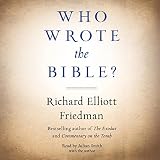
- Audible Audiobook
- Richard Friedman (Author) - Julian Smith, Richard Friedman (Narrators)
- English (Publication Language)
- 04/12/2022 (Publication Date) - Simon & Schuster Audio (Publisher)
Step-by-Step Plan to Engage with Friedman’s Arguments
1. Acquire a foundational understanding of source criticism: Begin by grasping the core principles of source criticism, a methodology used to identify underlying source materials within a text.
- What to look for: Friedman introduces this methodology early, explaining its purpose and how it applies to ancient texts.
- Mistake to avoid: Perceiving source criticism as an attack on faith or the Bible’s integrity; its aim is purely historical and literary analysis of textual origins.
2. Focus on the divine name variations (J vs. E): Pay close attention to Friedman’s initial arguments concerning the consistent use of “Yahweh” in some passages and “Elohim” in others.
- What to look for: Identify passages where the choice of divine name appears inconsistent or shifts abruptly. Note how Friedman interprets these shifts as markers of distinct sources.
- Mistake to avoid: Underestimating the significance of the divine name distinction; Friedman presents it as a crucial piece of evidence supporting the existence of separate sources.
3. Examine the characteristics of the Deuteronomist (D) source: Analyze Friedman’s evidence for a distinct source that forms the core of the book of Deuteronomy.
- What to look for: The characteristic sermonic style, emphasis on covenant, and focus on a central sanctuary for worship that Friedman attributes to the D tradition.
- Mistake to avoid: Equating the entire Pentateuch with Deuteronomy; recognize D as one specific layer of composition within the larger work.
4. Understand the Priestly (P) source: Observe the specific language, concerns, and structural elements Friedman associates with the P tradition.
- What to look for: Passages marked by precise legal stipulations, genealogical lists, an emphasis on ritual purity, and a formal, often abstract, theological tone.
- Mistake to avoid: Dismissing the theological importance of the P source; Friedman demonstrates its significant role in shaping Israel’s identity and its relationship with the divine.
5. Evaluate evidence of narrative inconsistencies and duplications: Identify instances where the same event is recounted with differing details or perspectives.
- What to look for: Examples such as the two flood accounts or multiple covenant-making events. Analyze how Friedman uses these to argue for separate source materials.
- Mistake to avoid: Attempting to reconcile these inconsistencies yourself before understanding Friedman’s argument for their origin in different sources.
6. Consider the process of compilation (Redaction): Friedman addresses not only the identification of sources but also how they were edited together into the final text.
- What to look for: Friedman’s explanations for how different sources were combined, potentially with later additions or modifications by editors.
- Mistake to avoid: Assuming the sources were seamlessly integrated; Friedman often points to remaining tensions and inconsistencies as evidence of a complex editorial process.
7. Engage with Friedman’s counterarguments and scholarly context: The book acknowledges challenges and alternative viewpoints regarding the documentary hypothesis.
- What to look for: Sections where Friedman addresses criticisms or alternative scholarly proposals concerning Pentateuchal authorship.
- Mistake to avoid: Skipping these discussions; understanding the counterarguments provides a more balanced perspective on the scholarly landscape.
Who Wrote The Bible?: An Investigative Approach and Scholarly Reception
Friedman’s Who Wrote The Bible? has been instrumental in introducing the documentary hypothesis to a wider audience by presenting complex scholarly arguments in an accessible manner. The hypothesis itself has a long and evolving history within biblical studies, with foundational work by scholars like Julius Wellhausen. While Friedman’s presentation is persuasive, it is important to acknowledge that the documentary hypothesis, in its entirety and specific details, remains a subject of ongoing scholarly discussion and refinement. Alternative models and critiques exist, and not all scholars agree with every proposed source boundary or dating. Nevertheless, Friedman’s work is a significant contribution for understanding the primary lines of evidence and reasoning that underpin critical approaches to the Pentateuch.
BLOCKQUOTE_0
Common Myths
- Myth: The documentary hypothesis, as presented by Friedman, definitively proves the Bible is not divinely inspired.
- Why it matters: This is a misunderstanding of the methodology. Source criticism is a historical and literary analytical tool focused on the composition of the text, not an argument against its theological significance or perceived divine origin for believers.
- Correction: Source criticism aims to understand how the text was written and compiled, which is distinct from theological claims about its ultimate source or truth. Many scholars who employ this method maintain their personal faith.
- Myth: Richard Elliott Friedman claims to have discovered the original authors of the Bible.
- Why it matters: Friedman’s work, like much source criticism, identifies distinct sources or traditions (J, E, D, P) based on textual evidence. While these are often associated with specific schools or authors, the precise identities and biographies of these individuals remain largely speculative.
- Correction: The focus is on identifying the characteristics and boundaries of different literary and theological streams that contributed to the final text, not on definitively naming and profiling individual authors.
Expert Tips for Engaging with Friedman’s Analysis
- Tip: Annotate for linguistic markers. Actively highlight or note recurring phrases, vocabulary, and sentence structures that Friedman identifies as characteristic of specific sources (J, E, D, P).
- Actionable Step: Keep a separate notebook or use digital annotation tools to create a personal lexicon of key terms and phrases associated with each source as you encounter them.
- Mistake to Avoid: Reading passively without actively tracking these linguistic cues. This will make it difficult to follow Friedman’s arguments for source differentiation.
- Tip: Cross-reference parallel accounts. When Friedman points to two versions of the same story (e.g., creation, flood), compare them side-by-side yourself, noting the differences in detail, tone, and emphasis.
- Actionable Step: Before reading Friedman’s analysis of a parallel passage, read both versions yourself and jot down the differences you observe.
- Mistake to Avoid: Relying solely on Friedman’s summary of the differences without engaging with the primary biblical text directly.
- Tip: Map the arguments. As you read, consider creating a visual representation or outline of how Friedman connects specific textual evidence to his proposed sources and their compilation.
- Actionable Step: Draw a simple chart or mind map showing how a particular passage is attributed to a source, and what specific evidence (e.g., divine name, vocabulary) supports that attribution.
- Mistake to Avoid: Trying to absorb all the evidence mentally without externalizing it; this can lead to confusion as the arguments become more complex.
Who Wrote The Bible?: An Investigative Approach and Scholarly Context
Friedman’s contribution to the discussion of Who Wrote The Bible? by Richard Elliott Friedman lies in its
Quick Comparison
| Option | Best for | Pros | Watch out |
|---|---|---|---|
| Who Wrote The Bible by Richard Elliott Friedman Quick Answer | General use | Richard Elliott Friedman’s Who Wrote The Bible? presents the documentary hy… | Mistake to avoid: Perceiving source criticism as an attack on faith or the Bi… |
| Who This Is For | General use | This book is essential for readers interested in textual criticism, historica… | Mistake to avoid: Underestimating the significance of the divine name distinc… |
| What to Check First | General use | It provides a methodical, chapter-by-chapter examination of textual evidence… | Mistake to avoid: Equating the entire Pentateuch with Deuteronomy; recognize… |
| Understanding Who Wrote The Bible by Richard Elliott Friedman | General use | Individuals seeking a detailed, evidence-based understanding of the historica… | Mistake to avoid: Dismissing the theological importance of the P source; Frie… |
Decision Rules
- If reliability is your top priority for Who Wrote The Bible? by Richard Elliott Friedman, choose the option with the strongest long-term track record and support.
- If value matters most, compare total ownership cost instead of headline price alone.
- If your use case is specific, prioritize fit-for-purpose features over generic ‘best overall’ claims.