Understanding The Shift In Power: James Burnham’s ‘The Managerial Revolution
The Managerial Revolution by James Burnham: Quick Answer
- James Burnham’s “The Managerial Revolution” posits a fundamental shift in societal power from capitalists to a distinct managerial class.
- This transition is driven by the increasing complexity and scale of industrial production, requiring specialized administrators.
- The book offers a framework for analyzing organizational power beyond traditional ownership models.
Who This Is For
- Readers interested in the theoretical underpinnings of economic and political power structures.
- Individuals seeking to understand the historical analysis of corporate governance and control.
What To Check First
- Publication Date: Published in 1941, the book’s arguments are rooted in the industrial era and require contextualization for modern economies.
- Author’s Background: James Burnham was a former Marxist intellectual who later became a prominent critic of communism and a proponent of strategic analysis.
- Central Thesis: The primary argument is the rise of a “managerial elite” who control production and resources, displacing the capitalist class as the dominant group.
- Key Terminology: Understand Burnham’s definitions of “managerial elite,” “dominant class,” and “economic exploiters.”
For a concise overview of James Burnham’s seminal work, this quick answer section is a great starting point. If you’re looking to dive deeper into the core ideas, consider getting a copy of the book itself.
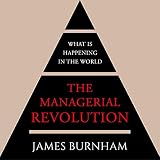
- Audible Audiobook
- James Burnham (Author) - Keith Hahn (Narrator)
- English (Publication Language)
- 08/02/2021 (Publication Date) - Lume Books (Publisher)
Step-by-Step Plan
Understanding The Managerial Revolution by James Burnham
1. Analyze the Historical Context: Recognize that Burnham wrote during a period of significant industrial expansion and the growth of large corporate bureaucracies.
- What to look for: Evidence of discussions on the decline of individual proprietorship and the rise of complex organizational structures.
- Mistake to avoid: Applying Burnham’s 1941 analysis directly to today’s digital economy without accounting for technological evolution and new forms of ownership.
2. Define the Managerial Elite: Grasp that Burnham defines this class by its administrative and control functions over production, not by capital ownership.
- What to look for: Descriptions of executives, engineers, and administrators as the new power holders.
- Mistake to avoid: Equating the managerial elite with general employees; Burnham highlights their distinct position of authority and interests.
3. Identify Driving Forces: Note Burnham’s emphasis on technological advancement and economic imperatives as catalysts for this shift.
- What to look for: Arguments about the increasing complexity of production necessitating specialized management expertise.
- Mistake to avoid: Overlooking the economic rationale; Burnham connects the shift to the demands of efficiency and control in large enterprises.
4. Examine Societal Implications: Analyze how Burnham suggests this managerial revolution reshapes political structures and social organization.
- What to look for: Discussions on the diminishing role of traditional property rights and the increasing interdependence of state and corporate entities.
- Mistake to avoid: Viewing the managerial revolution solely as an economic event; Burnham integrates it with broader power dynamics.
5. Evaluate the “Revolution” Concept: Understand Burnham’s framing of this transition as a fundamental, systemic change rather than a gradual evolution.
- What to look for: The decisive and transformative language used to describe the shift in power.
- Mistake to avoid: Underestimating the radical nature of Burnham’s claim; he posits a complete restructuring of societal control.
Common Mistakes
- Mistake: Interpreting “The Managerial Revolution” as purely an economic analysis.
- Why it matters: Burnham’s thesis is deeply integrated with political power and societal control. Missing this political dimension results in an incomplete understanding.
- Fix: Actively seek connections between economic changes and shifts in political authority and decision-making power within Burnham’s text.
- Mistake: Applying Burnham’s 1941 framework directly to contemporary business without acknowledging technological evolution.
- Why it matters: The nature of management, information dissemination, and corporate structure has significantly evolved since the book’s publication.
- Fix: Consider how concepts like the “managerial elite” might manifest differently in the current era of digital platforms and globalized supply chains, while retaining the core principles of control and administration.
- Mistake: Confusing the “managerial elite” with the broader workforce or labor unions.
- Why it matters: Burnham differentiates the managerial class by its unique position of authority and control over production processes and strategic decisions, distinct from labor interests.
- Fix: Focus on the decision-making power and administrative control that Burnham attributes to this specific group, rather than general employment status.
- Mistake: Dismissing the book as outdated solely due to its publication date.
- Why it matters: While specific examples may be dated, the core theoretical framework concerning the separation of ownership and control, and the rise of administrative power, remains relevant for analyzing modern organizations.
- Fix: Engage with the book for its analytical framework and the underlying logic of power shifts, rather than for precise predictions of future events.
Expert Tips
- Tip: Focus on the functional definition of power.
- Actionable Step: Identify who makes key operational and strategic decisions within organizations described by Burnham, regardless of formal ownership titles.
- Common Mistake to Avoid: Assuming power is solely tied to stock ownership or direct capital investment.
- Tip: Analyze the separation of ownership and control.
- Actionable Step: Trace how the increasing complexity of business necessitates professional management, thereby decoupling direct ownership from effective control.
- Common Mistake to Avoid: Overlooking the historical trend of professionalization in management as a driver of this shift.
- Tip: Consider the evolution of class interests.
- Actionable Step: Examine how Burnham argues the managerial class develops interests distinct from both traditional capitalists and the proletariat.
- Common Mistake to Avoid: Applying simplistic capitalist-worker class models without accounting for Burnham’s proposed managerial stratum.
The Managerial Revolution by James Burnham: A Contrarian Perspective
James Burnham’s seminal 1941 work, “The Managerial Revolution,” presents a provocative thesis: that the dominant class in modern society is not the capitalist, but the manager. This perspective challenges prevailing economic narratives and continues to provoke debate by questioning who truly wields power in industrialized nations.
The Core Argument: A Shift in Dominance
Burnham posits that historical forces, particularly technological advancements and the increasing complexity of industrial production, have rendered the traditional capitalist owner less central to power. Instead, control has gravitated towards those who administer, organize, and direct the means of production—the managerial elite. This elite, comprising executives, engineers, administrators, and technicians, derives its power not from ownership of capital, but from its strategic position within the production process.
BLOCKQUOTE_0
This quote encapsulates Burnham’s central claim: power resides with those who exercise functional control, irrespective of formal ownership. The managerial class, in his view, develops its own interests and ideologies, distinct from those of the capitalist class it supplants. This represents a fundamental reordering of societal influence, moving beyond the traditional Marxist dichotomy.
Counterpoint: The Enduring Power of Capital
While Burnham’s analysis highlights the increasing role of management, a contrarian view suggests that the power of capital ownership remains foundational, albeit in evolved forms. Modern corporations, even those with dispersed shareholding, are ultimately beholden to capital markets and the imperatives of shareholder value.
- Decision Criterion: The influence of finance capital versus managerial autonomy.
- Scenario 1 (Capital Dominance): In companies heavily reliant on external financing or subject to activist investor pressure, managerial autonomy may be curtailed, and decisions are still largely dictated by financial returns and capital accumulation goals. Here, Burnham’s prediction of a complete managerial takeover appears less realized, as capital’s leverage persists.
- Scenario 2 (Managerial Autonomy): In large, stable corporations with strong internal cash flow and entrenched leadership, managerial decision-making can appear highly independent of direct capital owner intervention, lending credence to Burnham’s thesis.
Burnham himself acknowledged the complexity, noting that the transition was not instantaneous but a fundamental restructuring. However, the persistent influence of financial institutions, venture capital, and shareholder activism in contemporary business suggests that capital’s leverage has not disappeared, but rather adapted. The “managers” Burnham described often operate within the framework and constraints set by those who control the flow of capital.
Limitations and Enduring Relevance
Burnham’s work is undeniably a product of its time. His predictions about the geopolitical landscape and the specific forms of societal organization did not unfold precisely as he envisioned. The rise of global capitalism, the information age, and the intricate interplay of state and corporate power present a more nuanced reality than his stark dichotomy might suggest. For instance, the rise of technocratic governance in some states and the increasing influence of global financial institutions present complexities beyond a simple managerial class dominance.
Despite these limitations, “The Managerial Revolution” remains a significant text for its contribution to understanding the dynamics of power in complex organizations. It forces readers to consider who truly holds the reins when ownership is diffused and administration becomes paramount.
| Aspect | Burnham’s Thesis | Contrarian Critique | Modern Manifestation |
|---|---|---|---|
| <strong>Dominant Class</strong> | Managerial Elite (administrators, engineers) | Capital Owners (shareholders, financiers) | Hybrid: Managers operate within capital-driven market structures. |
| <strong>Source of Power</strong> | Control over production and administration | Ownership of capital and access to finance | Interdependence: Managers wield operational power, capital owners wield financial power. |
| <strong>Societal Structure</strong> | Managerial society, distinct from capitalism/socialism | Evolved capitalism, with management as a key function | Complex globalized economy with significant state-corporate interactions. |
Burnham’s analysis provides a vital lens through which to examine the power structures within modern corporations, urging a critical look beyond the superficialities of ownership to the practicalities of control and administration
Decision Rules
- If reliability is your top priority for The Managerial Revolution by James Burnham, choose the option with the strongest long-term track record and support.
- If value matters most, compare total ownership cost instead of headline price alone.
- If your use case is specific, prioritize fit-for-purpose features over generic ‘best overall’ claims.