Understanding Marshall McLuhan’s The Medium Is The Massage
Quick Answer
- “The Medium Is The Massage” argues that the inherent characteristics of communication technologies, not their content, are the primary drivers of societal change and altered human perception.
- The book visually demonstrates how various media, from early tools to electronic networks, reshape our sensory balance and understanding of reality.
- Its unconventional, visually driven format is integral to conveying its core message about the medium’s influence on the reader’s experience.
Who This Is For
- Individuals seeking to understand foundational theories of media’s impact on human consciousness and societal structures.
- Readers interested in critically examining how communication channels shape our perceptions and interactions, beyond the explicit information conveyed.
What To Check First
- The Book’s Format: “The Medium Is The Massage” is a visual collage, not a traditional linear text. Its layout, typography, and image-text interplay are essential to grasping McLuhan’s thesis.
- The Core Argument: “The medium is the message”: Understand that McLuhan argues the medium’s inherent qualities and structure are more significant than its content in shaping human experience and society.
- The Title’s Wordplay: The title “The Medium Is The Massage” is a deliberate pun, implying that media actively shapes, molds, and influences us.
- Historical Context (1967): The book was published during a period of rapid technological change, particularly the rise of electronic media like television. Its arguments offer a framework for analyzing contemporary digital technologies.
Step-by-Step Plan: Deconstructing The Medium Is The Massage by Marshall McLuhan
This plan outlines a methodical approach to analyzing the arguments within “The Medium Is The Massage.”
1. Engage with the Visual-Textual Design:
- Action: Actively observe the relationship between text and images on each page. Note how their juxtaposition affects your reading pace and comprehension.
- What to look for: Pay close attention to typography, layout, and the interplay of visual elements. Recognize that these design choices are integral to McLuhan’s argument.
- Mistake: Reading the book solely for its textual content, thereby overlooking how the visual presentation embodies the thesis that the medium influences the message.
To truly grasp McLuhan’s groundbreaking ideas, it’s essential to experience the book itself. The visual and textual interplay is key to understanding his thesis.
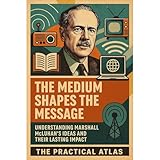
- Audible Audiobook
- The Practical Atlas (Author) - Virtual Voice (Narrator)
- English (Publication Language)
- 09/29/2025 (Publication Date)
2. Identify the “Mediums” Under Examination:
- Action: Recognize that McLuhan analyzes a broad spectrum of media, from early technologies like the wheel and alphabet to electronic forms like television and the electric circuit.
- What to look for: Note how McLuhan attributes societal transformations and shifts in human perception to the introduction and specific characteristics of these mediums.
- Mistake: Focusing predominantly on the content transmitted by media (e.g., specific television programs) rather than the inherent qualities of the medium itself (e.g., its speed, sensory engagement).
3. Understand the “Message” of Each Medium:
- Action: Grasp that the “message” refers to the effect the medium has on human senses, cognitive processes, and social organization, not the literal information conveyed.
- What to look for: Observe how McLuhan connects different mediums to changes in our sensory ratios and how these shifts alter our experience of reality. For example, the shift from print to television.
- Mistake: Interpreting “message” as the explicit content or data being communicated, rather than the fundamental impact on human consciousness and societal structures.
4. Differentiate Sensory Ratios:
- Action: Analyze how different media prioritize or de-emphasize certain senses, thereby altering our overall sensory balance.
- What to look for: McLuhan contrasts print (visual, linear) with electronic media (auditory, simultaneous). He suggests that a shift in sensory dominance restructures our cognitive environment and perception of the world.
- Mistake: Assuming that all media engage our senses equally or neutrally; failing to recognize that the dominance of one sense over others has profound cognitive consequences.
5. Evaluate the “Global Village” Concept:
- Action: Consider how electronic media, by collapsing space and time through instant communication, create a sense of interconnectedness akin to a village.
- What to look for: Observe how McLuhan suggests this immediacy fosters a collective consciousness but can also lead to a saturation of information and a blurring of public and private spheres.
- Mistake: Underestimating the societal implications of rapid, widespread communication, viewing it merely as an increase in information flow rather than a fundamental alteration of social interaction and awareness.
6. Distinguish Between “Hot” and “Cool” Media:
- Action: Differentiate between media that require high sensory participation (“hot”) and those that require low sensory participation (“cool”).
- What to look for: McLuhan classifies print as “hot” (high definition, little participation required) and television as “cool” (low definition, requiring more sensory input and participation from the viewer).
- Mistake: Applying a singular understanding of media engagement, failing to recognize McLuhan’s categorization of media based on the degree of sensory involvement they demand.
Common Mistakes
- Mistake: Treating “The Medium Is The Massage” as a conventional book with a linear narrative.
- Why it matters: The book’s deliberately fragmented and visually dense format is a demonstration of McLuhan’s core thesis: the medium shapes the message and the reader’s experience.
- Fix: Engage with the book as a designed artifact. Pay attention to its layout, typography, and the integration of images, recognizing these elements as active participants in conveying McLuhan’s ideas.
- Mistake: Focusing solely on the content of media examples.
- Why it matters: McLuhan’s central argument is that the inherent characteristics of the communication channel—its structure, speed, and sensory impact—are more influential than the specific information it conveys.
- Fix: When analyzing any media, shift your focus to the medium’s properties. Ask: “What is it about this form of communication (e.g., print, internet, social media) that alters our perception and society, irrespective of the specific content?”
- Mistake: Interpreting the title “The Medium Is The Massage” literally as “message.”
- Why it matters: The title is a deliberate pun. “Massage” implies an active, shaping, and molding force that influences our senses and minds, reinforcing McLuhan’s concept of media’s transformative power.
- Fix: Understand “massage” as signifying an active, transformative process. Consider how media actively alter our perceptions and societal structures, rather than passively delivering information.
- Mistake: Dismissing the book’s insights as outdated due to its 1967 publication date.
- Why it matters: While specific examples may reference older technologies, McLuhan’s fundamental principles about how new technologies reshape human perception and social organization remain highly relevant for analyzing contemporary digital media.
- Fix: Apply McLuhan’s frameworks to modern technologies like the internet, social media, and smartphones. Consider how these new mediums are reshaping our senses and society in ways analogous to those he described for television.
Expert Tips
- Tip: Actively question the sensory experience each medium creates.
- Actionable Step: For any given medium (e.g., a podcast, a website, a physical book), identify which senses are most engaged and which are de-emphasized.
- Common Mistake to Avoid: Assuming that all media engage our senses equally and neutrally, without considering how specific sensory prioritization alters our cognitive processing.
- Tip: Analyze the structure and flow of information delivery.
- Actionable Step: Examine how information is presented—is it linear and sequential, or fragmented and simultaneous? Consider how this structure influences your engagement and understanding.
- Common Mistake to Avoid: Overlooking the structural impact of a medium, focusing only on the factual content and neglecting how the arrangement of that content shapes perception.
- Tip: Consider the societal implications of technological shifts.
- Actionable Step: When a new medium becomes dominant, reflect on how it might alter social interactions, community structures, and the balance of public and private life.
- Common Mistake to Avoid: Viewing technological advancements solely as tools for efficiency or information dissemination, without considering their broader, often unintentional, societal consequences.
The Medium Is The Massage by Marshall McLuhan: A Contrarian Perspective
“The Medium Is The Massage,” authored by Marshall McLuhan and Quentin Fiore, first published in 1967, offers a counterintuitive and visually dynamic perspective on communication. It challenges the conventional belief that the value of media resides primarily in its content. McLuhan’s central thesis is that the medium itself—its inherent form, structure, and sensory characteristics—is the true “message,” fundamentally shaping human consciousness and societal evolution. This is not a book to be read passively; its experimental, collage-like format is designed to actively involve the reader, thereby demonstrating the very principles it espouses.
The title itself, a deliberate pun on “The Medium Is The Message,” signals McLuhan’s argument that media actively “massage” or mold our senses and perceptions. He contends that technological innovations, from early tools to contemporary electronic networks, alter our sensory ratios. For example, McLuhan argued that print media, with its linear and visual emphasis, fostered a detached, individualistic, and rational mode of thought. In contrast, he suggested that electronic media like television, with their immersive and simultaneous nature, create a “global village,” fostering a more interconnected consciousness but also potentially leading to a saturation of experience. This perspective encourages a critical stance, urging readers to look beyond the surface-level information to understand the deeper, structural impact of the technologies we use daily.
BLOCKQUOTE_0
This quote encapsulates the core of McLuhan’s argument: the profound influence of the medium itself. It suggests that our focus on the explicit content of communication often blinds us to the more significant ways in
Quick Comparison
| Option | Best for | Pros | Watch out |
|---|---|---|---|
| Quick Answer | General use | “The Medium Is The Massage” argues that the inherent characteristics of commu… | Mistake: Reading the book solely for its textual content, thereby overlooking… |
| Who This Is For | General use | The book visually demonstrates how various media, from early tools to electro… | Mistake: Focusing predominantly on the content transmitted by media (e.g., sp… |
| What To Check First | General use | Its unconventional, visually driven format is integral to conveying its core… | Mistake: Interpreting “message” as the explicit content or data being communi… |
| Step-by-Step Plan Deconstructing The Medium Is The Massage by Marshall McLuhan | General use | Individuals seeking to understand foundational theories of media’s impact on… | Mistake: Assuming that all media engage our senses equally or neutrally; fail… |
Decision Rules
- If reliability is your top priority for The Medium Is The Massage by Marshall McLuhan, choose the option with the strongest long-term track record and support.
- If value matters most, compare total ownership cost instead of headline price alone.
- If your use case is specific, prioritize fit-for-purpose features over generic ‘best overall’ claims.