Understanding Milton Friedman’s ‘Free to Choose
Quick Answer
- Core Argument: Advocates for free markets and minimal government intervention as the most effective path to individual liberty and economic prosperity.
- Central Thesis: Economic freedom is intrinsically linked to political freedom; unfettered markets foster innovation and well-being.
- Key Focus: Critiques government overreach and central planning, highlighting unintended negative consequences.
Who This Is For
- Individuals seeking to understand foundational arguments for economic libertarianism and capitalism.
- Readers interested in a contrarian perspective challenging the efficacy of extensive government economic intervention.
What to Check First
- Friedman’s Definition of Freedom: Clarify his emphasis on economic choice and voluntary exchange as primary components of liberty.
- Historical Context (1980 Publication): Recognize the book’s arguments are framed by the economic and political conditions of its publication era.
- Critiqued Policies: Identify specific government interventions (e.g., price controls, extensive regulation) that Friedman targets.
- Underlying Assumptions: Note the reliance on concepts like rational economic actors and the inherent efficiency of competitive markets.
Step-by-Step Plan: Analyzing Free to Choose by Milton Friedman
This plan provides a structured approach to understanding the core arguments and potential limitations of Free to Choose.
1. Identify the Central Thesis:
- Action: Read the introductory and concluding sections to grasp Friedman’s main argument.
- Look for: Explicit connections between economic freedom, voluntary exchange, and individual liberty.
- Mistake: Assuming Friedman advocates for a complete absence of government; he defines necessary governmental functions.
2. Examine Case Studies and Examples:
- Action: Analyze the specific historical and economic examples Friedman uses to support his claims.
- Look for: How he contrasts market-driven outcomes with those resulting from government intervention in areas like education or inflation.
- Mistake: Accepting anecdotal evidence without considering alternative interpretations or counter-evidence.
3. Deconstruct the Role of Government:
- Action: Trace Friedman’s arguments for limiting government’s economic functions.
- Look for: His proposed minimal governmental roles, such as enforcing contracts and protecting property rights.
- Mistake: Overlooking Friedman’s acknowledgment of legitimate, albeit limited, government functions.
For a foundational understanding of free-market economics and its philosophical underpinnings, Milton Friedman’s influential work, Free to Choose, is essential reading. This book, co-authored with his wife Rose Friedman, accompanied a television series and aimed to demystify economic principles for a general audience.
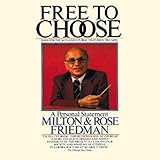
- Audible Audiobook
- Milton Friedman (Author) - James Adams (Narrator)
- English (Publication Language)
- 06/22/2007 (Publication Date) - Blackstone Audio, Inc. (Publisher)
4. Evaluate the Concept of Voluntary Exchange:
- Action: Focus on how Friedman frames economic transactions as voluntary.
- Look for: The emphasis on mutual benefit derived from free exchange and the absence of coercion.
- Mistake: Failing to acknowledge that power imbalances can affect the true voluntariness of exchange for some individuals.
5. Assess the Impact on Individual Liberty:
- Action: Connect Friedman’s economic arguments to his concept of individual freedom.
- Look for: How he argues economic freedom enables or is a prerequisite for other freedoms.
- Mistake: Ignoring the potential for concentrated economic power in free markets to limit choices for less affluent individuals.
6. Consider Counterarguments and Criticisms:
- Action: Actively seek out critiques of Free to Choose and free-market ideology.
- Look for: Arguments regarding income inequality, market failures, and externalities.
- Mistake: Reading Free to Choose in isolation without engaging with dissenting economic viewpoints.
7. Identify the “Failure Mode” of Oversimplification:
- Action: Analyze instances where Friedman’s arguments might simplify complex societal problems.
- Look for: Situations where market mechanisms alone may not fully address issues of equity or social welfare.
- Mistake: Applying Friedman’s principles rigidly to all situations without considering context-specific factors or the need for complementary policies.
Free to Choose by Milton Friedman: A Deeper Dive
Milton Friedman’s influential work, Free to Choose, published in 1980, serves as a cornerstone for understanding free-market economics and its philosophical underpinnings. Co-authored with his wife Rose Friedman, the book accompanied a television series and aimed to demystify economic principles for a general audience, advocating strongly for free markets and limited government. The central thesis posits an inseparable link between economic freedom and political freedom, asserting that competitive, unfettered markets are the most effective mechanism for fostering individual liberty, innovation, and overall societal prosperity. Friedman critiques extensive government intervention and central planning, arguing they invariably lead to inefficiencies, unintended negative consequences, and a reduction in personal freedom.
The book systematically examines various economic sectors—including inflation, education, and housing—to illustrate the detrimental effects of government control. Friedman draws upon historical examples and economic theory to champion policies like deregulation, privatization, and free trade. He contends that the “spontaneous order” of the market, guided by prices and voluntary exchange, superiorly coordinates economic activity compared to bureaucratic decision-making. A significant strength of Free to Choose lies in its clear articulation of complex economic concepts, making them accessible. It presents a compelling case for readers who value individual responsibility and the power of free enterprise.
Understanding the Principles of Free to Choose by Milton Friedman
At the core of Free to Choose are fundamental principles derived from classical liberal and free-market economic thought. Friedman emphasizes voluntary cooperation and competition as the primary drivers of economic progress and social welfare. He posits that individuals, acting in their self-interest within a framework of protected property rights and the rule of law, collectively achieve outcomes more beneficial than those dictated by government planning.
A key principle is the critique of price controls. Friedman illustrates how attempts to fix prices below market-clearing levels—whether due to perceived exploitation or wartime necessity—inevitably lead to shortages and black markets. He argues that prices serve as vital signals coordinating economic activity; distorting these signals leads to resource misallocation. For instance, he might discuss rent control, arguing it discourages new construction and maintenance, ultimately harming tenants by reducing housing availability.
Another critical principle is the advocacy for school choice. Friedman argues that government-run education systems, often functioning as monopolies, lack the competitive pressures needed for innovation and quality improvement. He proposes that providing parents with vouchers or similar mechanisms to select private schools would foster a more competitive educational landscape, leading to better student outcomes. This highlights his belief that competition, driven by consumer choice, is a more effective regulator than government mandates.
Friedman also extensively discusses the importance of monetary policy. He is a strong proponent of a stable and predictable monetary framework, asserting that inflation is primarily a monetary phenomenon caused by excessive growth in the money supply. He criticizes discretionary monetary policy by central banks, suggesting it often results in economic instability. His preferred solution is often a rule-based monetary policy, such as a constant growth rate of the money supply, to provide certainty and prevent arbitrary currency devaluation.
BLOCKQUOTE_0
Common Mistakes When Interpreting Free to Choose
Readers may misinterpret Friedman’s arguments, leading to an incomplete or inaccurate understanding of his philosophy.
- Mistake: Assuming Friedman advocates for the complete elimination of government.
- Why it matters: Friedman explicitly defines essential functions for government, including enforcing contracts, protecting property rights, and providing a stable monetary framework. He is not an anarchist.
- Fix: Re-read sections detailing the minimal yet crucial roles Friedman assigns to government in maintaining a free society.
- Mistake: Believing Friedman ignores market failures.
- Why it matters: While skeptical of government’s ability to effectively address market failures, he acknowledges their existence. His primary argument is that government intervention is often a worse solution than the problem itself.
- Fix: Look for instances where Friedman discusses externalities or monopolies, noting his proposed solutions often involve property rights or competition rather than direct regulation.
Expert Tips for Engaging with Free to Choose
To gain the most from Free to Choose, consider these practical recommendations.
- Tip 1: Focus on the “Why” Behind Limited Government:
- Action: When Friedman argues for reducing government intervention, actively seek the specific reasons he provides for that reduction, linking it to efficiency, liberty, or unintended consequences.
- Common Mistake to Avoid: Simply noting that he wants less government without understanding the underlying economic or philosophical justification for that stance.
- Tip 2: Analyze the Structure of Friedman’s Arguments:
- Action: For each chapter or major point, identify the premise, the evidence (examples, data), and the conclusion. Assess the logical flow and the strength of the supporting evidence.
- Common Mistake to Avoid: Accepting his conclusions without scrutinizing the quality and relevance of the evidence he uses to support them.
- Tip 3: Seek Out Counter-Arguments Early:
- Action: Before or immediately after reading a chapter, research common criticisms or alternative economic perspectives on the topic being discussed (e.g., critiques of deregulation, arguments for social safety nets).
- Common Mistake to Avoid: Reading Free to Choose as a definitive statement without engaging with opposing viewpoints, which limits a balanced understanding.
Common Myths About Free to Choose
Several common myths surround the ideas presented in Free to Choose. Addressing these myths provides a more nuanced understanding.
- Myth 1: Milton Friedman believed that all government activity is inherently bad and should be eliminated.
- Evidence-based Rebuttal: Friedman consistently argued for a limited but essential role for government. This includes enforcing laws, protecting property rights, and maintaining a stable monetary system. He distinguishes between necessary governmental functions and overreach into economic planning.
- Myth 2: Free to Choose argues that free markets always lead to equitable outcomes.
- Evidence-based Rebuttal: While Friedman emphasizes that free markets are the most effective engine for prosperity and opportunity, he acknowledges that they do not
Quick Comparison
| Option | Best for | Pros | Watch out |
|---|---|---|---|
| Quick Answer | General use | Core Argument: Advocates for free markets and minimal government intervention… | Mistake: Assuming Friedman advocates for a complete absence of government; he… |
| Who This Is For | General use | Central Thesis: Economic freedom is intrinsically linked to political freedom… | Mistake: Accepting anecdotal evidence without considering alternative interpr… |
| What to Check First | General use | Key Focus: Critiques government overreach and central planning, highlighting… | Mistake: Overlooking Friedman’s acknowledgment of legitimate, albeit limited,… |
| Step-by-Step Plan Analyzing Free to Choose by Milton Friedman | General use | Individuals seeking to understand foundational arguments for economic liberta… | Mistake: Failing to acknowledge that power imbalances can affect the true vol… |
Decision Rules
- If reliability is your top priority for Free to Choose by Milton Friedman, choose the option with the strongest long-term track record and support.
- If value matters most, compare total ownership cost instead of headline price alone.
- If your use case is specific, prioritize fit-for-purpose features over generic ‘best overall’ claims.