Thomas L. Friedman’s Journey From Beirut To Jerusalem
This analysis focuses on Thomas L. Friedman’s influential work, “From Beirut to Jerusalem,” examining its narrative, thematic depth, and relevance for contemporary readers. The book provides an extensive exploration of the Middle East, charting Friedman’s progression as a journalist and his developing comprehension of the region’s enduring conflicts.
Who This Is For
This book is recommended for readers seeking a comprehensive, journalistically informed account of the Arab-Israeli conflict and the broader political landscape of the Middle East. It is especially valuable for those interested in understanding the historical underpinnings of current events through the perspective of an experienced foreign correspondent.
What to Check First
Before engaging with “From Beirut to Jerusalem,” consider the following points:
- Friedman’s Journalistic Lens: Recognize that the book is a narrative shaped by Friedman’s personal experiences and interpretations as a foreign correspondent. While insightful, it reflects his observations and analyses from the time of writing.
- Publication Date Context: First published in 1989, with subsequent editions, the book’s core reporting predates many significant recent developments in the Middle East. Understanding this temporal context is vital for a complete understanding of its analysis.
- Narrative Focus: Friedman’s strength lies in his storytelling and his ability to humanize complex geopolitical issues. The book is a journalist’s journey, rich with detail, rather than a purely academic historical treatise.
- Edition Specifics: If reading a later edition, note any introductory or concluding remarks by Friedman that offer updated perspectives or reflections on his earlier reporting.
Step-by-Step Plan for Understanding From Beirut to Jerusalem by Thomas L. Friedman
To fully appreciate the depth and nuances of “From Beirut to Jerusalem by Thomas L. Friedman,” a structured approach is recommended.
1. Begin with Part One: Beirut. Start by reading the sections detailing Friedman’s early reporting experiences in Beirut.
- Action: Focus on his dispatches from the Lebanese Civil War.
- What to Look For: Observe the societal fragmentation, the rise of sectarian divisions, and the initial impacts of external interventions.
- Mistake to Avoid: Assuming the conflicts described are isolated incidents; recognize their interconnectedness and the cyclical nature of regional instability.
2. Transition to Part Two: Jerusalem. Proceed to the segments covering Friedman’s subsequent reporting in Jerusalem.
- Action: Analyze his accounts of the Israeli-Palestinian conflict, including the First Intifada.
- What to Look For: The contrasting viewpoints of Israelis and Palestinians, the complexities of occupation, and the emergence of religious extremism.
- Mistake to Avoid: Accepting any single narrative as definitive; acknowledge the inherent subjectivity present in reporting from deeply divided societies.
3. Identify Recurring Themes. Throughout your reading, actively identify and track recurring thematic elements.
- Action: Note instances of religious fundamentalism, nationalism, and the consequences of foreign policy decisions.
- What to Look For: How these themes intersect and influence events across the different countries and time periods covered in the book.
- Mistake to Avoid: Isolating individual events without connecting them to the broader historical and ideological currents that Friedman explores.
4. Analyze the “Why.” Pay close attention to Friedman’s efforts to explain the underlying causes of conflict, not merely the events themselves.
- Action: Look for his analysis of historical grievances and cultural misunderstandings.
- What to Look For: The author’s evolving understanding and how his initial assumptions are challenged and refined by his reporting.
- Mistake to Avoid: Focusing exclusively on the “what” of the events, neglecting Friedman’s crucial exploration of the “why,” which is central to the book’s thesis.
5. Integrate Updates from Later Editions. If you are reading a revised edition, pay attention to the added material.
- Action: Note how Friedman revisits his earlier observations in light of subsequent events and his own reflections.
- What to Look For: Any shifts in his perspective or new insights gained over time.
- Mistake to Avoid: Treating the book as a static historical document, disregarding the author’s post-publication reflections and updated context.
From Beirut to Jerusalem by Thomas L. Friedman: Strengths and Limitations
“From Beirut to Jerusalem by Thomas L. Friedman” is a significant work due to its journalistic rigor and compelling narrative. However, like any extensive reportage, it possesses inherent strengths and limitations that shape its reader experience.
Strengths:
- Immersive Journalism: Friedman’s reporting is characterized by its on-the-ground presence and detailed anecdotes, offering readers a visceral understanding of the human impact of conflict. His descriptions of Beirut during the civil war and the atmosphere of Jerusalem during the Intifada are particularly vivid. For example, his account of the siege of Beirut in 1982, detailing the daily lives and fears of civilians caught in the crossfire, provides a powerful human dimension.
- Thematic Cohesion: The book successfully weaves disparate events into a coherent narrative, exploring how religious and political ideologies fuel conflict. Friedman’s ability to connect seemingly unrelated incidents provides a valuable framework for understanding regional dynamics. His tracing of the rise of Islamist movements from Egypt to Lebanon demonstrates this thematic linkage.
- Personal Evolution: The narrative captures Friedman’s own intellectual journey, illustrating how his initial assumptions about the Middle East were tested and often reshaped by his experiences. This self-awareness adds a layer of authenticity and encourages critical reflection in the reader. His candid admission of initial naivete regarding certain political factions is a key example.
Limitations:
- Temporal Constraints: As a book first published in 1989, its analysis of the Israeli-Palestinian conflict and broader Middle Eastern politics predates significant developments such as the Oslo Accords, the rise of Hamas, the September 11th attacks, and the Arab Spring. While later editions offer updates, the core analysis remains rooted in an earlier era. For instance, the book does not account for the significant demographic and political shifts in the Palestinian territories post-1990s.
- Journalist’s Lens: While a strength, Friedman’s perspective is inherently that of a foreign correspondent. His interpretations, though well-informed, are filtered through his own experiences and the exigencies of news reporting, which can sometimes lead to a focus on compelling narratives over exhaustive academic analysis. His reliance on personal interviews and observations, while engaging, may not always capture the full spectrum of academic historical interpretation.
- Counter-Intuitive Insight: The “Logic” of Violence: A less commonly discussed aspect is Friedman’s exploration of how violence, once initiated, can develop its own internal logic and momentum, often becoming self-perpetuating. He illustrates how seemingly irrational acts of violence can be deeply rational within the specific, often desperate, contexts of the individuals and groups involved. This challenges a purely external, analytical view of conflict and forces readers to consider the internal motivations and perceived necessities driving such actions, a point often overlooked in favor of broader geopolitical explanations. This insight is particularly evident in his analysis of Palestinian resistance tactics during the First Intifada, where he explains the strategic rationale behind seemingly spontaneous acts of defiance.
For a deep dive into the complex history and ongoing conflicts of the Middle East, Thomas L. Friedman’s seminal work, ‘From Beirut to Jerusalem,’ is an essential read. This book offers unparalleled journalistic insight into the region.
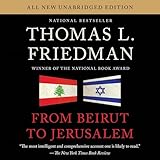
- Audible Audiobook
- Thomas L. Friedman (Author) - Robert Petkoff (Narrator)
- English (Publication Language)
- 04/16/2024 (Publication Date) - Macmillan Audio (Publisher)
Common Myths
- Myth: “From Beirut to Jerusalem” offers a definitive, unbiased historical account of the Arab-Israeli conflict.
- Why it matters: This misconception can lead readers to accept Friedman’s narrative as absolute truth, potentially overlooking the inherent subjectivity of journalistic reporting and the passage of time.
- Fix: Approach the book as a deeply informed, yet personal, journalistic narrative that presents a specific perspective shaped by the author’s experiences and the era in which he reported. Cross-reference key events with other historical accounts and academic analyses to gain a broader understanding.
- Myth: The book’s analysis is entirely irrelevant due to its publication date.
- Why it matters: Dismissing the book entirely overlooks the enduring relevance of its core themes—religious extremism, nationalism, and the cyclical nature of conflict—which continue to shape the region.
- Fix: Recognize that while specific events and political contexts have evolved, the underlying human and ideological drivers of conflict explored by Friedman remain pertinent. Use the book as a foundation for understanding historical context, then supplement with contemporary analysis and current events.
Expert Tips for Reading
- Tip 1: Contextualize Friedman’s Journey.
- Actionable Step: Before or during reading, research the major geopolitical events occurring in Lebanon and Israel during the late 1970s and 1980s. For example, understanding the PLO’s presence in Lebanon prior to the 1982 invasion provides crucial background for Friedman’s early reporting.
- Common Mistake to Avoid: Reading Friedman’s account in isolation without understanding the broader historical backdrop against which his reporting unfolded, which can lead to misinterpretations of motivations and consequences.
- Tip 2: Trace the Evolution of Themes.
- Actionable Step: Keep a running list of recurring themes (e.g., religious fundamentalism, national identity, external intervention) and note how Friedman connects them across different chapters and regions. Observe how his initial observations about the motivations of certain groups evolve as he gains more experience.
- Common Mistake to Avoid: Focusing solely on individual anecdotes without recognizing the overarching thematic arguments Friedman is building throughout the book, which can result in a fragmented understanding.
- Tip 3: Engage with the Nuance of “Rationality” in Conflict.
- Actionable Step: When encountering acts of violence or seemingly irrational political decisions, pause to consider Friedman’s explanation for the internal logic or perceived necessity driving them, even if you disagree with the action itself. For instance, his discussion of the motivations behind suicide attacks, while not condoning them, attempts to explain the perceived strategic or ideological imperatives.
- Common Mistake to Avoid: Dismissing actors or actions as simply “crazy” or “evil” without attempting to understand the context and motivations, however flawed, that Friedman presents, which limits a deeper comprehension of conflict dynamics.
Quick Comparison
| Option | Best for | Pros | Watch out |
|---|---|---|---|
| Who This Is For | General use | Friedman’s Journalistic Lens: Recognize that the book is a narrative shaped b… | Mistake to Avoid: Assuming the conflicts described are isolated incidents; re… |
| What to Check First | General use | Publication Date Context: First published in 1989, with subsequent editions,… | Mistake to Avoid: Accepting any single narrative as definitive; acknowledge t… |
| Step-by-Step Plan for Understanding From Beirut to Jerusalem by Thomas L Friedman | General use | Narrative Focus: Friedman’s strength lies in his storytelling and his ability… | Mistake to Avoid: Isolating individual events without connecting them to the… |
| From Beirut to Jerusalem by Thomas L Friedman Strengths and Limitations | General use | Edition Specifics: If reading a later edition, note any introductory or concl… | Mistake to Avoid: Focusing exclusively on the “what” of the events, neglectin… |
Decision Rules
- If reliability is your top priority for From Beirut to Jerusalem by Thomas L. Friedman, choose the option with the strongest long-term track record and support.
- If value matters most, compare total ownership cost instead of headline price alone.
- If your use case is specific, prioritize fit-for-purpose features over generic ‘best overall’ claims.