Sven Beckert’s Empire of Cotton: A Global History
Empire Of Cotton by Sven Beckert: Quick Answer
- Sven Beckert’s Empire of Cotton: A Global History provides a comprehensive and critical analysis of cotton’s pivotal role in shaping global capitalism, industrialization, and modern society, highlighting its deep connections to slavery and empire.
- This book is essential for readers interested in understanding the foundational economic and social forces that propelled global development, particularly within the textile industry.
- A common reader failure mode is underestimating the book’s extensive historical detail and its unflinching perspective on the human cost of cotton production.
Who This Is For
- Individuals seeking a deep dive into economic history, the evolution of global capitalism, and the interconnectedness of industries and societies.
- Readers interested in understanding the historical underpinnings of the textile industry and its profound impact on labor, race, and imperial expansion.
What To Check First
- Historical Scope: Confirm your readiness for a broad, sweeping historical narrative that spans centuries and continents, rather than a narrowly focused case study.
- Critical Perspective: Be prepared for a narrative that confronts the brutal realities of cotton production, including its intrinsic links to slavery and widespread exploitation.
- Academic Rigor: The book is a work of serious historical scholarship, dense with information and analytical depth, requiring focused and attentive reading.
- Core Argument: Understand Beckert’s central thesis: the rise of cotton is inextricably linked to the expansion of capitalism and the creation of a global market driven by both free and unfree labor.
Step-by-Step Plan: Understanding Empire Of Cotton by Sven Beckert
1. Initiate Reading with Foundational Chapters.
- Action: Begin with the introductory chapters to grasp Beckert’s core arguments regarding cotton’s historical significance.
- What to look for: Identify how Beckert establishes cotton not merely as a crop, but as a transformative force that reshaped economies and societies.
- Mistake: Skipping the introduction and early sections, which are critical for understanding the book’s overarching thesis and analytical framework.
2. Trace the Global Cotton Trade Routes.
- Action: Follow the pathways Beckert details, from cultivation centers in the Americas and elsewhere to processing hubs in Europe and Asia.
- What to look for: Note the economic incentives and political forces that drove the expansion of cotton cultivation and the establishment of global trade networks.
- Mistake: Focusing on individual regions without appreciating the interconnected global system Beckert meticulously describes.
For a deep dive into the history of global capitalism and industrialization, Sven Beckert’s Empire of Cotton is an indispensable read. It masterfully connects the rise of cotton to the expansion of empire and the human cost involved.
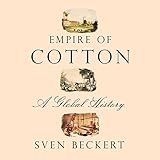
- Audible Audiobook
- Sven Beckert (Author) - Jim Frangione (Narrator)
- English (Publication Language)
- 12/02/2014 (Publication Date) - HighBridge, a Division of Recorded Books (Publisher)
3. Analyze the Role of Slavery and Unfree Labor.
- Action: Carefully examine the sections detailing the profound reliance on enslaved people and other forms of coerced labor in cotton production.
- What to look for: Understand how slavery was, according to Beckert, a fundamental pillar of early industrial capitalism, not an peripheral element.
- Mistake: Minimizing or overlooking the centrality of slavery in the economic success and expansion of the cotton industry.
4. Connect Cotton to Industrialization and Capitalism.
- Action: Identify how the escalating demand for cotton fueled technological innovation and the development of the factory system.
- What to look for: Recognize the reciprocal relationship between raw material supply, manufacturing capacity, and market expansion in driving industrial growth.
- Mistake: Viewing industrialization and the cotton trade as separate historical phenomena rather than deeply intertwined and mutually reinforcing processes.
5. Examine the Social and Political Consequences.
- Action: Assess the broad impact of the cotton economy on labor movements, class structures, and international political relations.
- What to look for: Observe how the relentless pursuit of profit within the cotton industry shaped political decisions, social hierarchies, and colonial policies.
- Mistake: Neglecting the significant human cost and societal upheaval that accompanied the rapid growth of the cotton empire.
6. Synthesize the “Empire of Cotton” as a System.
- Action: Integrate the various threads of the book to understand cotton as a comprehensive global system of production, trade, and power.
- What to look for: Appreciate the long-term legacy of this system on contemporary global economic inequalities and power dynamics.
- Mistake: Reading the book as a simple history of textiles without grasping its broader implications for political economy and global development.
Common Mistakes
- Underestimating the Book’s Critical Stance — Why it matters — This can lead to surprise or disappointment if a purely celebratory or neutral economic history is anticipated. — Fix: Approach the book with an awareness of its critical lens, which examines exploitation and power dynamics.
- Treating Cotton in Isolation — Why it matters — A key strength of the book is its demonstration of cotton’s interconnectedness with slavery, industrialization, and empire. — Fix: Actively seek out and note how cotton production influenced and was influenced by other historical forces.
- Getting Lost in Detail Without the Thesis — Why it matters — The wealth of historical information can sometimes obscure Beckert’s central arguments. — Fix: Periodically pause to ask how the specific details presented support the book’s core claims about capitalism and global development.
- Ignoring the Human Element — Why it matters — The narrative risks becoming dry if the experiences of laborers, enslaved people, and factory workers are overlooked. — Fix: Actively seek out and consider the human stories embedded within the economic and political analysis.
Common Myths About Empire Of Cotton by Sven Beckert
- Myth 1: Empire of Cotton is solely a history of the textile industry.
- Correction: While textiles are central, Beckert frames cotton as the engine of global capitalism. The book details its connections to slavery, industrialization, empire-building, and the creation of modern financial systems, extending far beyond the mere production of cloth.
- Myth 2: The book presents a purely negative view, focusing only on exploitation.
- Correction: Beckert critically examines the economic innovations and transformations driven by cotton. However, he consistently foregrounds the human cost and the systemic exploitation inherent in these developments, offering a balanced but critical perspective.
Quick Comparison
| Aspect | Empire Of Cotton by Sven Beckert | Alternative Histories |
|---|---|---|
| Primary Focus | The global history of cotton as a driver of capitalism and industrialization, emphasizing its link to slavery and empire. | Often focus on technological advancements, specific national industrial revolutions, or individual industries in isolation. |
| Analytical Depth | Deeply interrogates the relationship between capital, labor (free and unfree), and state power. | May offer broader overviews or more localized economic analyses without the same emphasis on systemic exploitation. |
| Reader Experience | Demanding, rich in detail, critical, and thought-provoking. Requires sustained attention. | Can vary from accessible overviews to specialized economic studies. May be less confrontational. |
Decision Rules
- If understanding the foundational role of a single commodity in shaping global economic systems and power structures is your goal, Empire of Cotton by Sven Beckert is the definitive choice.
- If you prefer a narrative that emphasizes technological progress over the human and social costs of industrialization, other historical accounts might be more suitable.
- If you are prepared for a challenging yet deeply rewarding intellectual journey into the interconnectedness of global history, this book warrants your attention.
FAQ
- Q: Is Empire of Cotton suitable for casual readers?
- A: While accessible to dedicated readers, Empire of Cotton is a dense academic work. It requires focused attention and a willingness to engage with complex historical and economic arguments.
- Q: How does Sven Beckert’s Empire of Cotton differ from other histories of the Industrial Revolution?
- A: Beckert uniquely centers the global cotton trade as a primary driver of the Industrial Revolution, explicitly linking it to the expansion of capitalism, slavery, and imperial ambitions. This offers a more critical and interconnected perspective than histories focused solely on European technological advancements.
- Q: What is the central argument of Empire of Cotton?
- A: The central argument is that cotton, more than any other commodity, was the engine of the modern capitalist world. It drove industrialization, shaped global trade, and profoundly impacted social structures through the pervasive use of both free and unfree labor.
- Q: Does the book focus heavily on the American Civil War?
- A: The American Civil War is a significant event within the book’s narrative, particularly concerning its impact on cotton supply and the abolition of slavery. However, the book’s scope extends far beyond this single conflict, covering centuries of global cotton history.
The Global Cotton System
Sven Beckert meticulously details how cotton emerged as the foundational commodity of the modern global economy. His analysis demonstrates that the insatiable demand for cheap cotton textiles in Europe, particularly Britain, directly fueled the expansion of plantation slavery in the Americas. This system, driven by profit, required vast amounts of land and labor, leading to immense human suffering and the fundamental reshaping of societies.
BLOCKQUOTE_0
This quote encapsulates Beckert’s thesis: cotton’s influence extended beyond economics to fundamentally alter political structures, social hierarchies, and the very nature of global capitalism. The drive to produce and market cotton created an intricate web of relationships between producers, merchants, manufacturers, and consumers, all operating within a framework of imperial power and exploitation.
Examining the Threads of Empire Of Cotton by Sven Beckert
Understanding the interconnectedness of the global cotton trade is key to appreciating Beckert’s work. The book illustrates how innovations in textile manufacturing in Europe created a demand that outstripped local production, leading to the forceful acquisition of land and labor elsewhere. This created a cycle of dependency and exploitation that defined the era.
- Example: The Lancashire textile mills, powered by innovations like the spinning jenny and power loom, consumed raw cotton at an unprecedented rate. This demand was met by the expansion of cotton plantations in the American South, reliant on enslaved African labor.