James Clear’s Atomic Habits: Building Better Routines
Quick Answer
- Atomic Habits by James Clear provides a practical framework for building better habits and breaking bad ones through small, consistent changes.
- The methodology is structured around four laws of behavior change: Make it Obvious, Make it Attractive, Make it Easy, and Make it Satisfying.
- The book emphasizes that lasting change stems from identity-based habits and well-designed systems, rather than solely from goals.
Who This Is For
- Individuals seeking a systematic, actionable method to implement sustainable behavioral changes in their personal or professional lives.
- Readers interested in understanding the underlying principles of habit formation and applying them to improve productivity, health, or any area requiring consistent effort.
What to Check First
- Identify Target Behaviors: Clearly define the specific actions you aim to cultivate or eliminate. Precision is key; vague intentions lead to vague results.
- Analyze Your Environment: Assess your surroundings for cues that trigger existing habits. Identify elements that support desired behaviors and those that hinder them.
- Define Your Desired Identity: Consider the person you aspire to be. Your habits should be a reflection and reinforcement of this identity.
- Evaluate Current Systems: Examine your daily routines and existing processes. Pinpoint areas of friction or inefficiency that can be optimized to support new habits.
Step-by-Step Plan for Building Habits with Atomic Habits by James Clear
This plan outlines the application of the Four Laws of Behavior Change, as detailed in Atomic Habits by James Clear, for habit modification.
1. Make it Obvious (Cue):
- Action: Implement the “Implementation Intention” strategy. State precisely when and where you will perform your habit: “I will [BEHAVIOR] at [TIME] in [LOCATION].” For example, “I will read one chapter of a book at 9:00 PM in my bedroom.”
- What to look for: A concrete, unambiguous cue that triggers the desired behavior. Specificity reduces the cognitive load required to initiate the action.
- Mistake: Vague intentions like “I will read more.” This lacks a defined cue and timing, making it easy to defer or forget.
For a practical guide to building better habits and breaking bad ones, James Clear’s Atomic Habits is an excellent choice. It offers a clear framework for making small, consistent changes that lead to significant long-term results.
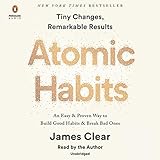
- Audible Audiobook
- James Clear (Author) - James Clear (Narrator)
- English (Publication Language)
- 10/16/2018 (Publication Date) - Penguin Audio (Publisher)
2. Make it Attractive (Craving):
- Action: Employ “Temptation Bundling.” Pair an activity you want to do with an activity you need to do. For example, “I will only listen to my favorite podcast while I am exercising.”
- What to look for: The association of a desirable activity with the habit you are trying to build, increasing its perceived value. Immediate pleasure reinforces the connection.
- Mistake: Relying solely on future benefits or abstract motivations. Immediate, tangible rewards are more effective for initial habit formation.
3. Make it Easy (Response):
- Action: Apply the “Two-Minute Rule.” Reduce the initial barrier to entry for any new habit so it takes less than two minutes to start. For example, “Put on your running shoes” instead of “Run 5 miles.”
- What to look for: The habit should be so simple to begin that resistance is minimal. The objective is to establish the routine of showing up.
- Mistake: Setting an overly ambitious starting point, such as “Write 1,000 words daily” when you are a beginner. This creates unnecessary friction.
4. Make it Satisfying (Reward):
- Action: Implement “Habit Tracking” with immediate reinforcement. Mark your progress (e.g., an ‘X’ on a calendar) and provide a small, immediate reward upon completion. For instance, after completing your daily meditation, allow yourself 15 minutes of leisure.
- What to look for: A tangible marker of progress and an immediate positive sensation linked to habit completion. This reinforces the behavior loop.
- Mistake: Depending solely on long-term outcomes for satisfaction. The brain prioritizes immediate gratification, making direct rewards crucial.
5. Reframe Your Identity:
- Action: Focus on the person you want to become. Instead of “I want to exercise regularly,” think “I am an active person.” Each completed habit is a vote for this identity.
- What to look for: The belief that performing the habit is evidence of embodying the desired identity. This internalizes the behavior.
- Mistake: Concentrating only on the outcome of the habit (e.g., weight loss) rather than the identity that drives consistent action towards that outcome.
6. Apply the Inverse for Bad Habits:
- Action: Make unwanted habits invisible, unattractive, difficult, and unsatisfying. For example, to make a habit of late-night snacking invisible, remove all tempting snacks from your immediate environment.
- What to look for: Increasing the barriers and decreasing the rewards associated with undesirable behaviors. This creates friction against the bad habit.
- Mistake: Inconsistently applying the inverse laws. For example, leaving unhealthy snacks visible while trying to make the habit unattractive is an incomplete strategy.
Common Mistakes
- Mistake: Focusing on goals rather than systems.
- Why it matters: Goals represent desired outcomes, but systems are the processes that lead to those outcomes. Without effective systems, goals often remain out of reach. Atomic Habits posits that focusing on systems leads to achieving goals as a byproduct.
- Fix: Shift your attention from the desired end result to the daily habits and processes that will naturally lead to it. Aim for incremental improvements in your system.
- Mistake: Attempting drastic changes at once.
- Why it matters: Large, abrupt changes are difficult to sustain and can lead to overwhelm and failure. The principle of “atomic” habits emphasizes the power of tiny, consistent improvements.
- Fix: Utilize the “Two-Minute Rule” to start new habits with minimal effort. Build momentum with small, easy wins before gradually increasing the intensity or duration.
- Mistake: Underestimating environmental influence.
- Why it matters: Your environment significantly cues behavior. A cluttered workspace can impede productivity, while easily accessible healthy food options encourage better eating habits.
- Fix: Proactively design your environment to support your desired habits. Make good habits obvious and easy, and bad habits invisible and difficult.
- Mistake: Waiting for motivation.
- Why it matters: Motivation is often unreliable and temporary. Habits are built through consistent action, not by waiting for the “right mood.” Action can, in fact, generate motivation.
- Fix: Commit to taking action on your habit regardless of your current motivational state. Focus on showing up and performing the action, even in its smallest form.
Decision Criteria for Atomic Habits by James Clear
When evaluating Atomic Habits by James Clear for your personal development toolkit, consider these specific application scenarios:
- If your primary constraint is time: Prioritize the “Two-Minute Rule” and habit stacking techniques to integrate new behaviors seamlessly into your existing schedule.
- If your challenge is maintaining consistency: Focus on identity-based habits and habit tracking mechanisms to reinforce desired behaviors and build self-efficacy over time.
- If you struggle with breaking undesirable habits: Systematically apply the inverse of the Four Laws by making unwanted behaviors invisible, unattractive, difficult, and unsatisfying.
Decision Rules
- If reliability is your top priority for Atomic Habits by James Clear, choose the option with the strongest long-term track record and support.
- If value matters most, compare total ownership cost instead of headline price alone.
- If your use case is specific, prioritize fit-for-purpose features over generic ‘best overall’ claims.
FAQ
- Q: Is Atomic Habits by James Clear only for people trying to build new habits?
- A: No, the book provides a comprehensive framework for both building good habits and breaking bad ones by applying the inverse of the Four Laws of Behavior Change.
- Q: How does Atomic Habits differ from other habit-building books?
- A: Atomic Habits differentiates itself by focusing on the cumulative effect of small, incremental changes (atomic habits) and by emphasizing identity-based habits over outcome-based goals, providing a practical, four-step system.
- Q: Can the principles of Atomic Habits be applied to professional goals?
- A: Yes. The principles of making tasks obvious, attractive, easy, and satisfying are highly applicable to improving work processes, productivity, and skill development in any professional context.
- Q: What is the core message of Atomic Habits by James Clear?
- A: The core message is that significant long-term results are achieved through the aggregation of small, consistent improvements, focusing on the systems and habits that drive behavior rather than solely on the goals themselves.
Key Principles of Atomic Habits by James Clear
James Clear’s framework in Atomic Habits by James Clear is built on the premise that substantial change arises from the compounding effect of minor, consistent actions. He advocates for a focus on systems—the processes and daily routines that lead to results—over setting ambitious goals that may not be supported by sustainable habits. The book distills habit formation into four universal laws, designed to be applied universally for both establishing positive behaviors and eradicating negative ones.
BLOCKQUOTE_0
This principle highlights the book’s emphasis on identity-based habits. By consistently performing actions that align with the person you wish to become, you reinforce that identity, making the desired behaviors more ingrained and self-sustaining.
Habit Formation Mechanics
| Law of Behavior Change | Building Good Habits | Breaking Bad Habits |
|---|---|---|
| Make it Obvious | Design cues to be visible | Design cues to be invisible |
| Make it Attractive | Pair with positive rewards | Pair with negative outcomes |
| Make it Easy | Reduce friction | Increase friction |
| Make it Satisfying | Provide immediate reward | Make the outcome unsatisfying |
This table summarizes the direct application of each law for both habit acquisition and elimination.