Solving The Chinese Orange Mystery by Ellery Queen
Quick Answer
- The Chinese Orange Mystery by Ellery Queen is a prime example of a Golden Age detective novel, focusing on intricate plotting and fair-play deduction.
- This novel is best suited for readers who enjoy meticulously constructed puzzles where the solution is logically derivable from the clues presented.
- Readers prioritizing fast-paced action or extensive character development might find its deliberate, puzzle-centric narrative less engaging.
Who This Is For
- Enthusiasts of classic detective fiction who appreciate intellectual challenges and rigorous logical problem-solving.
- Individuals interested in the craft of mystery writing, specifically how authors construct complex puzzles and employ misdirection.
What to Check First
- Author’s Deductive Philosophy: Ellery Queen novels, including this one, strictly adhere to the “fair play” principle. All essential clues for solving the mystery are provided to the reader. Expect a focus on deduction over sensationalism.
- The Locked-Room Scenario: This novel is a quintessential example of the locked-room mystery. The central challenge involves solving a crime committed in a seemingly impossible, sealed environment.
- Narrative Structure and Reader Interaction: The story is designed to build complexity. Ellery Queen frequently pauses to directly address the reader, inviting them to solve the case—a signature technique of the author.
- Publication Context: Published in 1936, the novel reflects the literary conventions and societal norms of its era, which can influence plot devices and character motivations.
Step-by-Step Plan for Engaging with The Chinese Orange Mystery by Ellery Queen
This section outlines a systematic approach for readers to enhance their engagement and deductive process while reading The Chinese Orange Mystery by Ellery Queen.
1. Initial Crime Scene Analysis: Begin by meticulously processing the discovery of the crime.
- Action: Read the opening chapters detailing the victim’s discovery and the immediate surroundings with utmost precision.
- What to Look For: Note the exact state of the room, the victim’s position, and any initial observations made by authorities or witnesses. Pay close attention to details that establish the “locked room” premise.
- Mistake: Dismissing early descriptive elements as mere atmospheric filler. In this novel, the setup is critical, and seemingly minor details often form the bedrock of the solution.
2. Character and Alibi Compilation: Systematically record all introduced characters and their stated whereabouts.
- Action: Create a roster of all suspects and meticulously document their alibis as they are presented.
- What to Look For: Inconsistencies, vagueness, or unusual emotional responses tied to their statements. Note any potential conflicts of interest or relationships with the victim.
- Mistake: Accepting alibis without critical scrutiny. In a Queen novel, alibis are frequently as much a part of the puzzle as physical evidence.
3. Clue and Deduction Tracking: Monitor the introduction of evidence and Ellery Queen’s analytical process.
- Action: Maintain a running log of every piece of physical evidence and every significant statement. Record Ellery’s lines of questioning.
- What to Look For: Seemingly insignificant objects, subtle contradictions in testimony, and the specific points Ellery focuses on during interrogations.
- Mistake: Overlooking or de-emphasizing details that do not immediately appear relevant to a violent crime. Ellery’s deductions often hinge on the mundane.
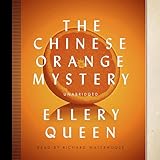
- Audible Audiobook
- Ellery Queen (Author) - Richard Waterhouse (Narrator)
- English (Publication Language)
- 10/16/2013 (Publication Date) - Blackstone Audio, Inc. (Publisher)
4. Reader’s Challenge Integration: Recognize and utilize the narrative’s direct address to the reader.
- Action: When Ellery Queen pauses the narrative to challenge the reader, treat this as a critical checkpoint for your own deduction.
- What to Look For: The explicit invitation to solve the mystery based on the facts presented up to that point. This is where the author signals that all necessary information is available.
- Mistake: Treating this section as a mere literary device or skipping it. This is a direct test of the reader’s observation and deductive skills.
5. Solution Reconciliation: Carefully analyze Ellery Queen’s final explanation.
- Action: Read Ellery’s solution and trace his logical progression step-by-step, cross-referencing with your notes.
- What to Look For: How the seemingly minor or overlooked clues are recontextualized and connected to explain the “impossible” crime.
- Mistake: Failing to see how the solution directly addresses the initial paradoxes presented, especially regarding the locked room.
The Chinese Orange Mystery by Ellery Queen: A Masterclass in Misdirection
This novel serves as a textbook example of how a skilled author can manipulate reader perception through deliberate construction. The brilliance of The Chinese Orange Mystery by Ellery Queen lies not solely in its solution, but in the elaborate edifice of deception that leads the reader astray.
- Failure Mode: The most common failure mode for readers engaging with this mystery is succumbing to the primary misdirection: the apparent impossibility of the crime. The narrative foregrounds the locked-room aspect so effectively that readers tend to focus their deductive efforts on how the killer could have entered or exited, while overlooking subtler clues related to the victim’s actions or the nature of the “crime” itself. For instance, the emphasis on the sealed room might distract from a simpler explanation of the victim’s demise or the circumstances of the discovery.
- Detection: Early detection of this failure mode involves actively questioning the most obvious interpretation of events. When confronted with a seemingly impossible scenario, ask: “Is there another way to interpret the facts presented, one that doesn’t require a supernatural or overly complex physical explanation?” Consider if the “locked room” is truly as impenetrable as it appears, or if the nature of the death itself is being misunderstood.
Common Myths
- Myth 1: The solution to The Chinese Orange Mystery relies on a secret passage or hidden mechanism.
- Correction: While the locked-room setup is central, Ellery Queen’s novels operate under the fair-play rule. The solution is derived from clues presented openly, not from hidden architectural features or undiscovered devices. The “impossibility” is often a matter of interpretation of the facts.
- Myth 2: Ellery Queen’s novels are primarily about the psychological state of the killer.
- Correction: While character motivations are important, the core of Ellery Queen’s method, as exemplified in The Chinese Orange Mystery, is logical deduction based on physical evidence and testimony. The focus is on piecing together the “how” and “why” through rational analysis rather than deep psychological profiling.
Common Mistakes
- Mistake: Over-reliance on the “locked room” aspect for the solution.
- Why it matters: This is often the novel’s primary red herring. The solution frequently hinges on external factors, a reinterpretation of the room’s state, or the victim’s own actions, rather than the mechanics of entry or exit.
- Fix: Allocate equal investigative focus to the victim’s state, the timeline of events before the discovery, and any unusual objects or statements that don’t directly seem to pertain to the room’s security.
- Mistake: Underestimating the significance of seemingly trivial details.
- Why it matters: Ellery Queen novels are built on the “fair play” principle. The solution is invariably present within the text, often embedded in observations that appear minor or inconsequential at first reading.
- Fix: Maintain a comprehensive log of all clues, regardless of their perceived importance. Periodically revisit these notes, considering how each detail might be reinterpreted as the narrative unfolds.
- Mistake: Neglecting Ellery Queen’s direct challenge to the reader.
- Why it matters: This narrative device is a key structural element where the author explicitly signals that all necessary information for solving the mystery has been provided.
- Fix: Treat this section as a critical deductive checkpoint. Attempt to formulate your own solution based on the presented facts before proceeding to Ellery’s explanation.
- Mistake: Assuming a complex motive or killer without sufficient evidence.
- Why it matters: The most elegant solutions in detective fiction often rely on the simplest explanation that fits all the facts, once the misdirection is removed.
- Fix: Prioritize motives and methods that are directly and unequivocally supported by the textual evidence, even if they appear less dramatic or convoluted than initially hypothesized.
Expert Tips
- Tip 1: Deconstruct the “Impossible” Premise.
- Actionable Step: When faced with a seemingly impossible crime, such as a locked room, systematically question the assumptions about how the impossibility is achieved. Is the room truly sealed? Was the crime committed in the manner initially perceived?
- Common Mistake to Avoid: Accepting the initial premise of impossibility without rigorous examination. This often leads to chasing elaborate, incorrect theories that deviate from the core clues.
- Tip 2: Prioritize Ellery’s Deductive Path.
- Actionable Step: Closely follow Ellery Queen’s lines of questioning and his analysis of clues. Note which specific details he focuses on and the logical connections he makes.
- Common Mistake to Avoid: Focusing solely on the sensational aspects of the crime and overlooking Ellery’s methodical breakdown of evidence. His process often contains the subtle hints that lead to the solution.
- Tip 3: Re-evaluate the Victim’s Role.
- Actionable Step: Consider the victim’s actions, state of mind, and relationships leading up to the murder. The victim’s own behavior can often be a key to understanding the crime’s mechanics or motive.
- Common Mistake to Avoid: Viewing the victim solely as a passive recipient of the crime. In many classic mysteries, the victim’s prior actions are integral to the solution.
BLOCKQUOTE_0
Quick Comparison
| Option | Best for | Pros | Watch out |
|---|---|---|---|
| Quick Answer | General use | The Chinese Orange Mystery by Ellery Queen is a prime example of a Golden Age… | Mistake: Dismissing early descriptive elements as mere atmospheric filler. In… |
| Who This Is For | General use | This novel is best suited for readers who enjoy meticulously constructed puzz… | Mistake: Accepting alibis without critical scrutiny. In a Queen novel, alibis… |
| What to Check First | General use | Readers prioritizing fast-paced action or extensive character development mig… | Mistake: Overlooking or de-emphasizing details that do not immediately appear… |
| Step-by-Step Plan for Engaging with The Chinese Orange Mystery by Ellery Queen | General use | Enthusiasts of classic detective fiction who appreciate intellectual challeng… | Mistake: Treating this section as a mere literary device or skipping it. This… |
Decision Rules
- If reliability is your top priority for The Chinese Orange Mystery by Ellery Queen, choose the option with the strongest long-term track record and support.
- If value matters most, compare total ownership cost instead of headline price alone.
- If your use case is specific, prioritize fit-for-purpose features over generic ‘best overall’ claims.