Richard Hofstadter’s ‘The Paranoid Style in American Politics
Quick Answer
- ‘The Paranoid Style in American Politics’ by Richard Hofstadter analyzes the persistent, often extreme, and conspiratorial mode of political expression in American history.
- It argues that this style is not necessarily indicative of individual mental illness but rather a distinct rhetorical and cognitive pattern within certain political movements.
- The book is essential for understanding recurring patterns of fear, suspicion, and demonization in public discourse, providing a framework for critical analysis of contemporary political rhetoric.
Who This Is For
- Readers seeking to understand the historical roots and recurring manifestations of extreme political rhetoric and conspiracy thinking in the United States.
- Students and scholars of American history, political science, and sociology who need a foundational text for analyzing political discourse.
What to Check First
- Publication Context: The book was published in 1964, reflecting on historical trends up to the mid-20th century. Consider how these patterns have evolved or persisted since.
- Hofstadter’s Definition: Understand his specific definition of “paranoid style” as a mode of expression, not necessarily clinical paranoia. He focuses on the style of argument and belief formation.
- Historical Examples: Familiarize yourself with the historical episodes Hofstadter uses as examples (e.g., McCarthyism, anti-Masonic movements, Populist critiques of elites).
- Key Themes: Identify core themes such as the use of apocalyptic language, the perception of vast, secret conspiracies, and the demonization of opponents.
Step-by-Step Plan for Understanding The Paranoid Style In American Politics by Richard Hofstadter
This plan outlines how to engage with Hofstadter’s work to gain a robust understanding of his thesis and its implications.
1. Read the Introduction and First Chapter:
- Action: Begin by reading Hofstadter’s introductory essay and the first chapter, “The Paranoid Style and American Politics.”
- What to Look For: Pay close attention to his initial definition of the “paranoid style” and the historical examples he introduces to illustrate it. Note his distinction between the style and individual pathology.
- Mistake to Avoid: Assuming the “paranoid style” refers solely to diagnosed mental illness rather than a distinct mode of political articulation.
2. Analyze Case Studies:
- Action: Systematically examine the historical case studies presented in subsequent chapters (e.g., the Anti-Masonic movement, the Populist critique of elites, McCarthyism).
- What to Look For: Identify the common rhetorical strategies, the nature of the perceived enemies, and the societal conditions that Hofstadter links to the emergence of this style. Note the specific language and accusations used.
- Mistake to Avoid: Treating these historical examples as isolated incidents without recognizing the underlying patterns Hofstadter aims to expose.
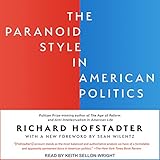
- Audible Audiobook
- Richard Hofstadter (Author) - Keith Sellon-Wright (Narrator)
- English (Publication Language)
- 05/15/2018 (Publication Date) - Tantor Media (Publisher)
3. Identify Core Rhetorical Devices:
- Action: Isolate and list the recurring rhetorical techniques Hofstadter identifies within the paranoid style.
- What to Look For: Examples include apocalyptic framing, the belief in a vast, hidden conspiracy, the attribution of immense power and malice to the opposition, and the use of absolute moral judgments.
- Mistake to Avoid: Overlooking the specific linguistic and argumentative patterns, focusing only on the content of the beliefs.
4. Consider the “Contrarian” Element:
- Action: Evaluate Hofstadter’s contrarian stance against the prevailing narratives of his time.
- What to Look For: Recognize that Hofstadter challenged the idea that such extreme rhetoric was merely the product of a few disturbed individuals. He argued it was a recurring feature of American political culture, often deployed by otherwise rational actors.
- Mistake to Avoid: Discounting his analysis because it seems to legitimize or normalize extreme political expression; his goal is analysis, not endorsement.
5. Assess Contemporary Relevance:
- Action: Apply Hofstadter’s framework to contemporary political discourse and events.
- What to Look For: Observe how similar patterns of conspiracy theorizing, demonization of opponents, and apocalyptic rhetoric manifest today. Note the platforms and media that facilitate their spread.
- Mistake to Avoid: Concluding that modern examples are entirely unprecedented, failing to see the historical continuities Hofstadter illuminated.
6. Engage with Criticisms and Nuances:
- Action: Seek out scholarly reviews or critiques of Hofstadter’s work.
- What to Look For: Understand arguments that might expand upon, challenge, or refine his thesis. Consider if his focus on elite discourse overlooks grassroots expressions or if his historical examples are interpreted too narrowly.
- Mistake to Avoid: Accepting Hofstadter’s thesis as unassailable without considering alternative interpretations or limitations.
Common Mistakes
- Mistake: Equating the “paranoid style” with clinical paranoia.
- Why it Matters: Hofstadter explicitly defines the “paranoid style” as a mode of political expression and argumentation, not a diagnosis of mental illness. Confusing the two misinterprets his central thesis.
- Fix: Focus on the rhetorical patterns and cognitive frameworks Hofstadter describes, such as the belief in vast, hidden conspiracies and the demonization of opponents, rather than seeking evidence of psychological disorders.
- Mistake: Viewing the “paranoid style” as exclusively a fringe phenomenon.
- Why it Matters: Hofstadter argues that this style can manifest across the political spectrum and be employed by individuals who are otherwise rational and influential. It is a style that can be adopted, not just an inherent trait of a marginalized group.
- Fix: Recognize that the paranoid style can appear in mainstream political discourse, often used strategically to mobilize support or discredit opponents, even by figures not typically considered extreme.
- Mistake: Dismissing Hofstadter’s work as outdated due to its 1964 publication date.
- Why it Matters: While historical context is important, the core patterns of fear, suspicion, and conspiracy theorizing Hofstadter identifies are recurring elements of human political behavior and have found new avenues of expression in the digital age.
- Fix: Apply Hofstadter’s analytical framework to contemporary political events and discourse, noting how the mechanisms of the paranoid style persist and adapt, even if the specific targets or media differ.
- Mistake: Focusing solely on the content of beliefs rather than the structure of arguments.
- Why it Matters: Hofstadter’s contribution lies in identifying the way people argue and construct their worldview when employing the paranoid style, not just what specific conspiracy theories they believe.
- Fix: Analyze the commonalities in how arguments are framed: the attribution of agency to hidden forces, the rejection of contradictory evidence as part of the conspiracy, and the use of all-or-nothing moral dichotomies.
The Paranoid Style In American Politics by Richard Hofstadter: A Deeper Dive
Hofstadter’s seminal work provides a framework for understanding a persistent feature of American political discourse: the tendency towards apocalyptic thinking, vast conspiracy theories, and the demonization of opponents. He posits that this “paranoid style” is not merely a symptom of individual pathology but a recognizable mode of expression that has surfaced repeatedly throughout American history, often from figures who are otherwise rational and engaged in mainstream politics.
The contrarian aspect of Hofstadter’s thesis lies in its challenge to the assumption that such extreme rhetoric is always the product of the mentally unwell or the politically marginal. Instead, he suggests it is a recurring pattern of thought and expression that can be strategically employed to mobilize sentiment and frame political battles in stark, Manichean terms.
Understanding The Paranoid Style In American Politics by Richard Hofstadter
Hofstadter identifies several key characteristics of the paranoid style. These include:
- Apocalyptic Thinking: The belief that society is facing an imminent, existential crisis.
- Conspiratorial Worldview: The conviction that events are orchestrated by hidden, malevolent forces.
- Demonization of Opponents: Portraying political adversaries not merely as wrong, but as evil, inherently corrupt, or agents of destruction.
- Selective Evidence: The tendency to embrace information that confirms the conspiratorial narrative while dismissing or reinterpreting contradictory evidence as part of the plot.
He illustrates these points with historical examples ranging from the Anti-Masonic movement of the 1830s, which saw Freemasons as a secret, subversive force, to the McCarthy era, where Senator Joseph McCarthy claimed vast communist infiltration of American institutions. These were not isolated incidents but part of a discernible historical pattern.
BLOCKQUOTE_0
Expert Tips for Identifying and Countering Political Paranoia
Navigating the landscape of political discourse requires a critical lens, especially when confronted with the paranoid style. Here are some expert tips:
- Tip 1: Scrutinize the “Us vs. Them” Dichotomy.
- Actionable Step: When encountering political rhetoric that rigidly divides the world into absolute good versus absolute evil, pause and investigate the claims.
- Common Mistake to Avoid: Accepting the stark moral framing without seeking nuance or evidence of shared interests or complexities. This often leads to uncritical acceptance of demonization.
- Tip 2: Trace the Evidence Chain.
- Actionable Step: For any extraordinary claim, especially those involving secret plots or conspiracies, demand clear, verifiable evidence from reputable sources.
- Common Mistake to Avoid: Allowing the certainty or intensity of the claim to substitute for factual backing. Unsubstantiated assertions, even when delivered with conviction, remain unsubstantiated.
- Tip 3: Recognize the Appeal to Emotion Over Reason.
- Actionable Step: Be wary of rhetoric that primarily aims to provoke fear, anger, or outrage, rather than engage in reasoned debate or present policy solutions.
- Common Mistake to Avoid: Being swayed by emotionally charged language that bypasses critical thinking. This emotional appeal is a hallmark of manipulative communication.
Common Myths About The Paranoid Style
- Myth: The “paranoid style” is exclusively found among conspiracy theorists and fringe groups.
- Rebuttal: Hofstadter’s central argument is that this style is a recurring feature of American political discourse, capable of being employed by individuals and movements across the political spectrum, including those who are otherwise considered mainstream or rational. The style is about how one argues, not solely who is arguing.
- Myth: The “paranoid style” is a new phenomenon, exacerbated by the internet and social media.
- Rebuttal: Hofstadter’s book, published in 1964, details historical instances of the paranoid style predating modern digital communication. While the internet may amplify and accelerate its spread, the underlying patterns of apocalyptic thinking and conspiratorialism are deeply embedded in American political history.
Quick Comparison
| Option | Best for | Pros | Watch out |
|---|---|---|---|
| Quick Answer | General use | ‘The Paranoid Style in American Politics’ by Richard Hofstadter analyzes the… | Mistake to Avoid: Assuming the “paranoid style” refers solely to diagnosed me… |
| Who This Is For | General use | It argues that this style is not necessarily indicative of individual mental… | Mistake to Avoid: Treating these historical examples as isolated incidents wi… |
| What to Check First | General use | The book is essential for understanding recurring patterns of fear, suspicion… | Mistake to Avoid: Overlooking the specific linguistic and argumentative patte… |
| Step-by-Step Plan for Understanding The Paranoid Style In American Politics by Richard Hofstadter | General use | Readers seeking to understand the historical roots and recurring manifestatio… | Mistake to Avoid: Discounting his analysis because it seems to legitimize or… |
Decision Rules
- If reliability is your top priority for The Paranoid Style In American Politics by Richard Hofstadter, choose the option with the strongest long-term track record and support.
- If value matters most, compare total ownership cost instead of headline price alone.
- If your use case is specific, prioritize fit-for-purpose features over generic ‘best overall’ claims.
FAQ
- Q: Is Richard Hofstadter’s ‘The Paranoid Style in American Politics’ still relevant today?
- A: Yes, the book remains highly relevant. The patterns of rhetoric and thought Hofstadter identified—fear of hidden enemies, apocalyptic framing, and demonization—continue to manifest in contemporary political discourse, amplified by modern media.
- Q: How does Hofstadter differentiate the “paranoid style” from individual mental illness?
- A: Hofstadter defines the “paranoid style” as a distinct mode of political argumentation and perception, characterized by specific rhetorical strategies and beliefs about conspiracies. He distinguishes this from clinical paranoia, suggesting it is a cultural and political phenomenon rather than solely a psychological disorder.
- Q: What are the primary historical examples Hofstadter uses to illustrate his thesis?
- A: Hofstadter draws upon several historical episodes, including the Anti-Masonic movement