Peter Buffett on Shaping Your Own Life’s Path
Life Is What You Make It by Peter Buffett: Quick Answer
- “Life Is What You Make It” by Peter Buffett offers a practical framework for personal agency, emphasizing that individual choices and perspectives significantly shape life outcomes.
- The book is best suited for those seeking to reframe their approach to challenges and take more deliberate control over their daily experiences.
- Readers should first consider their current mindset regarding external factors versus internal control to best engage with Buffett’s core message.
Who This Is For
- Individuals feeling stuck or overwhelmed by circumstances, looking for actionable strategies to regain a sense of control.
- Readers interested in philosophical yet grounded perspectives on personal responsibility and the power of perspective in navigating life’s complexities.
What to Check First
- Your Current Control Narrative: Assess whether you tend to attribute outcomes to external forces (luck, fate, others’ actions) or internal decisions and efforts. This book challenges a purely external attribution.
- Definition of “Success”: Consider what “success” means to you beyond conventional metrics. Buffett’s approach often redefines success through personal fulfillment and impact.
- Willingness to Shift Perspective: Be prepared to actively question your assumptions about limitations and possibilities. The book requires an open mind to new ways of framing challenges.
- Book’s Core Premise: Understand that the central argument is about the power of choice and perception, not a guaranteed formula for specific external achievements.
Step-by-Step Plan: Implementing Life Is What You Make It
This plan outlines how to apply the principles from Peter Buffett’s “Life Is What You Make It” to your own life.
1. Identify a Recurring Challenge:
- Action: Select one specific area in your life where you consistently face difficulties or feel blocked. This could be a work project, a personal relationship, or a habit you wish to change.
- What to Look For: A situation where your immediate reaction is often frustration, blame, or a feeling of helplessness.
- Mistake to Avoid: Choosing a problem that is too broad or abstract; focus on a concrete, manageable issue.
2. Analyze Your Current Perspective:
- Action: Write down your typical thoughts and feelings about this challenge. Who or what do you blame? What limitations do you perceive?
- What to Look For: Patterns of external attribution (e.g., “My boss is unreasonable,” “The economy is bad,” “I’m just not good at this”).
- Mistake to Avoid: Skipping this step and moving directly to solutions without understanding your current mental framing.
3. Reframe the Challenge:
- Action: Consciously rephrase the situation from an internal locus of control. Ask: “What is within my power to influence here?” “What can I learn from this?” “What action can I take, however small?”
- What to Look For: Shifting from “I can’t” to “How can I?” or from “It’s their fault” to “What is my role?”
- Mistake to Avoid: Merely telling yourself to be positive without identifying specific, actionable internal changes.
4. Define a Small, Actionable Step:
- Action: Based on your reframed perspective, identify one concrete, achievable action you can take within the next 24-48 hours.
- What to Look For: A step that directly addresses an aspect of the challenge that is within your control, no matter how minor.
- Mistake to Avoid: Setting an unrealistic or overly ambitious goal that leads to discouragement.
5. Execute the Action:
- Action: Carry out the small, actionable step you defined.
- What to Look For: The act of doing, regardless of the immediate outcome. Focus on the process of taking initiative.
- Mistake to Avoid: Procrastinating or finding excuses not to take the action.
6. Observe and Adjust:
- Action: Reflect on the outcome of your action. What happened? How did it feel? Did your perspective shift, even slightly?
- What to Look For: Any changes in your internal state or in the situation itself, however subtle. Note what worked and what didn’t.
- Mistake to Avoid: Over-analyzing minor results or becoming discouraged if the immediate outcome isn’t dramatic.
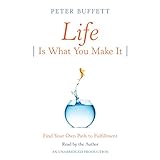
- Audible Audiobook
- Peter Buffett (Author) - Peter Buffett (Narrator)
- English (Publication Language)
- 04/27/2010 (Publication Date) - Random House Audio (Publisher)
7. Iterate and Expand:
- Action: Based on your observations, define the next small, actionable step. Continue this cycle of reframing, acting, and observing.
- What to Look For: Building momentum through consistent, small wins. Gradually increasing the scope of your actions as your confidence grows.
- Mistake to Avoid: Abandoning the process after one attempt; consistent application is key.
Life Is What You Make It by Peter Buffett: Addressing Misconceptions
This section addresses common misunderstandings about the book’s central tenets.
- Myth: The book promises a simplistic “law of attraction” or “positive thinking” solution where wishing makes it so.
- Why it Matters: This misunderstands Buffett’s emphasis on agency and action. It can lead to disappointment if external results don’t materialize solely from positive thoughts.
- Correction: Buffett stresses that while mindset is crucial, it is the foundation for action. The power lies in how you choose to act based on your perspective, not just in the thoughts themselves. The book advocates for deliberate, informed choices and consistent effort.
- Myth: The book implies that all suffering is self-inflicted and therefore avoidable with the right mindset.
- Why it Matters: This dismisses the reality of systemic issues, genuine misfortune, and the impact of external trauma that are beyond an individual’s immediate control. It can lead to victim-blaming.
- Correction: Buffett acknowledges that external factors exist and can be challenging. However, his focus is on how individuals respond to these factors. The book’s power is in empowering individuals to find agency within their circumstances, not to deny the existence of those circumstances or to suggest they are solely responsible for all hardship.
Expert Tips for Navigating Your Life’s Path
Here are practical insights derived from Peter Buffett’s approach to personal agency.
- Tip: Cultivate a “Choice Inventory.”
- Actionable Step: At the end of each day, list at least three choices you consciously made, regardless of their significance (e.g., what to eat, how to respond to an email, whether to take a break).
- Common Mistake to Avoid: Focusing only on major life decisions and overlooking the cumulative impact of daily, seemingly minor choices.
- Tip: Practice “Perspective Shifting Drills.”
- Actionable Step: When faced with a setback, deliberately try to articulate the situation from three different perspectives: your own, an objective observer’s, and someone who might benefit from the situation.
- Common Mistake to Avoid: Getting stuck in a single, negative viewpoint and failing to explore alternative interpretations.
- Tip: Define “Meaningful Action” Over “Productive Action.”
- Actionable Step: Before embarking on a task, ask yourself: “Does this action align with my values and contribute to what I deem important, even if it’s not the most efficient or conventionally ‘productive’?”
- Common Mistake to Avoid: Chasing external validation of productivity (e.g., busywork) at the expense of activities that foster genuine growth or fulfillment.
BLOCKQUOTE_0
Decision Rules
- If reliability is your top priority for Life Is What You Make It by Peter Buffett, choose the option with the strongest long-term track record and support.
- If value matters most, compare total ownership cost instead of headline price alone.
- If your use case is specific, prioritize fit-for-purpose features over generic ‘best overall’ claims.
FAQ
Q1: Does “Life Is What You Make It” suggest I should ignore external problems?
No. Buffett’s work is about how you respond to external challenges. It encourages you to find agency and make choices within your sphere of influence, rather than being paralyzed by factors outside your control.
Q2: Is this book about achieving immense wealth or fame?
Not directly. While Buffett comes from a wealthy background, the book’s focus is on personal fulfillment, agency, and making meaningful choices. It redefines success beyond material accumulation.
Q3: What if I feel like I have very little control over my circumstances?
The book’s premise is to help you identify and expand the areas where you do have control, however small. It’s a process of gradually shifting your focus and actions to build momentum and a sense of agency.
Q4: How does this book differ from other self-help books?
“Life Is What You Make It” is often less prescriptive and more philosophical, emphasizing personal responsibility and the power of perspective. It encourages introspection and self-discovery rather than providing rigid formulas for success.
| Aspect of Life | Buffett’s Approach | Potential Pitfall | How to Mitigate |
|---|---|---|---|
| Career Development | Focus on skills you can develop and opportunities you can create. | Waiting for promotions or ideal job offers. | Proactively seek training, network strategically, take on challenging projects. |
| Personal Relationships | Emphasize your own communication and emotional responses. | Blaming partners or friends for relational issues. | Practice active listening, express needs clearly, and manage your own reactions. |
| Financial Well-being | Prioritize informed financial decisions and responsible habits. | Relying solely on external financial advice or luck. | Educate yourself on personal finance, budget diligently, and save consistently. |
| Dealing with Adversity | Frame challenges as opportunities for growth and learning. | Becoming overwhelmed by negative events. | Break down problems, focus on actionable steps, and seek support when needed. |