Discovering the Origins of Innovative Ideas
Where Good Ideas Come From by Steven Johnson: A Framework for Understanding
Steven Johnson’s Where Good Ideas Come From offers a compelling, evidence-based exploration into the genesis of innovation. Moving beyond the myth of the lone genius, Johnson argues that groundbreaking ideas are often the product of specific environmental conditions, social interactions, and the recombination of existing knowledge. This book provides a practical, scientific lens for understanding how to foster environments conducive to creativity and breakthrough thinking.
Who This Is For
- Individuals and teams seeking to understand the underlying mechanisms of innovation beyond anecdotal accounts.
- Leaders and managers aiming to cultivate a more innovative culture within their organizations by understanding the factors that truly drive idea generation.
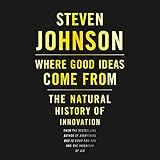
- Audible Audiobook
- Steven Johnson (Author) - Erik Singer (Narrator)
- English (Publication Language)
- 10/05/2010 (Publication Date) - Penguin Audio (Publisher)
What to Check First
Before implementing strategies for idea generation, consider these foundational concepts as outlined by Johnson:
- The “Adjacent Possible”: Understand that innovation often involves connecting existing ideas or technologies in novel ways. Your current knowledge base defines the boundaries of what’s immediately possible.
- The Role of Environment: Recognize that physical and social environments play a crucial role. Spaces that encourage serendipitous encounters and diverse interactions are fertile grounds for new ideas.
- The “Liquid Network” Effect: Ideas spread and evolve through social connections. The strength and diversity of your network directly influence the quality and quantity of ideas generated.
- The “Slow Hunch” Principle: Be aware that most significant innovations don’t occur in a single flash. They often build upon a series of smaller, nascent thoughts that are nurtured over time.
Where Good Ideas Come From by Steven Johnson: Unpacking the Mechanisms
Steven Johnson’s work systematically dismantles the romanticized image of the solitary inventor. Instead, he presents a robust argument that innovation is fundamentally an emergent property of complex systems—both social and environmental. The book meticulously details how ideas arise not from a vacuum of pure intellect, but from the fertile ground of interconnectedness, exploration, and the strategic synthesis of existing elements. For anyone involved in creative processes, scientific discovery, or entrepreneurial ventures, understanding these principles is paramount to fostering a more innovative output.
The Architecture of Innovation: Key Principles
Johnson identifies several core principles that govern the emergence of innovative ideas, shifting the focus from individual brilliance to systemic conditions.
- The Innovation Ecosystem: Johnson argues that environments rich in diverse stimuli and opportunities for cross-pollination are essential. These can be physical spaces, like the bustling coffee shops of historical innovation hubs, or digital platforms that facilitate broad information exchange. For example, the early days of the internet, with its open protocols and interconnectedness, fostered an unprecedented wave of innovation.
- Action: Actively seek out diverse information sources and engage with individuals from different disciplines or backgrounds.
- What to Look For: Unforeseen connections between seemingly unrelated concepts or the application of a concept from one field to another.
- Mistake: Limiting information intake to familiar channels or staying within a strictly defined professional silo, which restricts exposure to novel inputs.
- The “Slow Hunch” Phenomenon: Contrary to the popular “aha!” moment narrative, Johnson explains that many significant ideas begin as vague, underdeveloped notions—”slow hunches”—that gradually mature through experimentation and refinement. The development of the World Wide Web, for instance, was not an instantaneous flash but an iterative process built upon earlier networking concepts and evolving needs.
- Action: Document nascent ideas, even if they lack immediate clarity or a complete solution, and revisit them periodically.
- What to Look For: The gradual evolution and refinement of an initial thought through consistent engagement and iterative development.
- Mistake: Discarding an idea too early simply because it doesn’t present a fully formed concept or a clear path to implementation.
- The Power of the Network: Johnson emphasizes that ideas gain traction and evolve through social interaction. His concept of the “liquid network” highlights how loosely connected individuals can share and build upon concepts more effectively than rigid, hierarchical structures. The open-source software movement is a prime example, where a distributed network of contributors collectively innovates and refines projects.
- Action: Foster open communication channels and encourage the sharing of preliminary ideas within teams and across departments.
- What to Look For: The rapid iteration and improvement of concepts when shared broadly and subjected to diverse feedback.
- Mistake: Hoarding nascent ideas or establishing overly restrictive communication protocols that inhibit the free flow of preliminary thoughts.
Where Good Ideas Come From by Steven Johnson: The Counter-Intuitive Advantage of Constraints
A particularly insightful, and often counter-intuitive, aspect Johnson explores is the idea that constraints can paradoxically fuel innovation. While boundless resources might seem ideal, limitations can force creative problem-solving and lead to more elegant, efficient, and groundbreaking solutions. This challenges the assumption that more freedom automatically equates to more innovation.
BLOCKQUOTE_0
This perspective suggests that innovation is not solely about unrestricted exploration, but about the skillful navigation and creative manipulation of existing boundaries and limitations.
Common Myths About Idea Generation
Many widely held beliefs about where good ideas come from are, according to Johnson’s research, overly simplistic or entirely inaccurate. Understanding these myths is crucial for adopting more effective strategies.
- Myth: Great ideas are born from solitary moments of pure inspiration, often in isolation.
- Why it Matters: This myth leads individuals to isolate themselves, believing that true innovation requires solitude. This can result in missed opportunities for collaboration, diverse input, and the synergistic benefits of group ideation.
- Correction: Johnson presents extensive evidence that most significant innovations arise from the recombination of existing ideas, often facilitated by social interaction and exposure to varied perspectives. The development of the printing press, for instance, combined existing technologies like screw presses with new metallurgical techniques, a process heavily influenced by the exchange of knowledge.
- Myth: Innovation is primarily about radical, disruptive breakthroughs that appear suddenly.
- Why it Matters: This focus can lead to impatience and a devaluation of incremental progress. It overlooks the cumulative nature of many significant advancements, which are built upon a series of smaller, iterative improvements.
- Correction: Johnson highlights the importance of “slow hunches” and the gradual evolution of ideas. Many innovations are the result of decades of incremental development and refinement, such as the gradual evolution of the automobile from its early, rudimentary forms to modern vehicles.
- Myth: Idea generation is a chaotic, unpredictable process with no discernible underlying structure or controllable factors.
- Why it Matters: Believing innovation is purely random can lead to a passive approach, waiting for inspiration to strike rather than actively cultivating an environment conducive to idea emergence.
- Correction: Johnson identifies specific environmental and social factors that reliably foster innovation, such as diverse networks, exploration of the “adjacent possible,” and the encouragement of experimentation. These elements can be intentionally nurtured.
Step-by-Step Plan for Cultivating Innovative Ideas
1. Map Your Adjacent Possible:
- Action: Systematically identify and list all existing concepts, technologies, and knowledge within your immediate field and adjacent domains. This involves thorough research and documentation.
- What to Look For: Identify potential gaps, overlaps, or synergies between these elements that could lead to novel combinations.
- Mistake: Focusing only on established solutions and failing to explore less obvious, but potentially more innovative, connections between disparate elements.
2. Foster Diverse Input Streams:
- Action: Actively seek out information from varied sources, including different industries, disciplines, and cultural backgrounds. Subscribe to diverse publications, attend interdisciplinary conferences, or engage in cross-functional projects.
- What to Look For: Unforeseen insights or novel approaches that challenge your current thinking and expand your conceptual toolkit.
- Mistake: Limiting information intake to sources that confirm existing beliefs or stay within a narrow professional comfort zone, thereby restricting exposure to fresh perspectives.
3. Cultivate “Liquid Networks”:
- Action: Encourage open communication and informal idea sharing among team members and across departments. Create platforms or opportunities for spontaneous interaction, such as informal “water cooler” discussions or cross-departmental project teams.
- What to Look For: The free flow of preliminary ideas and constructive feedback, leading to rapid iteration and refinement.
- Mistake: Implementing rigid communication structures that stifle informal exchange and discourage the sharing of half-formed thoughts or speculative ideas.
4. Embrace the “Slow Hunch”:
- Action: Develop a consistent system for capturing and revisiting nascent ideas, even those that seem underdeveloped or impractical at first glance. Utilize notebooks, digital tools, or regular personal review sessions to track these evolving thoughts.
- What to Look For: The gradual evolution and refinement of initial concepts over time through sustained attention and iterative development.
- Mistake: Discarding an idea prematurely because it doesn’t immediately present a complete or polished solution, thereby losing potential breakthroughs.
5. Experiment and Iterate:
- Action: Create a safe environment for experimentation where failure is viewed as a learning opportunity rather than a setback. Encourage prototyping and testing of ideas, even on a small scale, to gather empirical data.
- What to Look For: The specific insights gained from testing and the iterative improvements that emerge from these experiments.
- Mistake: Avoiding experimentation due to fear of failure or investing heavily in a single untested concept without validation.
6. Analyze Environmental Triggers:
- Action: Observe and analyze the physical and social environments where innovation thrives. This might involve redesigning workspaces to encourage interaction, facilitating cross-team meetings, or exploring external collaboration models.
- What to Look For: The demonstrable impact of environmental factors and social dynamics on idea generation and problem-solving effectiveness.
- Mistake: Underestimating the influence of surroundings and social dynamics on creative output, treating innovation as solely an individual cognitive process.
## Quick Comparison
| Option | Best for | Pros | Watch out |
|---|---|---|---|
| Where Good Ideas Come From by Steven Johnson A Framework for Understanding | General use | Individuals and teams seeking to understand the underlying mechanisms of inno… | Mistake: Limiting information intake to familiar channels or staying within a… |
| Who This Is For | General use | Leaders and managers aiming to cultivate a more innovative culture within the… | Mistake: Discarding an idea too early simply because it doesn’t present a ful… |
| What to Check First | General use | The “Adjacent Possible”: Understand that innovation often involves connecting… | Mistake: Hoarding nascent ideas or establishing overly restrictive communicat… |
| Where Good Ideas Come From by Steven Johnson Unpacking the Mechanisms | General use | The Role of Environment: Recognize that physical and social environments play… | Mistake: Focusing only on established solutions and failing to explore less o… |
Decision Rules
- If reliability is your top priority for Where Good Ideas Come From by Steven Johnson, choose the option with the strongest long-term track record and support.
- If value matters most, compare total ownership cost instead of headline price alone.
- If your use case is specific, prioritize fit-for-purpose features over generic ‘best overall’ claims.