N.T. Wright’s ‘Surprised By Hope’: Understanding Christian Belief
Quick Answer
- Core Argument: N.T. Wright’s Surprised By Hope challenges the conventional Christian view of the afterlife, arguing that hope centers on bodily resurrection and the renewal of creation, not disembodied souls ascending to heaven.
- Key Takeaway: The book shifts Christian eschatology from a focus on escaping this world to actively engaging with the present, motivated by the certainty of God’s future physical transformation of the world.
- Impact: It provides a biblically robust framework for understanding humanity’s ultimate destiny and the future of the physical universe.
Who This Is For
- Christians seeking a more profound, scripture-based understanding of the afterlife and the future of God’s kingdom.
- Individuals interested in how theological perspectives on the end times influence present-day ethics and worldview.
For a deeper dive into N.T. Wright’s groundbreaking ideas on Christian hope, his book ‘Surprised By Hope’ is essential reading. It offers a biblically robust framework for understanding the afterlife.
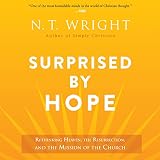
- Audible Audiobook
- N. T. Wright (Author) - James Langton (Narrator)
- English (Publication Language)
- 02/27/2018 (Publication Date) - HarperOne (Publisher)
What to Check First
- Existing Views on the Afterlife: Be prepared to critically examine your preconceptions about heaven, hell, and the nature of resurrection.
- Wright’s Scholarly Approach: The book is detailed and heavily reliant on biblical exegesis; a willingness to engage with scripture is essential.
- Influence of Philosophical Dualism: Recognize how philosophical ideas, particularly Greek dualism (separation of mind and body), may have shaped common Christian eschatology, a concept Wright addresses.
- The “Already, Not Yet” Kingdom: Familiarize yourself with the concept of the inaugurated kingdom of God, which is central to Wright’s arguments.
Step-by-Step Plan: Engaging with Surprised By Hope
1. Identify the Central Critique:
- Action: Read the introductory chapters with focused attention.
- What to Look For: Wright’s clear articulation of the prevailing “heaven-going” narrative and his thesis that this narrative deviates from biblical teaching.
- Mistake: Assuming Wright is presenting a novel idea without first understanding the problem he identifies in current interpretations.
2. Analyze Biblical Foundations:
- Action: Pay close attention to Wright’s exegesis of key Old and New Testament passages concerning death, resurrection, and the kingdom of God.
- What to Look For: The specific biblical texts Wright uses to support his arguments and how he interprets them in contrast to common understandings.
- Mistake: Accepting or rejecting his interpretations without engaging with the scriptural evidence he presents.
3. Deconstruct the Dualistic Assumption:
- Action: Focus on Wright’s arguments against the separation of soul and body.
- What to Look For: His emphasis on the holistic nature of the human person and the biblical significance of bodily resurrection.
- Mistake: Continuing to hold a strong Platonic view of the soul’s inherent immortality, which Wright argues is not the primary biblical emphasis.
4. Grasp the “New Creation” Hope:
- Action: Understand Wright’s concept of God’s ultimate plan as the renewal of the entire cosmos.
- What to Look For: How the idea of a “new heaven and new earth” shapes the Christian’s present and future hope.
- Mistake: Confusing the renewal of creation with a simple re-establishment of the current world, rather than a transformed, redeemed reality.
5. Evaluate the Implications for Present Action:
- Action: Consider the practical outcomes Wright derives from his theological framework.
- What to Look For: How a hope in the renewed earth motivates engagement in social justice, environmental stewardship, and building God’s kingdom now.
- Mistake: Reading the book as purely an academic theological discussion without considering its impact on daily life and ethical choices.
6. Engage with Counterarguments:
- Action: Note where Wright addresses potential objections or alternative viewpoints.
- What to Look For: His responses to common criticisms and how he defends his position.
- Mistake: Approaching the book as an unquestionable authority rather than a reasoned argument that invites critical engagement.
Common Mistakes in Understanding Christian Eschatology
- Mistake: Believing the primary Christian hope is an escape from this physical world to a disembodied existence in heaven.
- Why it Matters: This perspective can lead to a devaluing of creation and a detachment from present-day responsibilities towards it, fostering a disengaged or passive faith.
- Fix: Focus on the biblical emphasis on bodily resurrection and the renewal of the cosmos, as detailed in passages like Isaiah 65 and Revelation 21. Understand that God’s plan is for redemption of the world, not abandonment of it.
- Mistake: Interpreting Jesus’ resurrection as merely a personal validation of his claims or a guarantee that individual souls go to heaven.
- Why it Matters: This minimizes the cosmic significance of Christ’s resurrection. It is the foundational event that inaugurates God’s new age and points to the future redemption of all creation.
- Fix: Understand Jesus’ resurrection as the “first fruits” of a broader, cosmic renewal, signifying the inauguration of God’s kingdom and the promise of a future bodily resurrection for all believers.
- Mistake: Equating “heaven” with a purely spiritual realm, detached from any physical reality.
- Why it Matters: This misunderstands the biblical vision of God’s ultimate dwelling with humanity. The biblical narrative culminates in God dwelling with His people in a renewed, physical reality – a new heaven and a new earth.
- Fix: Study biblical descriptions of God’s presence with humanity, from Eden to the eschatological vision in Revelation 21, which depicts a tangible, renewed creation where God is present with His people.
- Mistake: Treating the “kingdom of God” as solely a future, spiritual reality, separate from present-day engagement.
- Why it Matters: Wright argues for an “inaugurated eschatology” – the kingdom has already broken into history through Jesus but awaits its full consummation. Neglecting this can lead to passivity.
- Fix: Recognize that Christ’s reign has begun, and Christians are called to live as citizens of this kingdom, actively embodying its values and bringing its influence to bear on the present world.
Surprised By Hope by N.T. Wright: Challenging Conventional Wisdom
N.T. Wright’s Surprised By Hope is a foundational text for understanding contemporary Christian eschatology. Wright meticulously dismantles the popular notion that Christian hope primarily involves the soul departing the body for a disembodied existence in heaven. Instead, he argues, based on a thorough examination of scripture, that the core of Christian belief is the resurrection of the body and the ultimate renewal of creation. This reorientation shifts the focus from an escapist view of the afterlife to a hopeful engagement with the present world, grounded in the certainty of God’s future transformative work.
The book’s strength lies in its detailed biblical exegesis, tracing themes from the Old Testament prophets through Jesus’ ministry and the early church. Wright contends that a pervasive dualistic thinking, influenced by Greek philosophy, has distorted the Hebraic understanding of the whole person and the inherent goodness of God’s material creation. He posits that Jesus’ resurrection is not merely a prelude to individual souls going to heaven, but the pivotal event that inaugurates God’s plan for the complete redemption and restoration of all things. This perspective transforms Christian hope from a passive waiting for death into an active participation in God’s ongoing redemptive mission.
BLOCKQUOTE_0
This quote encapsulates Wright’s central thesis: Jesus’ resurrection is the pivotal event that inaugurates the future renewal of all things, not merely a personal endorsement or a prelude to individual disembodied existence.
Surprised By Hope by N.T. Wright: A Contrarian Perspective
While Surprised By Hope offers a compelling and biblically robust re-visioning of Christian eschatology, it is essential to approach its arguments with a critical, contrarian lens. The book’s strength lies in its thorough engagement with scripture and its challenge to popular, often unexamined, beliefs. However, the very nature of theological interpretation means that alternative readings are possible, and not all readers will find Wright’s conclusions universally convincing.
One key area for contrarian consideration is the degree to which popular eschatology is truly a distortion versus a simplified expression of complex biblical truths. While Wright rightly identifies a pervasive dualism, the extent to which this has entirely supplmented a more nuanced understanding of bodily resurrection in historical Christian thought warrants careful examination. Furthermore, the practical implications Wright draws for present-day engagement, while logically flowing from his theological framework, can be seen by some as placing an undue burden on believers or as a departure from a more contemplative spiritual focus. Ultimately, Surprised By Hope provides a powerful argument, but readers should engage with it by testing its assertions against their own understanding of scripture and tradition, rather than accepting it as the definitive final word.
Expert Tips for Understanding Surprised By Hope
- Tip 1: Focus on the “New Creation” as the Ultimate Goal.
- Actionable Step: When reading, actively highlight and reflect on passages that describe the “new heavens and new earth” (e.g., Revelation 21). Consider how this vision differs from the common idea of “going to heaven.”
- Common Mistake to Avoid: Assuming “heaven” is the final destination and overlooking the biblical emphasis on the renewal of the physical cosmos. This can lead to a devaluation of creation and present-day responsibilities.
- Tip 2: Connect Theology to Ethics and Action.
- Actionable Step: Identify specific sections where Wright discusses how belief in the resurrection and new creation should influence our actions in the present world, such as in areas of social justice, environmental care, and community building.
*
Quick Comparison
| Option | Best for | Pros | Watch out |
|---|---|---|---|
| Quick Answer | General use | Core Argument: N.T. Wright’s Surprised By Hope challenges the conventional… | Mistake: Assuming Wright is presenting a novel idea without first understandi… |
| Who This Is For | General use | Key Takeaway: The book shifts Christian eschatology from a focus on escaping… | Mistake: Accepting or rejecting his interpretations without engaging with the… |
| What to Check First | General use | Impact: It provides a biblically robust framework for understanding humanity’… | Mistake: Continuing to hold a strong Platonic view of the soul’s inherent imm… |
| Step-by-Step Plan Engaging with Surprised By Hope | General use | Christians seeking a more profound, scripture-based understanding of the afte… | Mistake: Confusing the renewal of creation with a simple re-establishment of… |
Decision Rules
- If reliability is your top priority for Surprised By Hope by N.T. Wright, choose the option with the strongest long-term track record and support.
- If value matters most, compare total ownership cost instead of headline price alone.
- If your use case is specific, prioritize fit-for-purpose features over generic ‘best overall’ claims.