Marc Morris’ ‘The Anglo Saxons’: A Historical Account
Quick Answer
- The Anglo Saxons by Marc Morris offers a comprehensive, narrative-driven account of early medieval England, emphasizing political and military developments.
- It is best suited for readers seeking a detailed, chronological overview of the period rather than a deep dive into social or cultural history.
- Readers should approach the book with an understanding that Morris prioritizes the “great men” and power struggles of the era.
Who This Is For
- Readers interested in a robust, traditional historical narrative of the Anglo-Saxon period, focusing on kings, battles, and state formation.
- Individuals who appreciate a clear, chronological structure and a focus on political machinations, similar to works by authors like Peter Heather or Ian Kershaw.
What to Check First
- Author’s Previous Work: Marc Morris is known for his accessible yet detailed historical accounts. Familiarity with his style in books like King John can set expectations.
- Scope and Focus: This book primarily covers the political and military history from the end of Roman Britain to the Norman Conquest. If your interest lies more in social structures, daily life, or religion, this might not be the primary resource.
- Narrative Style: Morris employs a storytelling approach. If you prefer highly analytical or theoretical histories, his method might feel less suited to your taste.
- Chronological Structure: The book follows a largely chronological path. If you prefer thematic deep dives, be prepared for a more linear progression.
Step-by-Step Plan: Engaging with The Anglo Saxons by Marc Morris
1. Begin with the Roman Withdrawal: Start by understanding the context Morris establishes regarding the vacuum left by the Romans.
- Action: Read the initial chapters carefully.
- What to Look For: Evidence of the immediate post-Roman power vacuum and the initial migrations.
- Mistake: Skimming the early sections, assuming prior knowledge of Roman Britain’s decline.
2. Track Key Dynasties and Kingdoms: Follow the rise and fall of major Anglo-Saxon kingdoms like Wessex, Mercia, and Northumbria.
- Action: Pay attention to genealogies and succession narratives.
- What to Look For: The development of distinct regional powers and their interrelationships.
- Mistake: Losing track of which kingdom is dominant and the key figures within them.
3. Analyze Military Campaigns and Conquests: Focus on the military strategies and outcomes Morris describes.
- Action: Note the details of significant battles and invasions, such as those by Vikings.
- What to Look For: The impact of military success or failure on political landscapes.
- Mistake: Underestimating the constant threat of external invasion and internal conflict.
4. Identify the Role of Key Figures: Recognize the centrality of powerful rulers and church leaders in Morris’s account.
- Action: Note how Morris portrays figures like Alfred the Great or Æthelstan.
- What to Look For: The author’s interpretation of their agency and impact.
- Mistake: Assuming a balanced representation of all societal strata, as Morris focuses heavily on leadership.
5. Observe the Formation of English Identity: Trace the gradual emergence of a sense of “Englishness” amidst diverse kingdoms.
- Action: Look for instances where Morris discusses shared customs, laws, or the concept of a unified kingdom.
- What to Look For: The linguistic and cultural threads that bind disparate groups.
- Mistake: Expecting a fully formed, modern national identity to appear early in the narrative.
6. Understand the Norman Impact: Conclude with the Norman Conquest and its immediate aftermath.
- Action: Read the final chapters to grasp the transition.
- What to Look For: The ways in which Norman rule fundamentally altered the existing political and social structures.
- Mistake: Treating the Norman Conquest as a mere footnote rather than a pivotal turning point as presented by Morris.
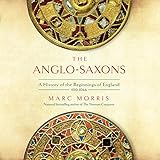
- Audible Audiobook
- Marc Morris (Author) - Roy McMillan (Narrator)
- English (Publication Language)
- 05/25/2021 (Publication Date) - Brilliance Audio (Publisher)
Common Myths
- Myth: The Anglo-Saxon period was a static, unchanging era of isolated kingdoms.
- Why it Matters: This overlooks the dynamic nature of political alliances, constant warfare, and significant cultural exchanges, particularly with Scandinavia and continental Europe.
- Fix: Focus on Morris’s detailed accounts of shifting borders, evolving legal systems, and the impact of external forces like Viking raids.
- Myth: Anglo-Saxon society was purely agrarian and lacked sophisticated political organization.
- Why it Matters: This understates the development of early urban centers, complex legal codes (e.g., the laws of Æthelberht), and sophisticated administrative structures, particularly under rulers like Alfred.
- Fix: Look for Morris’s descriptions of royal administration, coinage, and the establishment of fortified settlements (burhs).
Expert Tips
- Tip: Focus on the author’s emphasis on political and military history to avoid disappointment.
- Actionable Step: Before reading, acknowledge that The Anglo Saxons by Marc Morris prioritizes the “great men” and their struggles for power.
- Common Mistake to Avoid: Expecting a detailed exploration of everyday peasant life or intricate social stratification; these are secondary to the political narrative.
- Tip: Use the maps and timelines provided to orient yourself within the complex geography and chronology.
- Actionable Step: Refer to the maps frequently to visualize the shifting territories of the Anglo-Saxon kingdoms and Viking settlements.
- Common Mistake to Avoid: Trying to memorize all the place names and dates without visual aids, leading to confusion about geographical relationships.
- Tip: Be prepared for a narrative that champions strong leadership.
- Actionable Step: Note how Morris frames the successes of figures like Alfred the Great, often attributing significant societal advancements to their personal agency.
- Common Mistake to Avoid: Critically questioning the extent to which individual agency drove historical change versus broader societal or economic forces, as Morris’s narrative leans towards the former.
The Anglo Saxons by Marc Morris: A Reader’s Perspective
Marc Morris’s The Anglo Saxons positions itself as a comprehensive narrative of England’s formative centuries, charting a course from the twilight of Roman rule to the seismic shift of the Norman Conquest. The book’s strength lies in its lucid prose and its dedication to presenting a coherent, chronological account of political and military developments. Morris excels at weaving together the often-fragmented evidence to create a compelling story of kings, battles, and the slow, arduous construction of a kingdom.
However, this narrative focus inherently shapes the reader’s experience. Those seeking deep dives into the minutiae of social history, economic structures, or the daily lives of ordinary people may find these aspects less developed. Morris’s approach is akin to a grand tapestry where the prominent figures and pivotal events are rendered in sharp detail, while the background textures are suggested rather than fully explored. This is not a flaw, but a deliberate choice that defines the book’s character and its intended audience.
Strengths and Limitations
The book’s primary strength is its accessibility. Morris manages to make complex political maneuvers and military campaigns understandable without sacrificing historical rigor. For instance, his depiction of Alfred the Great’s strategic genius in defending Wessex against Viking incursions provides a clear, engaging example of effective leadership in crisis.
Conversely, a limitation arises from this very focus. The emphasis on political and military history can sometimes overshadow other crucial aspects of the period. For readers who might be drawn to the cultural synthesis of the era, the influence of Christianity on societal norms, or the evolution of language and art, The Anglo Saxons offers less granular detail. The narrative, while gripping, tends to follow the trajectory of power, meaning that periods of relative peace or cultural flourishing might receive less narrative weight if they don’t directly impact the political landscape.
Reading Context and Audience Fit
The Anglo Saxons by Marc Morris is an excellent entry point for those new to the period or for readers who appreciate a traditional, story-driven historical account. It functions effectively as a foundational text, providing a solid chronological framework upon which more specialized knowledge can be built.
Readers who prefer thematic explorations, detailed social histories, or works that explicitly engage with historiographical debates might find this book less satisfying. For example, if one is particularly interested in the archaeological evidence for Anglo-Saxon settlement patterns or the nuances of Old English literature, other specialized works would be more appropriate. This book matters now as a clear, authoritative synthesis that makes a complex period of English history accessible to a broad readership, reinforcing the traditional narrative of state formation.
BLOCKQUOTE_0
Quick Comparison
| Option | Best for | Pros | Watch out |
|---|---|---|---|
| Quick Answer | General use | The Anglo Saxons by Marc Morris offers a comprehensive, narrative-driven ac… | Mistake: Skimming the early sections, assuming prior knowledge of Roman Brita… |
| Who This Is For | General use | It is best suited for readers seeking a detailed, chronological overview of t… | Mistake: Losing track of which kingdom is dominant and the key figures within… |
| What to Check First | General use | Readers should approach the book with an understanding that Morris prioritize… | Mistake: Underestimating the constant threat of external invasion and interna… |
| Step-by-Step Plan Engaging with The Anglo Saxons by Marc Morris | General use | Readers interested in a robust, traditional historical narrative of the Anglo… | Mistake: Assuming a balanced representation of all societal strata, as Morris… |
Decision Rules
- If reliability is your top priority for The Anglo Saxons by Marc Morris, choose the option with the strongest long-term track record and support.
- If value matters most, compare total ownership cost instead of headline price alone.
- If your use case is specific, prioritize fit-for-purpose features over generic ‘best overall’ claims.
FAQ
- Q: Does the book cover the Norman Conquest in detail?
- A: Yes, the book concludes with a thorough examination of the Norman Conquest, detailing its causes, key events like the Battle of Hastings, and its immediate impact on England.
- Q: Is The Anglo Saxons suitable for academic study?
- A: While excellent for general readers and as an introduction, academic specialists might find its focus on narrative and political history less suited for in-depth theoretical analysis compared to more specialized scholarly works.
- Q: How does Morris’s work compare to other histories of the Anglo-Saxons?
- A: Morris’s book is generally praised for its narrative clarity and comprehensive scope, often serving as a more accessible alternative to denser academic tomes. It prioritizes a chronological, political history over thematic or social deep dives.