M. Scott Peck’s The Road Less Traveled
Quick Answer
- The Road Less Traveled by M. Scott Peck is a philosophical exploration of personal growth through confronting life’s difficulties and embracing discipline.
- It argues that true growth and fulfillment stem from choosing the harder, more introspective path over immediate gratification.
- This book is best suited for readers prepared for deep self-reflection and a nuanced understanding of psychological and spiritual development.
Who This Is For
- Individuals seeking a profound, introspective guide to personal development that emphasizes responsibility and conscious effort.
- Readers interested in the intersection of psychology, spirituality, and philosophy as applied to everyday life challenges.
What to Check First
- Peck’s Central Thesis: Understand that the book posits life is inherently difficult and that growth comes from facing these difficulties.
- The Four Tools of Discipline: Familiarize yourself with Peck’s framework: delaying gratification, accepting responsibility, dedicating yourself to truth, and balancing.
- Definition of Love: Note Peck’s distinction between “falling in love” and true love as an act of will and commitment.
- Spiritual Integration: Be prepared for the book’s integration of spiritual concepts, which Peck views as inseparable from psychological health.
Step-by-Step Plan: Navigating The Road Less Traveled by M. Scott Peck
Engaging with The Road Less Traveled by M. Scott Peck requires a deliberate approach to absorb its complex ideas.
For those seeking a profound guide to personal growth, M. Scott Peck’s ‘The Road Less Traveled’ offers a timeless exploration of confronting life’s difficulties. It’s a foundational text for anyone ready for deep self-reflection.
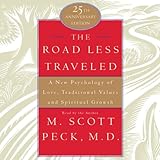
- Audible Audiobook
- M. Scott Peck (Author) - M. Scott Peck (Narrator)
- English (Publication Language)
- 10/25/2002 (Publication Date) - Simon & Schuster Audio (Publisher)
1. Understand the Premise of Life’s Difficulty:
- Action: Read the initial chapters carefully, focusing on Peck’s assertion that “Life is difficult.”
- What to look for: Peck’s explanation that problems are inherent to existence and that avoiding them leads to stagnation, while confronting them fosters growth.
- Mistake to avoid: Interpreting this as a pessimistic outlook; Peck frames difficulty as the essential catalyst for development.
2. Internalize the Tools of Discipline:
- Action: Dedicate time to understanding each of the four tools: delaying gratification, acceptance of responsibility, dedication to truth, and balancing.
- What to look for: How Peck defines each tool and provides examples of their application in overcoming life’s challenges. For instance, delaying gratification is not just about waiting, but about choosing a greater future reward over immediate pleasure.
- Mistake to avoid: Treating these tools as separate, isolated techniques; they are interconnected and work synergistically.
3. Deconstruct Peck’s Concept of Love:
- Action: Analyze Peck’s differentiation between romantic infatuation and true love.
- What to look for: Peck’s view of love as an active, conscious decision to extend oneself for the growth of another, requiring effort and commitment.
- Mistake to avoid: Equating Peck’s “love” with passive affection or dependency; it is an active, volitional process.
4. Explore the Nature of Dependency and Autonomy:
- Action: Examine Peck’s discussion on the psychological journey from dependency to independence and interdependence.
- What to look for: The stages of developing a healthy sense of self and the capacity for genuine connection without losing individual identity.
- Mistake to avoid: Confusing independence with isolation, or interdependence with a loss of personal agency.
5. Engage with the Spiritual Dimension:
- Action: Consider Peck’s perspective on spirituality and its role in psychological well-being.
- What to look for: Peck’s broad definition of God and the unconscious, and how he integrates spiritual seeking with personal growth.
- Mistake to avoid: Dismissing the spiritual aspects if they don’t align with personal beliefs; Peck argues they are integral to a complete understanding of the self.
6. Practice the Dedication to Truth:
- Action: Apply the principle of dedication to truth to your own life by honestly assessing situations and your role in them.
- What to look for: How self-deception hinders growth and how confronting uncomfortable truths, however difficult, is essential for progress.
- Mistake to avoid: Engaging in selective honesty or rationalizing away inconvenient facts to maintain a comfortable narrative.
The Road Less Traveled by M. Scott Peck: A Contrarian Viewpoint
While The Road Less Traveled by M. Scott Peck is celebrated for its profound insights, a contrarian perspective reveals potential limitations for certain readers. Peck’s emphasis on the “difficulty” of life and the necessity of embracing suffering as a catalyst for growth, while ultimately constructive, can be initially off-putting or even overwhelming for those seeking immediate solace or practical, straightforward solutions. The book demands significant introspection and a willingness to confront uncomfortable aspects of oneself, which may not be the desired approach for everyone.
A key decision criterion for adopting Peck’s philosophy revolves around the reader’s tolerance for abstract thought and philosophical inquiry versus a need for concrete, actionable steps. Peck’s framework is more akin to a philosophical map than a step-by-step instruction manual. For readers who prefer clear, linear guidance, the book’s density and the gradual unfolding of its principles might feel slow or less impactful. The “road less traveled” is indeed challenging, and its rewards are often delayed, requiring sustained effort and a deep commitment to the process.
Furthermore, Peck’s integration of spiritual concepts, while central to his thesis on wholeness, can be a point of divergence. His definition of God is expansive, but the underlying spiritual framework may not resonate with a strictly secular audience, potentially limiting the book’s universal appeal for those who prefer a purely psychological or secular self-help approach.
Decision Criterion: Tolerance for Abstract Philosophy vs. Concrete Action
- High Tolerance for Abstract Philosophy: If you are comfortable wrestling with complex ideas, enjoy deep introspection, and appreciate philosophical arguments that require time to integrate, Peck’s work will likely be highly rewarding. The value is in the exploration and gradual understanding.
- Preference for Concrete Action: If you primarily seek straightforward, step-by-step instructions for immediate problem-solving and find abstract philosophical discourse less engaging, this book may present a significant challenge or feel less directly applicable to your immediate needs.
Common Myths Addressed
- Myth: “The Road Less Traveled” suggests that life should be unnecessarily difficult and painful.
- Correction: Peck argues that life is inherently difficult, and growth comes from facing these difficulties with discipline and awareness, not from seeking out hardship for its own sake. The difficulty is a given; the response is where growth lies.
- Evidence: Peck states, “Life is difficult. This is a great truth, one of the greatest truths.” He then proceeds to explain how embracing this truth and applying discipline allows one to navigate these difficulties constructively.
- Myth: Peck’s concept of “love” is outdated or overly romanticized.
- Correction: Peck defines love not as a passive emotion or infatuation, but as an active, volitional act of the will focused on another’s spiritual growth. This definition is grounded in psychological maturity and commitment, not fleeting feelings.
- Evidence: Peck distinguishes “falling in love” (a temporary, involuntary state) from “love” (a sustained, conscious choice and effort). He emphasizes that true love requires work and dedication.
Expert Tips for Applying Peck’s Principles
- Tip 1: Embrace the “Acceptance of Responsibility” Tool.
- Actionable Step: When faced with a problem, consciously identify what aspects are within your control and take ownership of your role, rather than blaming external factors or individuals.
- Common Mistake to Avoid: Falling into victimhood or making excuses, which prevents you from leveraging this tool for growth.
- Tip 2: Practice the “Dedication to Truth” Consistently.
- Actionable Step: Regularly engage in honest self-assessment. Ask yourself, “What is the truth of this situation, even if it’s uncomfortable?” and apply this to your relationships and decisions.
- Common Mistake to Avoid: Engaging in self-deception or rationalization to avoid facing difficult realities about yourself or your circumstances.
- Tip 3: Understand “Balancing” as a Dynamic Process.
- Actionable Step: Recognize that balancing—between competing needs, desires, or responsibilities—is not about achieving a static equilibrium but a continuous, conscious adjustment.
- Common Mistake to Avoid: Striving for perfect, unchanging balance, which is unattainable and can lead to frustration. Instead, focus on making informed, adaptive choices.
Decision Rules
- If reliability is your top priority for The Road Less Traveled by M. Scott Peck, choose the option with the strongest long-term track record and support.
- If value matters most, compare total ownership cost instead of headline price alone.
- If your use case is specific, prioritize fit-for-purpose features over generic ‘best overall’ claims.
FAQ
- Q: What is the primary message of “The Road Less Traveled by M. Scott Peck”?
- A: The core message is that genuine personal growth and a meaningful life are achieved by consciously confronting life’s inherent difficulties and responsibilities through discipline, rather than seeking to avoid them.
- Q: How does Peck define “discipline” in the context of the book?
- A: Peck defines discipline not as punitive measures, but as a set of essential tools for navigating life: delaying gratification, accepting responsibility, dedicating oneself to truth, and balancing. These are active processes that facilitate problem-solving and growth.
- Q: Is “The Road Less Traveled” a strictly psychological or spiritual book?
- A: It is a blend of both. Peck, a psychiatrist, integrates psychological principles with spiritual exploration, viewing spiritual growth as an essential component of psychological maturity and a complete life.
- Q: Who would find “The Road Less Traveled” most beneficial?
- A: Individuals who are ready for deep introspection, willing to take responsibility for their lives, and open to exploring the philosophical and spiritual dimensions of personal growth will benefit most.
- Q: What are the potential drawbacks of reading this book?
- A: Its philosophical depth and abstract nature may be challenging for readers seeking quick, practical advice. Those who are averse to discussions of spirituality or who prefer a purely secular approach might also find it less accessible.
BLOCKQUOTE_0
| Concept | Peck’s Core Idea | Practical Application | Potential Misinterpretation |
|---|---|---|---|
| <strong>Life’s Difficulty</strong> | Life inherently presents challenges; facing them is the path to growth. | Acknowledge problems as natural, not personal failings, and engage with them actively. | Viewing difficulty as a negative state to be avoided rather than a catalyst for development. |
| <strong>Discipline Tools</strong> | Delaying gratification, accepting responsibility, dedication to truth, balancing. | Consciously apply these tools to manage impulses, own actions, seek honesty, and make informed decisions. | Treating tools as rigid rules rather than flexible strategies for navigating life’s complexity. |
| <strong>Nature of Love</strong> | Love is a volitional act of the will focused on another’s spiritual growth, requiring commitment and effort. | Invest time and energy in nurturing relationships, supporting growth, and making conscious commitments to loved ones. | Mistaking infatuation, dependency, or possessiveness for genuine, mature love. |
| <strong>Spiritual Growth</strong> | An integral part of psychological health and a complete life, involving a connection to something larger. | Engage in introspection, seek meaning, and cultivate a sense of purpose beyond immediate personal needs. | Dismissing spiritual aspects as irrelevant or confusing, thus missing a key dimension. |
| <strong>Dedication to Truth</strong> | Commitment to facing reality, including one’s own flaws, without self-deception. | Practice honest self-assessment and be open to uncomfortable truths about oneself and one’s situation. | Engaging in selective honesty or rationalizing inconvenient facts to maintain comfort. |