Keynes’s Economic Consequences of the Peace: A Critical Review
The Economic Consequences of the Peace by John Maynard Keynes: Quick Answer
- The Economic Consequences of the Peace by John Maynard Keynes is a foundational text for understanding the economic fallout of the Treaty of Versailles.
- It offers a prescient critique of the reparations imposed on Germany and their potential to destabilize Europe.
- This book is essential for students of economics, history, and international relations, but requires careful consideration of its historical context and potential biases.
Who this is for
- Individuals studying the interwar period or the economic underpinnings of World War II.
- Readers interested in the early works of John Maynard Keynes and his impact on economic thought.
For those looking to delve into the foundational arguments of this seminal work, the book ‘Economic Consequences Peace John Maynard Keynes’ is an indispensable resource.
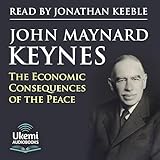
- Audible Audiobook
- John Maynard Keynes (Author) - Jonathan Keeble (Narrator)
- English (Publication Language)
- 09/11/2018 (Publication Date) - Ukemi Audiobooks from W. F. Howes Ltd (Publisher)
What to check first
Before diving into The Economic Consequences of the Peace by John Maynard Keynes, consider these points:
- Author’s Perspective: Keynes was present at the Paris Peace Conference, and his analysis is deeply informed by his direct experience and his role as an advisor. This perspective is both a strength and a potential limitation.
- Historical Context: The book was written in 1919, immediately following the treaty’s signing. Its arguments are rooted in the immediate aftermath and the prevailing economic conditions of that time.
- Key Arguments: Familiarize yourself with Keynes’s central thesis: that the punitive reparations demanded of Germany were economically unsustainable and politically dangerous, sowing the seeds for future conflict.
- Target Audience of the Original: Keynes wrote this work to influence public and political opinion at the time. Understanding this original intent can illuminate its rhetorical strategies.
Step-by-step plan
To effectively engage with The Economic Consequences of the Peace by John Maynard Keynes, follow these steps:
1. Read with Contextual Awareness: Begin by reading the introduction and any scholarly notes provided in your edition.
- What to look for: Information about Keynes’s role at the conference, the political climate of 1919, and the reception of the book.
- Mistake: Assuming the book is a neutral, objective historical account without considering the author’s immediate involvement and advocacy.
2. Identify Core Economic Arguments: Focus on Keynes’s critiques of the reparations clauses, the territorial divisions, and the proposed economic restructuring of Europe.
- What to look for: Specific figures on reparations, analyses of Germany’s capacity to pay, and predictions of economic instability.
- Mistake: Skimming over the detailed economic calculations, thereby missing the foundation of Keynes’s dire warnings.
3. Analyze Rhetorical Strategies: Pay attention to Keynes’s powerful prose and his use of vivid descriptions and strong pronouncements.
- What to look for: Instances where emotional appeals or striking imagery are used to support economic arguments.
- Mistake: Being swayed solely by the persuasive language without critically evaluating the underlying economic logic.
4. Compare with Historical Outcomes: After reading Keynes’s predictions, consult secondary historical sources to see how events unfolded in the years following the treaty.
- What to look for: Evidence supporting or refuting Keynes’s predictions about economic collapse and political unrest in Germany and Europe.
- Mistake: Accepting Keynes’s predictions as absolute prophecy without acknowledging the multitude of other factors that shaped the interwar period.
5. Consider Counterarguments and Revisions: Seek out scholarly analyses that critique Keynes’s work or offer alternative interpretations of the treaty’s economic impact.
- What to look for: Historians’ debates on the feasibility of reparations, the role of Allied economic policies, and Germany’s internal economic decisions.
- Mistake: Treating Keynes’s analysis as the final word on the subject, ignoring subsequent scholarly discourse and revised historical understanding.
6. Evaluate its Enduring Relevance: Reflect on which of Keynes’s arguments or insights remain pertinent to contemporary discussions of international economics, post-conflict reconstruction, and global financial stability.
- What to look for: Parallels between the post-WWI economic landscape and current global challenges.
- Mistake: Dismissing the book as purely historical without considering its potential lessons for present-day policy.
The Economic Consequences of the Peace by John Maynard Keynes: A Deeper Dive
This section offers a more granular examination of the book’s strengths and limitations, providing a framework for critical assessment.
Strengths
- Prescient Warnings: Keynes accurately foresaw many of the economic dislocations and political resentments that arose from the harsh terms of the Treaty of Versailles. His critique of the reparations burden proved remarkably prescient regarding Germany’s economic struggles and the rise of extremist movements.
- Powerful Economic Analysis: The book provides a detailed, albeit partisan, analysis of Germany’s economic capacity and the disruptive effects of the imposed reparations. Keynes’s ability to connect economic policy to political stability was groundbreaking for its time. For example, his calculations regarding Germany’s ability to pay reparations, outlined in Chapter VI, remain a focal point of historical debate.
- Literary Merit and Influence: Keynes was a gifted writer, and his impassioned prose made his economic arguments accessible and influential. The book played a significant role in shaping public opinion and subsequent historical narratives about the treaty’s failures.
Limitations
- Bias and Partisanship: As a direct participant and critic, Keynes’s work is inherently biased. His focus is on demonstrating the folly of the Allied demands, sometimes at the expense of a balanced consideration of other factors or perspectives.
- Limited Scope: The book primarily focuses on the economic consequences for Germany and Europe. It gives less attention to the broader geopolitical complexities or the internal political dynamics within Allied nations that influenced the treaty’s terms.
- Historical Context Dependence: While its historical insights are valuable, some of its specific economic models and assumptions are products of their time and may not directly translate to modern economic theory without adaptation.
Comparison Framework
When evaluating The Economic Consequences of the Peace by John Maynard Keynes, consider these comparative elements:
| Feature | The Economic Consequences of the Peace (Keynes) | The End of Plenty (Post-WWII Analysis) | Treaty of Versailles: A Reassessment (Modern Scholarship) |
|---|---|---|---|
| Primary Focus | Economic impact of WWI reparations on Germany | Post-WWII economic recovery and Marshall Plan | Comprehensive historical and economic analysis of the treaty |
| Authorial Stance | Critical, advocacy-driven | Analytical, reconstructive | Objective, evidence-based, multi-perspective |
| Economic Models | 1919-era, focused on national capacity | Post-war reconstruction, global trade | Contemporary economic theory, international finance |
| Key Takeaway | Punitive peace leads to instability | Aid and cooperation foster recovery | Complex interplay of factors shaped outcomes |
| Influence | Shaped early 20th-century economic thought | Informed post-war reconstruction efforts | Contributes to ongoing historical debate |
Common Mistakes
- Mistake: Treating Keynes’s predictions as absolute prophecies.
- Why it matters: Overstating the book’s predictive power can lead to a deterministic view of history, ignoring the agency of individuals and the influence of unforeseen events.
- Fix: Read the book as a powerful argument and a set of informed predictions, not as an unalterable blueprint of the future. Acknowledge the role of other historical forces.
- Mistake: Overlooking the book’s rhetorical power.
- Why it matters: Keynes’s eloquent prose can obscure the nuances of his economic arguments or lead readers to accept his conclusions without sufficient critical examination.
- Fix: Actively question the persuasive language. Ask: “Is this assertion supported by solid economic reasoning, or is it primarily an appeal to emotion or indignation?”
- Mistake: Ignoring subsequent historical scholarship.
- Why it matters: History is an ongoing conversation. Newer research may offer different interpretations or highlight aspects of the Treaty of Versailles that Keynes did not emphasize or fully grasp.
- Fix: Supplement your reading of Keynes with contemporary historical analyses and economic studies of the interwar period. For instance, consult works that delve into the internal economic policies of Weimar Germany.
Decision Rules
- If reliability is your top priority for The Economic Consequences of the Peace by John Maynard Keynes, choose the option with the strongest long-term track record and support.
- If value matters most, compare total ownership cost instead of headline price alone.
- If your use case is specific, prioritize fit-for-purpose features over generic ‘best overall’ claims.
FAQ
- Q: Is The Economic Consequences of the Peace by John Maynard Keynes still relevant today?
- A: Yes, its insights into the potential dangers of punitive economic measures in international relations and the interconnectedness of economic stability and political peace remain highly relevant.
- Q: Was Keynes correct about the Treaty of Versailles causing World War II?
- A: While Keynes powerfully argued that the treaty laid the groundwork for future conflict, most historians view World War II as the result of a complex interplay of factors, including the treaty’s economic terms, the rise of fascism, appeasement, and other geopolitical issues. His work is a crucial piece of that puzzle.
- Q: Where should I start if I want to read more about Keynes’s economic theories?
- A: After The Economic Consequences of the Peace by John Maynard Keynes, a logical next step for understanding his broader economic thought would be The General Theory of Employment, Interest and Money. However, for a review of his earlier work, consider a John Maynard Keynes’s ‘The Economic Consequences of the Peace’: A Review.