Gothic Horror in Edgar Allan Poe’s Fall of the House of Usher
Edgar Allan Poe’s “The Fall of the House of Usher” is a cornerstone of gothic literature, celebrated for its suffocating atmosphere and profound exploration of psychological decay. This analysis delves into Poe’s masterful construction of dread, examining the symbiotic relationship between the decaying setting, its tormented inhabitants, and the unraveling human psyche. It aims to illuminate the story’s gothic mechanics and offer a critical perspective on common reader interpretations, highlighting a frequent failure mode in appreciating its full impact.
The Fall of the House of Usher by Edgar Allan Poe: Quick Answer
- “The Fall of the House of Usher by Edgar Allan Poe” masterfully intertwines physical decay with psychological disintegration, creating a potent and enduring gothic horror experience.
- This story is essential for readers interested in the foundational techniques of gothic literature, particularly atmosphere, unreliable narration, and the psychological underpinnings of terror.
- A common failure mode readers encounter is assuming the narrator is a purely objective observer, overlooking his own susceptibility to the house’s oppressive influence, which is critical to understanding the story’s psychological depth.
Who This Is For
- Readers seeking to understand the core elements of gothic literature as exemplified in a seminal short story.
- Individuals interested in literary analysis that explores the intricate connections between setting, character psychology, and narrative tone.
What to Check First
- The House as a Sentient Entity: Observe how Poe anthropomorphizes the physical structure, imbuing it with decay and a sense of malevolent awareness that mirrors the Usher family’s condition.
- Roderick Usher’s Afflictions: Examine Roderick’s unique maladies, noting his heightened senses, profound fear of fear, and his conviction that inanimate objects possess life.
- The Narrator’s Psychological Journey: Track the narrator’s evolution from detached observer to an individual increasingly affected by the oppressive atmosphere and mounting dread.
- Symbolism of the Tarn: Consider the dark, stagnant body of water reflecting the house, symbolizing the Usher lineage’s stagnation and inevitable decline.
- Thematic Resonance of Heredity: Note Poe’s emphasis on the Usher family’s long lineage and peculiar traits as a contributing factor to their current state of decay and madness.
Step-by-Step Plan to Understand Gothic Horror in “The Fall of the House of Usher”
1. Establish the Oppressive Atmosphere:
- Action: Read the story’s opening descriptions of the landscape and the house meticulously.
- What to Look For: Identify adjectives and phrases that evoke gloom, desolation, and decay (e.g., “dreary tract,” “melancholy,” “ghastly,” “oppressive”).
- Mistake: Treating the setting as mere background; Poe imbues the environment with palpable malevolence that actively shapes the horror.
2. Analyze Roderick Usher’s Deterioration:
- Action: Focus on Roderick’s self-diagnosis and his interactions with the narrator.
- What to Look For: His “morbid acuteness of the senses,” “nervous agitation,” and his belief in the sentience of his surroundings.
- Mistake: Attempting to apply modern clinical diagnoses without acknowledging the exaggerated, symbolic nature of gothic characterization.
3. Deconstruct the Narrator’s Reliability:
- Action: Chart the narrator’s emotional state and his interpretations of events throughout the story.
- What to Look For: His initial rationalizations, growing fear, and moments where his perceptions are clearly influenced by the house’s atmosphere.
- Mistake: Assuming the narrator is an objective, detached observer; his own psychological state is compromised, making him a flawed witness.
4. Examine the Premature Burial of Madeline:
- Action: Scrutinize the circumstances surrounding Madeline Usher’s apparent death and entombment.
- What to Look For: The haste of the burial, the narrator’s acquiescence, and Roderick’s specific fears regarding his sister.
- Mistake: Accepting the explanation of Madeline’s death as a simple biological event, ignoring the gothic trope of premature burial and its psychological terror.
5. Assess the House’s Sentience:
- Action: Identify passages where the house is described as if it possesses life or consciousness.
- What to Look For: Descriptions of the “minute fungi,” the “rank sedge,” and the overall “air” of the place.
- Mistake: Dismissing these descriptions as purely poetic; they are integral to the house functioning as a character and a source of dread.
6. Analyze the Climax and Collapse:
- Action: Read the final scenes detailing Madeline’s return and the house’s physical disintegration.
- What to Look For: The direct correlation between Madeline’s reappearance, Roderick’s death, and the house’s structural failure.
- Mistake: Viewing the house’s collapse as a purely physical event; it is the symbolic end of the Usher line, triggered by the culmination of their internal and external decay.
7. Consider the Theme of Inherited Degeneration:
- Action: Reflect on the Usher family’s history and the narrator’s observations about their lineage.
- What to Look For: Mentions of the family’s “long race,” their “singular intensity of character,” and their susceptibility to mental and physical ailments.
- Mistake: Focusing solely on Roderick’s individual illness; the story suggests a deep-seated, generational curse or weakness.
For those looking to dive into Poe’s classic, the story ‘The Fall of the House of Usher by Edgar Allan Poe’ is a must-read. It masterfully blends physical decay with psychological disintegration, creating a potent gothic horror experience.
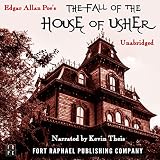
- Audible Audiobook
- Edgar Allan Poe (Author) - Kevin Theis (Narrator)
- English (Publication Language)
- 09/04/2018 (Publication Date) - Fort Raphael Publishing Company (Publisher)
Common Mistakes
- Over-reliance on Literal Interpretation:
- Why it Matters: Gothic horror thrives on suggestion, atmosphere, and psychological nuance. Taking every element literally strips away the intended dread and nuanced terror.
- Fix: Focus on the emotional impact of descriptions and events, considering how they contribute to a sense of unease rather than seeking concrete, factual explanations for supernatural occurrences.
- Ignoring the House as a Character:
- Why it Matters: The House of Usher is not merely a setting; Poe imbues it with agency and personality, making it a direct reflection and amplifier of the Usher family’s decay.
- Fix: Actively look for anthropomorphic descriptions of the house and consider its physical state as a direct manifestation of the family’s internal corruption.
- Treating the Narrator as Unimpeachable:
- Why it Matters: The narrator’s descent into fear and his compromised perception are central to the story’s psychological horror. His unreliability is a deliberate narrative choice.
- Fix: Pay close attention to the narrator’s internal monologue and emotional shifts, noting where his rationality falters and his fear takes over.
- Separating Physical and Psychological Decay:
- Why it Matters: Poe intricately weaves together the physical deterioration of the house and its inhabitants with their mental and emotional unraveling.
- Fix: Analyze how descriptions of the crumbling mansion, the suffocating atmosphere, and Roderick’s symptoms reinforce each other to create a holistic sense of doom.
The Fall of the House of Usher by Edgar Allan Poe: Failure Mode Analysis
A significant failure mode when engaging with “The Fall of the House of Usher by Edgar Allan Poe” is the assumption that the narrator is a purely objective, detached observer. This perspective overlooks Poe’s deliberate construction of the narrator’s own psychological susceptibility, which is crucial to the story’s gothic impact.
The narrator arrives at the Usher mansion with the stated intention of alleviating Roderick’s “nervous agitation.” Initially, he attempts to rationalize the strange occurrences and Roderick’s extreme condition, attributing them to the “peculiar constitution” of his friend. However, as the narrative progresses, the oppressive atmosphere of the house and the escalating horror begin to infect the narrator’s own psyche. He experiences increasing dread, sleeplessness, and a growing sense of being overwhelmed.
BLOCKQUOTE_0
This realization, articulated by the narrator himself, is key. He is not merely documenting events; he is actively being consumed by the same forces that are destroying Roderick and the house. His eventual panicked flight is not a sign of rational detachment but a symptom of his own compromised mental state. Recognizing this vulnerability in the narrator is essential to understanding how Poe masterfully draws the reader into the story’s psychological abyss, making the horror feel immediate and personal.
Expert Tips for Analyzing Poe’s Gothic Masterpiece
- Tip 1: Map the Interdependence of House and Inhabitant.
- Action: Create a visual representation (a list or simple diagram) that links specific descriptions of the physical house (e.g., the fissure, the tarn’s darkness) to Roderick’s symptoms or the overall mood.
- Mistake to Avoid: Treating the house and its inhabitants as separate entities; their fates and conditions are inextricably bound.
- Tip 2: Track the Narrator’s Shifting Emotional State.
- Action: Highlight or make notes on passages where the narrator’s tone or internal thoughts reveal a transition from analytical observation to overt fear or a sense of foreboding.
- Mistake to Avoid: Assuming the narrator maintains a consistent, objective viewpoint throughout the narrative.
- Tip 3: Identify Ambiguity as a Narrative Device.
- Action: Pinpoint moments where Poe intentionally leaves the cause of an event unclear, such as the true nature of Madeline’s “death” or the extent of the house’s sentience.
- Mistake to Avoid: Demanding definitive, rational explanations for every element; the power of gothic horror often lies in the suggestion of the uncanny and the unknown.
Key Gothic Elements in “The Fall of the House of Usher”
Edgar Allan Poe’s “The Fall of the House of Usher” is a quintessential example of gothic horror, achieving its terror not through overt supernatural monsters but through the insidious erosion of sanity and the palpable presence of decay. The narrative meticulously constructs an atmosphere where the external environment mirrors and amplifies internal turmoil, a defining characteristic of the genre.
The story’s effectiveness stems from its deep dive into psychological dread. Roderick Usher’s “morbid acuteness of the senses” and his pervasive fear—a fear of fear itself—are not mere eccentricities but manifestations of a profound, inherited malady that Poe uses to explore the fragility of the human mind under extreme pressure. This internal disintegration is intrinsically linked to the physical decay of his ancestral home.
| Gothic Element | Description in “Usher” | Reader Takeaway |
|---|---|---|
| <strong>Atmosphere of Decay</strong> | Described through the “melancholy house,” “barely perceptible fissure,” and the “sickly and dark” tarn. | The setting actively contributes to the sense of dread and foreshadows inevitable ruin. |
| <strong>Psychological Horror</strong> | Roderick’s hypersensitivity, paranoia, and the narrator’s own growing unease. | The horror originates from within the characters’ minds, amplified by their surroundings. |
| <strong>The Haunted Place</strong> | The House of Usher is presented as sentient, reflecting the Usher family’s decline and history of suffering. | The house is more than a setting; it is a character embodying the family’s curse and impending doom. |
| <strong>Supernatural Implication</strong> | Madeline’s return from the tomb and the house’s collapse suggest forces beyond natural explanation. | Ambiguity between the supernatural and extreme psychological breakdown creates deeper unease. |
| <strong>Inherited Curse</strong> | The Usher family’s long history and “singular intensity of character” suggest a genetic predisposition to madness. | The horror is not isolated to one individual but is a generational burden passed down. |
BLOCKQUOTE_1
This opening passage immediately establishes the oppressive, gothic tone. The “dull, dark, and soundless day” and the “oppressively low” clouds are not mere weather; they are extensions of the psychological state that pervades the story. The house itself is introduced with the adjective “melancholy,” personifying it and setting the stage for its role as a character deeply intertwined with the Usher lineage’s fate.
The narrative’s strength lies in its sustained focus on this interconnectedness. The narrator’s initial attempt to distance himself from the Usher family’s plight—he is an outsider, a childhood friend—gradually dissolves as the pervasive gloom and Roderick’s unraveling infect his own perceptions. This gradual immersion of the narrator into the horror is a key technique Poe employs to draw the reader deeper into the story’s psychological abyss.
Decision Rules
- If reliability is your top priority for understanding “The Fall of the House of Usher by Edgar Allan Poe,” focus on Poe’s consistent use of literary devices to create atmosphere and psychological tension.
- If value matters most, consider the story’s enduring influence on gothic literature and its accessibility as a foundational text for literary analysis.
- If your use case is specific, prioritize analyzing how Poe uses setting and character psychology to create a unique and disturbing narrative, rather than seeking straightforward plot resolutions.
FAQ
- Q: Is “The Fall of the House of Usher” considered a supernatural story?
- A: Poe deliberately blurs the lines. While supernatural elements are implied (e.g., the house’s sentience, Madeline’s return), the story also strongly suggests that extreme psychological states and inherited predispositions can manifest in ways that appear supernatural. The horror lies in this ambiguity.
- Q: What is the significance of the tarn in the story?
- A: The dark, still body of water reflects the house and its inhabitants. Its stagnant nature symbolizes the Usher family’s arrested development and the pervasive sense of decay and death that surrounds them.
- Q: How does Poe build suspense in “The Fall of the House of Usher”?
- A