George Bernard Shaw’s ‘Man And Superman’ Themes
Man And Superman by George Bernard Shaw: Quick Answer
- Central Conflict: The play dramatizes the “battle of the sexes,” driven by Shaw’s concept of the Life Force, an evolutionary impulse that compels procreation and societal advancement, primarily through female initiative.
- Philosophical Critique: It serves as a platform for Shaw’s dissection of romantic love, marriage, and societal hypocrisy, contrasting these with primal biological drives and evolutionary imperatives.
- The “Superman” Ideal: The work explores Shaw’s vision of an evolved humanity, distinct from Nietzsche’s concept, emphasizing reason and the Life Force’s direction.
Who This Is For
- Readers interested in George Bernard Shaw’s intellectual dramas and their underlying social and philosophical critiques.
- Individuals seeking to analyze plays that challenge conventional understandings of gender roles, love, and morality.
What to Check First
- The Life Force: Understand Shaw’s concept of a primal, evolutionary drive that propels humanity toward higher states of being, often personified by his female characters.
- Shaw’s “Superman”: Recognize this as an evolutionary ideal focused on reason and the Life Force, not a literal or Nietzschean figure of individual dominance.
- Social Critique: Be aware that the play functions as a vehicle for Shaw’s pointed commentary on societal conventions, marriage, and the hypocrisy of his era.
- Play Structure: Note the unconventional structure, particularly Act III’s philosophical dialogue in the Sierra Nevada, which is crucial for articulating the play’s core themes.
Step-by-Step Plan: Analyzing Themes in Man And Superman by George Bernard Shaw
1. Identify the Female Predatory Drive: Observe how female characters actively pursue male partners, subverting traditional gender roles.
- What to look for: Ann Whitefield’s persistent and strategic pursuit of John Tanner throughout the play.
- Mistake to avoid: Interpreting Ann’s actions as conventional romantic courtship rather than a manifestation of the Life Force’s imperative for procreation and evolutionary progress.
2. Examine the Critique of Romantic Love: Analyze Shaw’s satire of idealized romantic notions and his contrast with pragmatic, instinctual drives.
- What to look for: John Tanner’s intellectual arguments against the illusions of love and marriage, highlighting their artificiality.
- Mistake to avoid: Accepting romantic dialogue at face value without recognizing Shaw’s ironic intent and his underlying critique of societal expectations surrounding love.
3. Analyze the “Superman” Ideal: Assess how characters embody or resist Shaw’s concept of a higher, more evolved human being.
- What to look for: Tanner’s philosophical wrestling with his destiny and the contrasting perspective of the Devil in Act III.
- Mistake to avoid: Confusing Shaw’s “Superman” with Nietzsche’s concept or a literal superhero; it refers to an evolutionary stage of consciousness guided by reason and the Life Force.
4. Deconstruct Societal Hypocrisy: Pinpoint scenes and dialogue exposing the gap between stated ideals and actual behavior.
- What to look for: Characters’ discussions on morality and law in contrast to their underlying desires and actions.
- Mistake to avoid: Overlooking the satirical edge of Shaw’s dialogue, which often reveals the hypocrisy he aims to expose in conventional social norms.
5. Consider the Role of Pragmatism: Note how practical considerations and survival instincts often override sentimental or moralistic impulses.
- What to look for: Characters’ reactions to danger or significant life choices, such as Tanner’s flight from Ann’s pursuit.
- Mistake to avoid: Focusing solely on intellectual debates and ignoring the play’s grounding in basic human drives and the instinct for survival.
6. Evaluate the “Devil’s” Counterpoint: Recognize the significance of the Devil in Act III as a voice of traditional order and a foil to Shaw’s evolutionary ideas.
- What to look for: The Devil’s arguments defending established norms and critiquing the Life Force’s radical agenda.
- Mistake to avoid: Dismissing the Devil as a simple antagonist; he represents a valid philosophical counter-argument within Shaw’s dialectical framework.
For a concise overview of George Bernard Shaw’s thought-provoking play, ‘Man and Superman,’ this section provides a quick answer to its core themes and ideas.
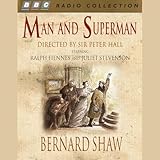
- Audible Audiobook
- Bernard Shaw (Author) - Full Cast, Judi Dench, Juliet Stevenson (Narrators)
- English (Publication Language)
- 09/06/2012 (Publication Date) - BBC Digital Audio (Publisher)
Common Mistakes
- Misinterpreting the “Superman”: Mistake — Believing Shaw’s “Superman” refers to a literal, physically superior being or a figure akin to Nietzsche’s Übermensch. — Why it matters — This leads to a misunderstanding of Shaw’s philosophical intent, which focuses on intellectual and evolutionary advancement driven by the Life Force, rather than brute force or individual will to power. — Fix — Understand Shaw’s Superman as a product of the Life Force, guided by reason and focused on the perpetuation and conscious evolution of humanity.
- Ignoring the Satire: Mistake — Taking romantic declarations or moral pronouncements at face value without considering Shaw’s satirical intent. — Why it matters — Shaw is a master satirist; failing to detect his irony means missing the core of his critique on societal conventions and human folly. — Fix — Read dialogue with a critical eye, looking for contradictions, exaggeration, and subtext that mocks conventional attitudes and pronouncements.
- Underestimating Female Agency: Mistake — Viewing Ann Whitefield as a damsel in distress or a passive romantic heroine. — Why it matters — Ann is the primary agent of the Life Force in the play, actively pursuing her goal with strategic intent, which subverts traditional gender roles and literary archetypes. — Fix — Recognize Ann’s active, strategic role as the driving force behind the play’s central conflict and her embodiment of evolutionary imperative.
- Dismissing Act III’s Philosophical Debate: Mistake — Considering the third act, set in the Sierra Nevada, as a gratuitous philosophical interlude disconnected from the plot. — Why it matters — This act is crucial for articulating Shaw’s core ideas about evolution, morality, and the nature of existence, directly informing the characters’ motivations and the play’s overall thematic structure. — Fix — Engage with the philosophical discussions in Act III as the thematic climax, providing the intellectual framework for the entire play’s dramatic tension.
Decision Rules
- If reliability is your top priority for understanding the themes of Man And Superman by George Bernard Shaw, focus on Shaw’s own essays and established critical analyses of his work.
- If value for time matters most, prioritize reading summaries of Act III before diving into the full text, as it contains the core philosophical arguments and the play’s thematic resolution.
- If your use case is specific to understanding gender dynamics, prioritize analyzing Ann Whitefield’s character arc and her strategic relationship with John Tanner.
FAQ
- Q1: What is the central conflict in Man And Superman by George Bernard Shaw?
A1: The central conflict is the “battle of the sexes,” driven by the Life Force’s imperative to propagate and evolve humanity. This often manifests as women actively pursuing men, challenging traditional romantic narratives and societal expectations.
- Q2: How does Shaw’s concept of the “Superman” differ from Nietzsche’s?
A2: Shaw’s “Superman” is less about individual will to power and more about a collective evolutionary drive guided by reason and the Life Force, aiming for a higher, more conscious state of being for humanity, not necessarily an isolated individual.
- Q3: Is Man And Superman a romantic comedy?
A3: While it contains elements of wit and sharp dialogue, it is not a traditional romantic comedy. Shaw uses the play to satirize romantic conventions and critique societal norms, focusing on philosophical and evolutionary themes rather than simple courtship.
- Q4: What is the significance of the Devil in Act III?
A4: The Devil acts as a foil to Shaw’s Life Force philosophy. He represents traditional order, established morality, and the status quo, providing a critical counterpoint to the more radical evolutionary ideas presented by other characters, particularly the Life Force itself.
- Q5: How does the play critique marriage?
A5: Shaw critiques marriage as a potentially stifling institution, often driven by economic or social expediency rather than genuine compatibility or the Life Force’s evolutionary goals. He suggests that societal pressures and romantic illusions lead to unhappy unions.
Key Thematic Elements
The Life Force and Evolutionary Imperative
Shaw’s most pervasive theme is the “Life Force,” an evolutionary drive that compels individuals, particularly women, to seek partners for the perpetuation and advancement of the species. This force operates on a primal, instinctual level, often overriding conventional morality and romantic sentiment. Ann Whitefield embodies this force, relentlessly pursuing John Tanner not out of romantic love as conventionally understood, but as a biological imperative to ensure the continuation of her lineage and the potential for a higher form of humanity. The play argues that this instinct is a more powerful and fundamental driver than societal laws or personal desires.
BLOCKQUOTE_0
This concept is central to understanding the characters’ motivations and the play’s dramatic tension. The struggle is not merely interpersonal but an elemental clash between individual will and the evolutionary mandate.
Critiques of Romantic Love and Marriage
Shaw uses the play to dismantle idealized notions of romantic love, portraying it as a dangerous illusion that distracts from the true biological imperatives. He satirizes the conventional courtship rituals and emotional displays, suggesting they are artificial constructs designed to mask the underlying pursuit of procreation and social advantage. Marriage, in Shaw’s view, is often a pragmatic arrangement or a consequence of societal pressure, rather than a union based on true compatibility or evolutionary purpose. John Tanner’s intellectual resistance to being “caught” by Ann highlights this critique, as he sees her pursuit as a trap set by societal and biological forces he philosophically opposes.
The Shaw “Superman”
The concept of the “Superman” in Man And Superman is distinct from Nietzsche’s, focusing less on individual will to power and more on a conscious, evolutionary leap for humanity. Shaw’s Superman is not necessarily a solitary figure but a product of the Life Force, guided by reason, and dedicated to the advancement of the human race. John Tanner, despite his philosophical objections and intellectual prowess, is presented as a potential candidate for this role, grappling with the destiny the Life Force seems to impose upon him. The play explores the idea that true progress lies not in maintaining the status quo but in evolving beyond current limitations.
A Contrarian Perspective on Man And Superman
While often lauded for its wit and philosophical depth, a contrarian view suggests that Shaw’s relentless pursuit of his thesis can lead to predictable character archetypes and a somewhat didactic tone. The very strength of the Life Force as a driving narrative element can render the human characters as mere pawns in its grand design, potentially diminishing their individual agency and emotional complexity.
Failure Mode: The Overbearing Thesis
Failure Mode: Readers can become so engrossed in identifying Shaw’s philosophical arguments that they miss the nuances of character interaction and the dramatic subtext. The play’s structure, particularly the extended philosophical debate in Act III, can feel detached from the characters’ immediate predicaments, leading to a sense that the ideas are being imposed rather than organically arising from the narrative.
Detection: A reader experiencing this failure mode might find themselves frequently pausing to look up Shaw’s philosophical concepts or feeling that the characters are speaking for Shaw rather than as individuals. They might also find the third act tedious or irrelevant to the “story.”
Mitigation: Approach the play with an awareness of Shaw’s didactic intent but prioritize observing the performance of these ideas through character dialogue and action. Consider the Devil’s arguments in Act III not just as a counterpoint to Shaw’s ideas, but as a valid perspective that highlights the potential costs of unchecked evolutionary drive. Recognize that even within Shaw’s framework, characters like Tanner exhibit genuine internal conflict and resistance, which adds dramatic weight beyond a simple affirmation of the Life Force.
Expert Tips for Engaging with Man And Superman
- Tip 1: Analyze the Devil’s Discourse.
- Actionable Step: Pay close attention to the Devil’s arguments in Act III. He represents a critical perspective on the Life Force and societal progress.
- Common Mistake to Avoid: Dismissing the Devil as a mere antagonist or a mouthpiece for outdated ideas. Shaw deliberately includes him to present a robust counter-argument, forcing the audience to consider the potential costs of radical evolution.
- Tip 2: Track the Subversion of Romantic Tropes.
- Actionable Step: Identify instances where traditional romantic comedy conventions are inverted. For example, note Ann’s active pursuit of Tanner, a reversal of the typical male protagonist’s role.
- Common Mistake to Avoid: Reading the dialogue for conventional romantic sentiment. Shaw’s wit often lies in his ironic subversion of these expectations, using romantic language to mask biological imperatives or social critiques.
- Tip 3: Distinguish Shaw’s “Superman” from other interpretations.
- Actionable Step: Focus on how Shaw’s “Superman” is linked to evolutionary progress and the Life Force, rather than solely on individual power or superiority.
- Common Mistake to Avoid: Equating Shaw’s concept directly with Nietzsche’s Übermensch or a literal, physically dominant figure. Shaw’s vision is more about conscious evolution and the collective advancement of humanity.
Comparative Table: Shaw’s Man And Superman Themes vs. Traditional Romances
| Feature | Man And Superman | Traditional Romance |
|---|---|---|
| Driving Force | The Life Force (evolutionary imperative) | Romantic Love (emotional connection, idealized attraction) |
| Female Role | Active pursuer, agent of the Life Force | Often passive, object of pursuit, seeking a partner |
| Marriage Concept | Pragmatic, potentially stifling, or tool for Life Force | Idealized union, culmination of romantic love |
| Conflict Source | Biological/evolutionary drives vs. societal convention/reason | Misunderstandings, external obstacles to union |
| Protagonist’s Goal | Fulfilling the Life Force’s evolutionary purpose | Achieving romantic fulfillment and a happy ending |
Quote
BLOCKQUOTE_1