Fara Dabhoiwala on What Is Free Speech?
Quick Answer
- “What Is Free Speech? by Fara Dabhoiwala” offers a historical and nuanced examination of free speech principles, tracing their evolution and challenging simplistic understandings.
- The book is essential for readers seeking to grasp the complexities and historical context behind contemporary debates on censorship and expression.
- It reveals that free speech is not a static concept but a contested and evolving idea, shaped by specific historical circumstances and power dynamics.
Who This Is For
- Readers interested in the intellectual history of free speech and its philosophical underpinnings.
- Individuals seeking to understand the historical context of current debates around censorship, hate speech, and online expression.
What to Check First
- The Historical Context: Dabhoiwala emphasizes that free speech has not always been universally valued and its definition has shifted significantly over time.
- The Role of Power: The book scrutinizes how power structures have influenced who gets to speak and whose speech is suppressed.
- Challenging Modern Assumptions: It prompts readers to question contemporary interpretations of free speech, often rooted in specific national or ideological frameworks.
- The Evolution of Censorship: Understand that methods of censorship have adapted from overt state control to more subtle forms, particularly in the digital age.
Step-by-Step Plan to Understanding Free Speech Through Dabhoiwala’s Lens
1. Engage with the Historical Roots: Begin by exploring the early conceptualizations of liberty and expression.
- Action: Read the introductory chapters detailing early thinkers and their views on speech.
- What to Look For: Evidence of how “freedom of speech” was initially conceived, often narrowly, and tied to specific social classes or political structures.
- Mistake to Avoid: Assuming that historical understandings of free speech directly map onto modern interpretations without acknowledging significant shifts.
2. Analyze the Impact of Print Culture: Understand how the printing press revolutionized the dissemination of ideas and, consequently, the challenges to authority.
- Action: Pay close attention to sections discussing the Renaissance and Reformation.
- What to Look For: How mass production of texts created new avenues for dissent and led to new forms of control.
- Mistake to Avoid: Underestimating the revolutionary impact of early mass media on the concept and practice of free speech.
3. Examine the Enlightenment and its Contradictions: Investigate how Enlightenment thinkers grappled with free speech, often within a framework of natural rights, yet sometimes excluding certain groups.
- Action: Focus on chapters covering the 18th century and key Enlightenment figures.
- What to Look For: The tension between universalist ideals of reason and the exclusionary practices of the era (e.g., regarding women, enslaved people).
- Mistake to Avoid: Accepting Enlightenment ideals at face value without recognizing their inherent limitations and the selective application of rights.
4. Trace the Rise of Liberalism and its Limits: Understand how liberal political thought shaped modern free speech doctrines, particularly in the West.
- Action: Review the sections on the development of liberal states and legal frameworks.
- What to Look For: The legal mechanisms and philosophical justifications that became central to free speech debates.
- Mistake to Avoid: Equating liberal free speech models with all historical or global conceptions of freedom of expression.
5. Confront the Challenges of the 20th and 21st Centuries: Explore how free speech has been tested by totalitarian regimes, ideological conflicts, and the digital revolution.
- Action: Read the later chapters addressing modern challenges.
- What to Look For: The emergence of new forms of censorship and the redefinition of speech boundaries in response to mass media and the internet.
- Mistake to Avoid: Believing that historical battles over free speech are entirely resolved or irrelevant to contemporary issues.
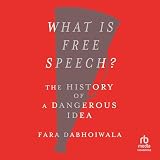
- Audible Audiobook
- Fara Dabhoiwala (Author) - Matthew Spencer (Narrator)
- English (Publication Language)
- 08/05/2025 (Publication Date) - Highbridge Audio (Publisher)
6. Consider the Global and Comparative Dimensions: Recognize that free speech is not a monolithic concept and varies significantly across cultures and political systems.
- Action: Look for examples and discussions that extend beyond Western contexts.
- What to Look For: How different societies balance speech with other values like public order, dignity, or national security.
- Mistake to Avoid: Assuming that one nation’s legal or cultural approach to free speech is universally applicable or inherently superior.
What Is Free Speech? by Fara Dabhoiwala: Deconstructing Modern Myths
This section addresses common misconceptions about free speech, offering a more historically grounded perspective.
- Myth: Free speech has always been a fundamental, universally accepted right.
- Correction: As Dabhoiwala meticulously demonstrates, the concept of free speech as a broad, unqualified right is a relatively recent development. Historically, speech was often seen as a privilege granted by authorities, and its limitations were deeply ingrained. For instance, in medieval Europe, blasphemy laws severely restricted expression, and the licensing of printing presses was common, indicating a view of speech as something to be controlled rather than inherently free.
- Myth: The primary threat to free speech comes from overt government censorship.
- Correction: While government censorship remains a concern, Dabhoiwala highlights how social pressures, economic forces, and the dynamics of digital platforms also shape what can be said. The book explores how the “marketplace of ideas” can be manipulated, and how powerful private entities or public opinion can effectively silence voices without direct state intervention. Consider the historical suppression of labor organizers or, in contemporary times, the impact of deplatforming on social media.
Expert Tips for Navigating Free Speech Debates
These practical insights, drawn from the book’s detailed analysis, can help in understanding and participating in discussions about free speech.
- Tip 1: Prioritize Historical Context.
- Actionable Step: When encountering a free speech debate, ask: “What historical precedents or shifts in understanding are relevant here?”
- Common Mistake to Avoid: Applying a modern, often American-centric, understanding of free speech to historical situations where such concepts did not exist or were defined differently.
- Tip 2: Recognize the Spectrum of Control.
- Actionable Step: Identify the various mechanisms of speech restriction, beyond direct state bans, such as economic boycotts, social ostracism, or algorithmic suppression.
- Common Mistake to Avoid: Focusing solely on legal prohibitions and overlooking informal or systemic methods that can chill expression.
- Tip 3: Question Universalist Claims.
- Actionable Step: Be skeptical of arguments that present a single model of free speech as universally applicable or inherently superior.
- Common Mistake to Avoid: Assuming that the values embedded in one culture’s approach to free speech are shared by all others, leading to misunderstandings in cross-cultural dialogue.
What Is Free Speech? by Fara Dabhoiwala: A Historical Perspective
Fara Dabhoiwala’s “What Is Free Speech?” is not a polemic for absolute expression, but rather a rigorous intellectual history that systematically dismantles the myth of a singular, timeless definition of free speech. The book argues that our contemporary understanding is a product of specific historical forces, particularly the rise of print culture and liberal political thought, and that this understanding has been continually contested and reshaped. Dabhoiwala moves beyond simplistic dichotomies of free versus censored speech to reveal a more complex landscape where the boundaries of permissible expression are always in flux, shaped by power, technology, and societal values.
BLOCKQUOTE_0
The strength of Dabhoiwala’s work lies in its meticulous research and its ability to connect seemingly disparate historical moments. For instance, the book draws parallels between the anxieties surrounding the spread of radical pamphlets during the English Revolution and the concerns about online misinformation today, demonstrating that the fundamental questions about the control and impact of speech are recurring.
| Historical Period | Key Developments in Speech Regulation | Impact on Free Speech Concept |
|---|---|---|
| Early Modern Europe | Licensing of printing presses, censorship of religious and political texts | Speech primarily viewed as a tool of the state or church; freedom was conditional and narrowly defined. |
| Enlightenment Era | Emergence of natural rights philosophy, salons, and coffee houses | Seeds of modern free speech planted, but often limited to educated, property-owning men; societal order remained paramount. |
| 19th Century Liberalism | Legal protections against sedition, libel; rise of mass media | Free speech gains traction as a liberal value, but still contested by concerns over public morality and social stability. |
| 20th/21st Century Digital Age | Internet, social media, globalized information flow | Redefinition of speech boundaries; new challenges from state surveillance, corporate control, and the speed of information. |
Reading Takeaways
- Speech is Contested, Not Given: Understand that “free speech” is not an inherent state but a concept that has been fought for and redefined across centuries.
- Power Shapes Discourse: Recognize how those in power have historically determined the limits of acceptable speech, and how this dynamic persists.
- Context is Crucial: Appreciate that debates about free speech are deeply embedded in their historical, social, and technological contexts.
Decision Rules
- If reliability is your top priority for What Is Free Speech? by Fara Dabhoiwala, choose the option with the strongest long-term track record and support.
- If value matters most, compare total ownership cost instead of headline price alone.
- If your use case is specific, prioritize fit-for-purpose features over generic ‘best overall’ claims.
FAQ
- Q: Does “What Is Free Speech? by Fara Dabhoiwala” argue for absolute free speech with no limits?
A: No, the book argues against the idea of absolute free speech. It demonstrates that throughout history, societies have always placed limits on speech based on various considerations, and that the nature and justification of these limits have evolved significantly.
- Q: How does the book’s historical approach help understand today’s free speech issues?
A: By examining the historical evolution of free speech, the book provides crucial context for understanding the roots of modern debates. It shows that current controversies over issues like hate speech or online content moderation are not entirely new but echo long-standing tensions about the role and regulation of expression in society.
- Q: Who is Fara Dabhoiwala and what is her background?
A: Fara Dabhoiwala is a historian and author. Her work focuses on intellectual history and the history of ideas, particularly concerning liberty and censorship, offering deeply researched perspectives on fundamental societal concepts.