Fantasy Epic: The Conclusion of Titus Alone
Titus Alone by Mervyn Peake: Quick Answer
- Titus Alone by Mervyn Peake serves as the concluding volume in the Gormenghast series, charting Titus’s solitary journey beyond the castle’s oppressive walls.
- This installment marks a significant shift in style and thematic focus, leaning towards existential introspection and allegory rather than the intricate plotting of its predecessors.
- Readers should approach Titus Alone with an appreciation for its philosophical depth and a willingness to engage with its abstract, introspective narrative.
Who This Is For
- Readers who have completed Titus Groan and Gormenghast and are seeking the narrative conclusion for the titular character, understanding that the style shifts considerably.
- Individuals interested in Mervyn Peake’s exploration of themes such as isolation, identity, and the search for meaning in a world stripped of inherited structures.
What to Check First
- Series Context: A thorough understanding of Titus Groan and Gormenghast is vital. The established world-building and character arcs directly inform Titus’s journey in Titus Alone. Without this context, the novel’s allegorical weight may be lost.
- Authorial Shift: Recognize that Peake’s approach in Titus Alone moves towards a more symbolic and philosophical mode, diverging significantly from the detailed, ritualistic world of Gormenghast. This is not a failure of consistency but a deliberate artistic choice.
- Narrative Style: Prepare for a less plot-driven narrative. The novel’s strengths lie in its atmosphere, thematic resonance, and introspective quality, rather than a propulsive storyline. Expect sustained passages of internal reflection and symbolic encounters.
- Reader Expectations: Understand that this installment is often the most divisive. Its abstract nature and departure from the earlier books’ specific narrative patterns may be challenging for those expecting a direct continuation of the intricate social mechanics or character-driven plots.
Step-by-Step Plan: Engaging with Titus Alone
1. Re-familiarize with Gormenghast’s Core: Before beginning, recall the key themes of ritual, decay, and the oppressive weight of tradition that defined the first two novels. This context is crucial for understanding Titus’s motivations for leaving.
- Action: Briefly review plot summaries or character lists for Titus Groan and Gormenghast.
- What to Look For: The contrast between the castle’s suffocating order and Titus’s burgeoning yearning for something beyond it.
- Mistake to Avoid: Assuming Titus Alone will replicate the extensive social mechanics and detailed descriptions of castle life present in the earlier books. The external world is intentionally different.
2. Grasp Titus’s Departure as Symbolic Act: Recognize that Titus’s exit from Gormenghast is a profound symbolic act, representing a shedding of his inherited destiny and the castle’s suffocating influence.
- Action: Pay close attention to the emotional and psychological weight of Titus’s decision to leave.
- What to Look For: The duality of liberation and disorientation that accompanies his departure.
- Mistake to Avoid: Interpreting his journey as a conventional quest for a specific external goal, such as finding a new kingdom or a specific person. His quest is internal.
3. Analyze the “Outside” Environment: Observe how Peake constructs the world beyond Gormenghast. It is often stark, fragmented, and symbolic, mirroring Titus’s own fractured perception and the existential void he is exploring.
- Action: Note the descriptions of the landscapes and the encounters with characters.
- What to Look For: The desolate landscapes and the archetypal figures Titus meets, who represent facets of human experience or societal breakdown.
- Mistake to Avoid: Expecting a realistic or conventionally rendered external environment. Its purpose is largely allegorical, reflecting internal states.
4. Appreciate the Evocative Prose: Mervyn Peake’s distinctive language remains a significant element. Pay close attention to the imagery, sentence rhythm, and melancholic tone, which are integral to the novel’s atmosphere and meaning.
- Action: Read passages aloud to appreciate the cadence and sonic quality of the prose.
- What to Look For: Vivid, often surreal descriptions that evoke atmosphere and Titus’s internal state.
- Mistake to Avoid: Skimming the prose for plot points. The stylistic elements are not mere decoration; they are integral to conveying the novel’s thematic and emotional core.
5. Engage with the Allegory of Isolation: Approach the novel as a philosophical exploration of isolation, consciousness, and the search for connection in a seemingly indifferent universe.
- Action: Identify recurring motifs and symbols that speak to universal human experiences.
- What to Look For: Symbols and recurring ideas that address loneliness, the struggle for identity, and the nature of existence.
- Mistake to Avoid: Demanding a straightforward narrative resolution or clear moral lessons. The “conclusion” is thematic and existential rather than plot-driven.
6. Reflect on the Open-Ended Conclusion: The novel concludes in a manner that emphasizes continuation rather than definitive closure, prompting the reader to contemplate Titus’s ongoing journey and the nature of self-discovery.
- Action: Consider the questions left unanswered and the overall mood of the final pages.
- What to Look For: The lingering questions and the sense of open-endedness that invites personal interpretation and reflection.
- Mistake to Avoid: Seeking a neat, happy ending that resolves all narrative threads. This is not the book’s objective; its aim is to provoke thought.
If you’re looking to complete your Gormenghast journey, the concluding volume, Titus Alone by Mervyn Peake, charts Titus’s solitary path beyond the castle walls. It’s a significant stylistic shift, leaning into introspection and allegory.
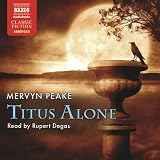
- Audible Audiobook
- Mervyn Peake (Author) - Rupert Degas (Narrator)
- English (Publication Language)
- 07/20/2011 (Publication Date) - Naxos AudioBooks (Publisher)
Titus Alone by Mervyn Peake: Thematic Evolution and Allegorical Depth
The thematic trajectory of Titus Alone by Mervyn Peake represents a significant pivot from its predecessors. While Titus Groan and Gormenghast meticulously detailed the intricate rituals and decaying aristocracy of the castle, Titus Alone shifts focus to the individual consciousness of its titular character. The novel becomes a profound exploration of existential isolation, charting Titus’s solitary journey into a world that is both alien and reflective of his own internal state. This change in emphasis from a sprawling, society-focused narrative to an introspective, allegorical one is a key characteristic that distinguishes this final installment and offers a unique reading experience.
Peake utilizes Titus’s displacement from the familiar confines of Gormenghast to examine universal themes of alienation and the search for identity outside of inherited roles. The external world encountered by Titus is often sparse and symbolic, serving as a canvas for his psychological landscape. This makes Titus Alone a potent, albeit often somber, meditation on human experience, reminiscent of works like Albert Camus’s The Stranger in its focus on an individual confronting an indifferent universe. For readers who were drawn to the intricate plotting and character dynamics of the earlier books, this thematic and structural departure may require an adjustment in expectations, but it is integral to Peake’s final statement on his protagonist’s fate and the human behavior.
Common Myths Addressed
- Myth: Titus Alone is a direct continuation of the Gormenghast narrative, featuring the same pacing and focus on detailed social mechanics.
- Correction: This is a misunderstanding of the novel’s artistic intent. Titus Alone is a significant departure, prioritizing philosophical allegory and individual introspection over the detailed societal mechanics and plot-driven structure of its predecessors. Its strength lies in thematic exploration and atmospheric prose, not narrative propulsion in the vein of Gormenghast. For instance, the detailed descriptions of ritual in the earlier books are replaced by sparse, symbolic landscapes.
- Myth: The external world in Titus Alone is intended to be a realistic depiction of a society outside Gormenghast.
- Correction: The world beyond the castle is largely symbolic and allegorical. Peake uses these sparse, often desolate settings and the archetypal characters Titus encounters to reflect his internal state of isolation and disorientation, rather than to portray a conventionally rendered external reality. Think of it less as a travelogue and more as a psychological projection, akin to the dreamlike logic found in some of Franz Kafka’s works.
- Myth: The novel offers a definitive, conclusive ending to Titus’s story, tying up all loose ends.
- Correction: Titus Alone concludes with a sense of open-endedness. The ending is thematic, suggesting the continuation of Titus’s journey and the ongoing nature of existential quests, rather than providing a neat resolution to all narrative threads. This approach aligns with the novel’s exploration of continuous self-discovery rather than a static endpoint.
Expert Tips for Navigating Titus Alone
- Tip 1: Embrace the Allegory. Recognize that the external world and characters Titus encounters are symbolic representations of internal states and universal human experiences.
- Actionable Step: When encountering a new character or location, consider what abstract concept or aspect of the human behavior they might represent. For example, the desolate landscapes can symbolize Titus’s internal void.
- Common Mistake to Avoid: Trying to find literal, real-world equivalents for every element, which can obscure the novel’s deeper thematic purpose.
- Tip 2: Focus on Titus’s Internal Journey. The primary narrative arc is Titus’s psychological and existential development, not a series of external plot events.
- Actionable Step: Pay close attention to Titus’s thoughts, feelings, and evolving perceptions of himself and the world around him. His internal monologue is as crucial as any dialogue.
- Common Mistake to Avoid: Becoming frustrated by the lack of a conventional, action-driven plot. The novel’s dynamism is internal.
- Tip 3: Savor Peake’s Unique Prose. The distinctive language, imagery, and atmosphere are central to the novel’s impact and meaning.
- **Action
Quick Comparison
| Option | Best for | Pros | Watch out |
|---|---|---|---|
| Titus Alone by Mervyn Peake Quick Answer | General use | <em>Titus Alone by Mervyn Peake</em> serves as the concluding volume in the Gormengh… | Mistake to Avoid: Assuming <em>Titus Alone</em> will replicate the extensive social… |
| Who This Is For | General use | This installment marks a significant shift in style and thematic focus, leani… | Mistake to Avoid: Interpreting his journey as a conventional quest for a spec… |
| What to Check First | General use | Readers should approach <em>Titus Alone</em> with an appreciation for its philosophi… | Mistake to Avoid: Expecting a realistic or conventionally rendered external e… |
| Step-by-Step Plan Engaging with Titus Alone | General use | Readers who have completed <em>Titus Groan</em> and <em>Gormenghast</em> and are seeking th… | Mistake to Avoid: Skimming the prose for plot points. The stylistic elements… |
Decision Rules
- If reliability is your top priority for Titus Alone by Mervyn Peake, choose the option with the strongest long-term track record and support.
- If value matters most, compare total ownership cost instead of headline price alone.
- If your use case is specific, prioritize fit-for-purpose features over generic ‘best overall’ claims.