Delving Into Human Acts By Han Kang
Quick Answer
- Human Acts by Han Kang is a powerful, fragmented novel examining the Gwangju Uprising of 1980. It uses multiple perspectives to explore trauma, memory, and resistance against state violence.
- The novel’s strength lies in its experimental structure and its unflinching portrayal of the psychological and physical impact of atrocity.
- This book is for readers seeking challenging literature that delves into historical trauma and the complexities of human endurance.
Who This Is For
- Readers interested in literary explorations of historical trauma, political oppression, and the resilience of the human spirit.
- Those who appreciate experimental narrative forms and are prepared for emotionally demanding content that confronts difficult truths.
What to Check First
- Historical Context: Familiarity with the 1980 Gwangju Uprising in South Korea, a pro-democracy student protest brutally suppressed by the military, is crucial for understanding the novel’s foundation.
- Narrative Approach: Be prepared for a non-linear, fragmented structure. The novel is divided into seven distinct parts, each with a different narrator or stylistic focus, creating a mosaic of experiences.
- Content Intensity: The book contains graphic depictions of violence, torture, and death. Readers sensitive to such material should proceed with caution.
- Thematic Depth: Human Acts prioritizes the emotional and psychological toll of violence over a straightforward historical account, focusing on the internal landscape of its characters.
If you’re looking for a profound literary experience that grapples with historical trauma, Han Kang’s Human Acts is an exceptional choice. This novel offers a unique and unflinching look at the Gwangju Uprising through multiple perspectives.
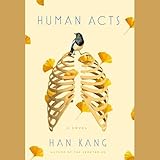
- Audible Audiobook
- Han Kang (Author) - Sandra Oh, Deborah Smith, Greta Jung (Narrators)
- English (Publication Language)
- 01/17/2017 (Publication Date) - Random House Audio (Publisher)
Step-by-Step Plan for Engaging with Human Acts by Han Kang
1. Begin with “The Whistle” (Prologue): This section introduces the voice of a deceased boy, Dong-ho, establishing the novel’s pervasive themes of loss and memory. What to look for: The fragmented, disembodied narration and the immediate sense of aftermath that signals the book’s tone. Mistake to avoid: Expecting a conventional introduction; this part is designed to immerse the reader directly into the novel’s atmosphere of profound sorrow.
2. Process “The Boy”: This segment continues Dong-ho’s perspective, detailing his direct experience of suffering and death during the uprising. What to look for: The raw, sensory descriptions of physical pain and the terror of violence, which are central to the novel’s impact. Mistake to avoid: Becoming desensitized to the graphic details; each instance contributes to the cumulative weight of trauma and the novel’s argument about the cost of atrocity.
3. Engage with “The Wound”: Shifting perspective to a survivor, this section explores the lasting physical and psychological scars of the events. What to look for: The depiction of ongoing pain, the burden of memory, and the difficulty of reintegrating into a semblance of normal life. Mistake to avoid: Interpreting this as a straightforward recovery arc; the novel emphasizes the enduring nature of trauma and its deep-seated effects.
4. Analyze “The Ashes”: This part offers a broader reflection on collective grief and the struggle to process widespread loss and destruction. What to look for: Imagery of burning and decay that symbolizes the devastation and the attempt to find meaning or closure in its wake. Mistake to avoid: Seeking a singular protagonist or clear narrative drive; this section highlights the overwhelming, collective dimension of the event.
5. Consider “The Dark Room”: This section delves into the psychological aftermath, focusing on isolation, despair, and the feeling of being trapped by past trauma. What to look for: The claustrophobic atmosphere and the exploration of mental anguish that persists long after the immediate events have passed. Mistake to avoid: Underestimating the psychological toll; the novel powerfully illustrates the lasting mental scars left by state-sanctioned violence.
6. Examine “The Stranger”: This section introduces a writer grappling with the challenge of bearing witness and articulating the unspeakable. What to look for: The meta-narrative element, which reflects on the author’s own struggle to represent profound suffering and the act of remembrance itself. Mistake to avoid: Disconnecting this perspective from the preceding testimonies; it demonstrates the ongoing difficulty and necessity of confronting historical trauma.
7. Reflect on “The Shadow”: This part offers a more abstract contemplation of human behavior in the face of extreme violence and atrocity. What to look for: The exploration of how violence fundamentally alters one’s perception of humanity and the self. Mistake to avoid: Dismissing this section as overly philosophical; these reflections are deeply rooted in the preceding concrete experiences of trauma.
8. Read “The Whistle” (Epilogue): Returning to the initial voice, this final section offers a form of continued haunting, reflecting on the cyclical nature of memory and the enduring presence of the past. What to look for: The persistence of memory and the ongoing resonance of the Gwangju Uprising’s events. Mistake to avoid: Expecting a definitive resolution or a neat conclusion; the novel leaves lingering questions about memory, justice, and the human capacity for both brutality and resilience.
Human Acts by Han Kang: Confronting Collective Trauma
Han Kang’s Human Acts is a profoundly impactful literary work that utilizes the backdrop of the 1980 Gwangju Uprising to explore the deep and lasting consequences of political violence. The novel does not aim for historical accuracy in a traditional sense; instead, it constructs a powerful, fragmented narrative that immerses the reader in the emotional and psychological dimensions of trauma. Through its seven distinct sections, each offering a unique perspective—from the eyes of a deceased boy to those of a grieving mother, a surviving student, and a writer—Kang meticulously dissects how atrocity fractures individual lives and collective memory. The thematic evolution within Human Acts is not about plot progression but about the deepening understanding of how trauma permeates existence, altering perceptions of humanity and the self. This book matters because it serves as a vital act of remembrance, forcing readers to confront the enduring legacy of violence and the complex, often painful, process of survival and bearing witness. A key aspect to consider is how the novel redefines “human acts” not just as deeds of violence, but also as acts of memory, resistance, and empathy in the face of overwhelming brutality.
Expert Tips for Understanding Human Acts by Han Kang
- Tip 1: Embrace the Fragmentation. The novel’s structure is intentionally discontinuous, mirroring the shattered experience of trauma. Actionable Step: Resist the urge to find a singular, linear plot. Instead, focus on how each distinct voice and perspective contributes to the overall emotional resonance and thematic mosaic of Human Acts by Han Kang. Common Mistake to Avoid: Frustration with the lack of a traditional protagonist or narrative arc; this deliberate fragmentation is key to conveying the disorienting impact of violence.
- Tip 2: Attend to Sensory and Corporeal Details. Kang employs vivid, often visceral, sensory language to convey the physical reality of suffering. Actionable Step: Pay close attention to descriptions of the body, pain, and the environment—the smell of decay, the feeling of cold, the sound of screams—as these details are crucial for building an immersive and empathetic understanding of the characters’ experiences. Common Mistake to Avoid: Skimming over graphic passages; these are not gratuitous but essential to illustrating the depth of human suffering and its impact.
- Tip 3: Analyze the Nuance of “Human Acts.” The title itself is a critical lens through which to read the novel. It refers not only to the horrific acts of violence but also to the smaller, often overlooked, human acts of resistance, memory, love, and survival that persist. Actionable Step: Actively seek out and consider both the destructive and the resilient impulses within the text, noting how ordinary individuals navigate extraordinary circumstances. Common Mistake to Avoid: Focusing exclusively on the brutality; the novel subtly emphasizes the enduring, albeit often quiet, forms of human connection and defiance that define humanity.
Common Myths About Human Acts by Han Kang
- Myth 1: Human Acts is a factual historical account of the Gwangju Uprising.
- Why it matters: This misconception can lead to disappointment if readers expect a chronological, documentary-style retelling of events, focusing on historical accuracy and specific political figures.
- Fix: Understand that Human Acts is a work of literary fiction. While inspired by the Gwangju Uprising, its primary aim is to explore the human experience of trauma, memory, and survival through fictionalized perspectives and symbolic representation, rather than to provide a historical record.
- Myth 2: The novel offers no hope and is purely an exercise in despair.
- Why it matters: This can make the book seem inaccessible or nihilistic, deterring readers who seek some form of catharsis or an understanding of human endurance.
- Fix: While unflinchingly depicting immense suffering, Human Acts also subtly highlights the persistence of memory, the act of bearing witness, and the quiet endurance of the human spirit. The very process of writing and reading about these events can be seen as a form of resistance and a way to honor those lost, suggesting a complex, if somber, form of hope.
Decision Criteria for Engaging with Human Acts by Han Kang
- Constraint: Desire for Structured Narrative. If a clear, linear plot with traditional character development is paramount, Human Acts may not be the ideal choice. Its fragmented structure prioritizes emotional truth and thematic exploration over conventional storytelling, making it a significant departure from typical narrative arcs.
- Constraint: Tolerance for Graphic Content. If you are highly sensitive to depictions of violence and suffering, Human Acts will present a significant challenge. Its unflinching portrayal is central to its thematic impact, but it demands a strong emotional fortitude and a willingness to engage with disturbing material.
Comparing Reading Experiences
| Aspect | Human Acts by Han Kang | Alternative: A Straightforward Historical Novel |
|---|---|---|
| Narrative Style | Fragmented, multi-perspective, experimental | Linear, chronological, character-driven |
| Focus | Emotional and psychological impact of trauma | Factual recounting of events and political context |
| Reader Engagement | Demands active interpretation and emotional immersion | Offers a more accessible, plot-driven |
Decision Rules
- If reliability is your top priority for Human Acts by Han Kang, choose the option with the strongest long-term track record and support.
- If value matters most, compare total ownership cost instead of headline price alone.
- If your use case is specific, prioritize fit-for-purpose features over generic ‘best overall’ claims.