Charles Williams’ ‘All Hallows’ Eve’: A Spiritual Tale
All Hallows’ Eve by Charles Williams: Quick Answer
- All Hallows’ Eve by Charles Williams is an allegorical novel exploring spiritual warfare, the nature of good and evil, and the interplay between the mundane and the supernatural.
- Its dense prose and philosophical depth are best suited for readers seeking challenging, thought-provoking literature rather than light entertainment.
- Readers should approach this work with a willingness to engage with symbolism and theological concepts, as direct plot exposition is secondary to thematic exploration.
Who This Is For
- Readers interested in theological fiction and allegorical storytelling, particularly those familiar with or curious about the works of C.S. Lewis and J.R.R. Tolkien, though Williams’ approach is distinctly more abstract.
- Individuals who appreciate dense, symbolic narratives and are willing to invest time in deciphering intricate thematic layers and philosophical arguments.
What to Check First
- Author’s Oeuvre: Charles Williams is known for his “divine comedies” and mythological novels. Understanding his broader thematic concerns (courtly love, the spiritual battle, the nature of poetry) provides crucial context.
- Allegorical Nature: The novel is not a straightforward narrative. Characters and events represent abstract concepts. Recognize that literal interpretations will likely prove insufficient.
- Theological Undertones: The book engages with Christian theology and mysticism. A basic familiarity with these concepts will enhance comprehension, though it is not strictly required for initial engagement.
- Pacing and Style: Williams’ prose is rich but can be challenging. Expect deliberate pacing, complex sentence structures, and a focus on internal states and spiritual forces over external action.
Step-by-Step Plan for Reading All Hallows’ Eve
1. Initial Character Introduction: Note the characters and their immediate circumstances. Look for: How do the characters’ initial situations hint at underlying spiritual or psychological states? Mistake to avoid: Assuming characters are purely secular or driven by mundane motivations.
2. Symbolic Object Identification: Pay close attention to recurring objects, particularly the “stone.” Look for: What qualities or associations does the object possess? How does its presence or use affect the characters? Mistake to avoid: Dismissing symbolic objects as mere plot devices.
3. Thematic Resonance of Events: Observe how seemingly ordinary events unfold with an uncanny or supernatural dimension. Look for: Patterns of temptation, spiritual struggle, or divine intervention. Mistake to avoid: Seeking conventional plot resolutions; the narrative often emphasizes ongoing spiritual conflict.
4. Dialogue Analysis: Examine conversations for subtext and layered meaning. Look for: Do characters speak directly about their inner lives or spiritual conditions, even when discussing mundane topics? Mistake to avoid: Taking dialogue at face value without considering its symbolic weight.
5. Interplay of Worlds: Track the points where the mundane world and the spiritual realm seem to intersect or influence each other. Look for: Moments where characters experience shifts in perception or awareness. Mistake to avoid: Expecting a clear demarcation between the physical and spiritual; they are often intertwined.
6. Authorial Voice and Commentary: Be aware of moments where the narrative voice might offer direct or indirect commentary on the events or characters’ spiritual journeys. Look for: Shifts in tone or explicit statements that guide the reader’s interpretation. Mistake to avoid: Overlooking the author’s guiding hand in shaping the allegorical meaning.
7. Thematic Synthesis: As you progress, attempt to connect the characters’ struggles, symbolic elements, and supernatural occurrences to broader themes of good, evil, love, and redemption. Look for: Overarching patterns or principles that emerge from the text. Mistake to avoid: Focusing solely on plot mechanics without considering the deeper allegorical message.
For those seeking a profound spiritual journey, Charles Williams’ ‘All Hallows’ Eve’ offers a unique allegorical exploration of good and evil. This challenging yet rewarding novel is a must-read for fans of theological fiction.
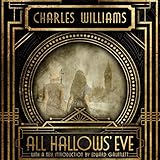
- Audible Audiobook
- Charles Williams (Author) - David Pickering (Narrator)
- English (Publication Language)
- 12/22/2021 (Publication Date) - Apocryphile Press (Publisher)
All Hallows’ Eve by Charles Williams: Navigating Spiritual Warfare
Charles Williams’ All Hallows’ Eve is a seminal work of theological fiction that delves into the unseen spiritual battles shaping human existence. Unlike many contemporary novels, its power lies not in plot twists but in its profound exploration of spiritual realities. The narrative presents a world where the ordinary is constantly under threat from, and in communion with, supernatural forces.
The novel’s core strength lies in its intricate symbolism and its ability to make abstract theological concepts palpable. For readers accustomed to more direct storytelling, the allegorical density can present a significant hurdle. However, for those willing to engage with its challenging prose and layered meanings, All Hallows’ Eve offers a uniquely rewarding spiritual and intellectual experience. It matters now as much as it did upon its release for its persistent inquiry into the nature of choice, consequence, and the ever-present spiritual dimension of human life.
BLOCKQUOTE_0
Common Myths and Countercases
- Myth: All Hallows’ Eve is a simple ghost story or a tale of supernatural horror.
- Why it matters: This misconception leads readers to expect conventional genre elements like jump scares or straightforward plots, which the novel deliberately eschews.
- Fix: Recognize the novel as an allegory. The “supernatural” elements are manifestations of spiritual forces, moral choices, and psychological states, not mere spectral visitations. The focus is on the internal battle for the soul, not external frights.
- Myth: The characters are merely pawns in a grand theological game, lacking genuine human agency.
- Why it matters: This view diminishes the novel’s exploration of free will and personal responsibility, which are central to Williams’ message.
- Fix: Observe how each character makes choices that have tangible spiritual consequences. Their agency is expressed through their reactions to spiritual forces and their decisions regarding good and evil, even when those choices are difficult or made under duress.
- Myth: The novel requires extensive prior theological knowledge to understand.
- Why it matters: This can deter readers who are interested in the themes but may not have a formal background in theology.
- Fix: While theological concepts are present, the novel is designed to be an exploration, not a textbook. Focus on the moral and spiritual dilemmas presented to the characters. The allegorical framework often makes the underlying principles accessible through narrative experience.
Expert Tips for Engaging with All Hallows’ Eve
- Tip 1: Embrace the Ambiguity.
- Actionable Step: When encountering a passage that feels unclear or symbolic, resist the urge to immediately find a definitive “answer.” Instead, consider the multiple layers of meaning it might hold.
- Common Mistake to Avoid: Trying to force a single, literal interpretation onto every symbol or event. Williams’ work often thrives on suggestion and resonance rather than explicit definition.
- Tip 2: Track Character Arcs as Spiritual Journeys.
- Actionable Step: For each significant character, note their initial spiritual state and how their experiences in the novel challenge, affirm, or transform their understanding of themselves and their place in the spiritual order.
- Common Mistake to Avoid: Focusing solely on external plot developments and neglecting the internal spiritual shifts that drive the narrative’s allegorical purpose.
- Tip 3: Pay Attention to the “Weight” of Actions.
- Actionable Step: Notice how actions, even seemingly small ones, are depicted as having significant spiritual repercussions. Consider the causality that extends beyond the immediate physical world.
- Common Mistake to Avoid: Underestimating the spiritual gravity of choices or viewing events as purely coincidental. Williams emphasizes the interconnectedness of actions and their spiritual consequences.
Decision Rules
- If reliability is your top priority for All Hallows’ Eve by Charles Williams, choose the option with the strongest long-term track record and support. This implies prioritizing works that have demonstrably sustained their thematic relevance and interpretive depth over time.
- If value matters most, compare total ownership cost instead of headline price alone. For a book, this translates to the intellectual and emotional investment required versus the perceived reward. A text that demands significant effort but yields profound insight might be considered higher value than a facile read.
- If your use case is specific, prioritize fit-for-purpose features over generic ‘best overall’ claims. For All Hallows’ Eve, this means assessing if its allegorical and theological depth aligns with your current reading goals, rather than seeking it out for general entertainment.
FAQ
- Q: Is All Hallows’ Eve a difficult book to read?
- A: Yes, it can be challenging due to its dense prose, complex symbolism, and allegorical nature. It requires careful reading and a willingness to engage with abstract concepts.
- Q: What is the primary theme of All Hallows’ Eve?
- A: The primary theme is spiritual warfare and the intersection of the human, divine, and demonic realms in shaping individual lives and destinies.
- Q: Should I read All Hallows’ Eve before or after other Charles Williams novels?
- A: While each novel can be read independently, reading The Greater Trumps or War in Heaven first might provide a helpful introduction to Williams’ style and thematic preoccupations. However, All Hallows’ Eve stands as a potent entry point for dedicated readers.
- Q: Who are the main antagonists in the novel?
- A: The antagonists are not necessarily individual characters but rather the spiritual forces of evil and temptation that seek to corrupt and control human souls. These forces often manifest through characters or circumstances that exploit human weakness.
| Character | Initial State | Spiritual Conflict Encountered | Potential Transformation |
|---|---|---|---|
| Lester | Pragmatic, detached | Confrontation with the supernatural, temptation of power | Awakening to spiritual reality, struggle for redemption |
| Nance | Vulnerable, seeking meaning | Encounters with forces of manipulation and despair | Journey toward inner strength and spiritual discernment |
| Simon | Unsettled, questioning | Navigation of moral and spiritual crossroads | Potential for grace |