Annie Cohen-Solal On Picasso The Foreigner
Quick Answer
- Picasso The Foreigner by Annie Cohen-Solal provides a deep dive into Pablo Picasso’s identity as a Spanish expatriate in France, arguing that his “foreignness” was a crucial element of his artistic development and reception.
- The book challenges conventional narratives by highlighting how Picasso’s outsider status informed his innovative spirit and his complex relationship with both his Spanish heritage and his adopted country.
- This work is essential for readers seeking a nuanced understanding of Picasso’s life beyond his artistic output, focusing on the socio-cultural forces that shaped him.
Who This Is For
- Readers interested in a biographical study that prioritizes the intersection of identity, nationality, and artistic creation.
- Those who appreciate scholarly yet accessible analyses of major cultural figures and the societal contexts in which they operate.
What To Check First
- Cohen-Solal’s Central Argument: Confirm that the book’s core thesis—that Picasso’s “foreignness” was not incidental but formative—aligns with your interest in his biography.
- Scope of “Foreignness”: Understand that the book examines foreignness not just as a legal or national status, but as a lived experience encompassing cultural, linguistic, and social dimensions.
- Historical Context: Familiarize yourself with the broader socio-political landscape of Paris during Picasso’s formative years and his subsequent career.
- Author’s Methodology: Note Annie Cohen-Solal’s reputation for meticulous research, often drawing from archives and personal accounts to reconstruct the lived realities of her subjects.
Step-by-Step Plan: Understanding Picasso The Foreigner by Annie Cohen-Solal
1. Analyze the Introduction and Early Chapters:
- Action: Read the initial sections carefully to establish Cohen-Solal’s specific definition of “foreignness” as applied to Picasso.
- What to Look For: Explicit statements detailing how Picasso’s Spanish origins impacted his early life and his initial reception in France.
- Mistake: Skimming the introduction; it lays the critical foundation for the entire argument and defines the unique lens through which Picasso’s life will be viewed.
2. Trace Picasso’s Journey and Integration Attempts:
- Action: Follow the narrative of Picasso’s movements between Spain and France, paying attention to the challenges he faced in each locale.
- What to Look For: Evidence of cultural misunderstandings, linguistic barriers, and social marginalization that Picasso encountered.
- Mistake: Assuming Picasso seamlessly integrated into French society; the book emphasizes the persistent nature of his outsider status.
3. Examine Picasso’s Engagement with Spanish Identity:
- Action: Identify how Picasso’s Spanish heritage manifested in his personal life and artistic output throughout his career.
- What to Look For: Cohen-Solal’s interpretation of Spanish themes, symbols, or connections in Picasso’s work, and how these relate to his foreignness.
- Mistake: Separating his Spanish identity from his artistic evolution; the book argues for their deep, intertwined relationship.
4. Evaluate Picasso’s Public Persona and Reception:
- Action: Analyze how Picasso’s foreignness influenced his interactions with the Parisian art world, including critics, dealers, and fellow artists.
- What to Look For: Examples of how his outsider status might have led to exoticization, curiosity, or a sense of perpetual difference.
- Mistake: Focusing solely on his artistic genius without considering the social dynamics that his foreignness introduced.
5. Connect Foreignness to Artistic Innovation:
- Action: Assess Cohen-Solal’s arguments linking Picasso’s outsider perspective to his revolutionary artistic breakthroughs.
- What to Look For: Specific instances where Picasso’s detachment from certain French artistic conventions may have enabled him to challenge them more readily.
- Mistake: Treating his biography and his art as separate entities; the book’s strength lies in demonstrating their interconnectedness.
6. Consider the Counter-Narrative:
- Action: Recognize how Cohen-Solal’s work challenges established myths and standard biographical interpretations of Picasso.
- What to Look For: The author’s use of evidence to support her claims and to revise commonly held beliefs about assimilation and artistic identity.
- Mistake: Reading the book as a conventional biography without appreciating its critical re-evaluation of Picasso’s life and legacy.
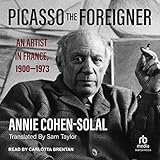
- Audible Audiobook
- Annie Cohen-Solal (Author) - Carlotta Brentan (Narrator)
- English (Publication Language)
- 06/13/2023 (Publication Date) - Tantor Audio (Publisher)
Common Myths
- Myth: Picasso fully assimilated into French culture and identity after moving to Paris.
- Why it Matters: This overlooks the persistent social and cultural barriers Picasso faced throughout his life. Cohen-Solal argues that his “foreignness” was a constant, influencing his interactions and worldview.
- Fix: Recognize that Picasso, despite his fame and long residence in France, often navigated Parisian society as an outsider, a status that the book demonstrates was integral to his identity.
- Myth: Picasso’s Spanish heritage was a minor influence on his art, secondary to his Parisian experiences.
- Why it Matters: This perspective minimizes the deep and continuous connection Picasso maintained with his Spanish roots. Cohen-Solal meticulously shows how Spanish culture, history, and aesthetics remained a vital source of inspiration.
- Fix: Look for the pervasive, often subtle, ways Spanish themes and influences are woven into Picasso’s work, as detailed by the author, rather than viewing them as isolated elements.
- Myth: Picasso’s status as a foreigner was merely a biographical detail, irrelevant to his artistic reception.
- Why it Matters: The book contends that his foreignness significantly shaped how his art was perceived by critics and the public in France, often leading to an exoticizing gaze.
- Fix: Consider the socio-cultural context of early 20th-century Paris and how an artist’s nationality could impact perceptions of their work, a dynamic Cohen-Solal extensively explores.
Expert Tips
- Tip 1: Prioritize the “Foreigner” Lens:
- Actionable Step: Actively seek out how Picasso’s outsider status, as described by Cohen-Solal, influences his decisions, relationships, and artistic expressions throughout the book.
- Common Mistake to Avoid: Reading the book as a standard chronological biography of Picasso’s art without consistently applying the analytical framework of his foreignness.
- Tip 2: Integrate Biographical Details with Artistic Output:
- Actionable Step: As you encounter specific anecdotes or observations about Picasso’s life as a foreigner, try to connect them to particular phases or works in his artistic career (e.g., his early Parisian period, his engagement with Iberian sculpture).
- Common Mistake to Avoid: Treating the biographical narrative and the analysis of his art as separate threads; Cohen-Solal’s argument relies on their interplay.
- Tip 3: Appreciate the Nuance of Identity:
- Actionable Step: Pay attention to how Cohen-Solal avoids simplistic conclusions about Picasso’s identity, acknowledging the complexities of maintaining multiple cultural affiliations.
- Common Mistake to Avoid: Assuming Picasso either fully embraced or rejected his Spanish identity; the book presents a more fluid and dynamic relationship with his heritage.
Picasso The Foreigner by Annie Cohen-Solal: A Critical Examination
Annie Cohen-Solal’s Picasso The Foreigner by Annie Cohen-Solal offers a compelling re-evaluation of the iconic artist’s life, centering on his enduring status as a Spanish expatriate in France. Rather than treating his foreignness as a mere biographical footnote, Cohen-Solal posits it as a fundamental element that shaped Picasso’s artistic vision, his personal identity, and his complex reception within the Parisian art world. The book meticulously details how Picasso, despite his eventual global fame, never fully shed the perception of being an outsider, a condition that, paradoxically, fueled his revolutionary drive and his unique artistic language.
The narrative unfolds by tracing Picasso’s early life in Spain and his subsequent move to Paris, highlighting the cultural, linguistic, and social hurdles he encountered. Cohen-Solal’s extensive research, drawing on a wealth of archival material, reveals how Picasso’s foreignness influenced his interactions with critics, dealers, and the broader public, often framing him through a lens of exoticism. This outsider perspective, the book argues, was not a limitation but a crucial catalyst for his artistic innovations, enabling him to question and dismantle established conventions. By situating Picasso firmly within the socio-cultural dynamics of early 20th-century Paris, Cohen-Solal presents a nuanced counter-narrative to more traditional biographies, emphasizing the persistent negotiation of identity within a foreign milieu.
BLOCKQUOTE_0
This approach challenges the often-assumed trajectory of assimilation for successful immigrants. Instead, Cohen-Solal suggests that Picasso’s art can be understood, in part, as a continuous dialogue with his Spanish origins and his experience of existing on the periphery of French cultural norms. The book’s strength lies in its detailed exploration of this dynamic, providing readers with a richer, more contextualized understanding of one of the 20th century’s most influential figures.
Picasso The Foreigner by Annie Cohen-Solal: Unpacking the Outsider Narrative
Annie Cohen-Solal’s deep dive into Pablo Picasso’s life as an expatriate in Picasso The Foreigner by Annie Cohen-Solal reveals a more intricate portrait than often presented. The book’s central thesis is that Picasso’s identity as a foreigner in France was not merely incidental but a defining characteristic that profoundly influenced his artistic trajectory and his public persona. Cohen-Solal argues that Picasso’s Spanish roots and his persistent status as an outsider provided him with a unique vantage point, enabling him to challenge artistic norms and contribute to groundbreaking movements like Cubism.
The work meticulously examines Picasso’s early life in Spain and
Quick Comparison
| Option | Best for | Pros | Watch out |
|---|---|---|---|
| Quick Answer | General use | Picasso The Foreigner by Annie Cohen-Solal provides a deep dive into Pablo Pi… | Mistake: Skimming the introduction; it lays the critical foundation for the e… |
| Who This Is For | General use | The book challenges conventional narratives by highlighting how Picasso’s out… | Mistake: Assuming Picasso seamlessly integrated into French society; the book… |
| What To Check First | General use | This work is essential for readers seeking a nuanced understanding of Picasso… | Mistake: Separating his Spanish identity from his artistic evolution; the boo… |
| Step-by-Step Plan Understanding Picasso The Foreigner by Annie Cohen-Solal | General use | Readers interested in a biographical study that prioritizes the intersection… | Mistake: Focusing solely on his artistic genius without considering the socia… |
Decision Rules
- If reliability is your top priority for Picasso The Foreigner by Annie Cohen‑Solal, choose the option with the strongest long-term track record and support.
- If value matters most, compare total ownership cost instead of headline price alone.
- If your use case is specific, prioritize fit-for-purpose features over generic ‘best overall’ claims.