Anne Carson’s The Beauty of the Husband: A Poetic Exploration of Marriage
Quick Answer
- The Beauty Of The Husband by Anne Carson is an intellectually demanding, fragmented poetic work that dissects the complexities of marriage through a philosophical lens.
- It is not a traditional narrative and requires active reader engagement to grasp its thematic and structural innovations.
- Its primary strength lies in its unflinching examination of love, betrayal, and the pursuit of knowledge within intimate relationships, presented with Carson’s signature rigor.
Who This Is For
- Readers who appreciate Anne Carson’s distinctive, intellectually dense, and experimental approach to poetry and prose.
- Individuals interested in exploring the philosophical underpinnings of marriage, love, and human connection through unconventional literary forms.
What to Check First
- Author’s Style: Anne Carson is known for blending classical allusions, philosophical inquiry, and raw emotional intensity with unconventional structures. This book is a prime example.
- Structural Approach: The work is divided into twenty-nine “acts,” interspersed with critical commentary and direct questioning, mimicking a philosophical treatise or a legal cross-examination rather than a linear story.
- Thematic Depth: Expect a deep dive into the intellectual and emotional architecture of a marriage, focusing on themes of knowledge, betrayal, desire, and the elusive nature of truth in relationships.
- Reader Expectation: This is not a book for passive consumption. It demands active intellectual participation and a willingness to grapple with ambiguity and challenging subject matter.
Step-by-Step Plan: Engaging with The Beauty Of The Husband by Anne Carson
This work is best approached as an analytical poem or philosophical inquiry, not a conventional narrative. The following steps outline a method for engaging with its complex structure and themes:
1. Initial Immersion: Read the text through from beginning to end without immediate pressure to fully comprehend every element.
- What to look for: The overall rhythm, recurring motifs, and the distinct voices (narrator, wife, husband) that emerge.
- Mistake: Expecting a clear plot arc or character development akin to a novel; this will lead to frustration.
For those seeking to dive deep into Anne Carson’s unique literary style, The Beauty Of The Husband is an essential read. This work offers a profound and challenging exploration of marriage.
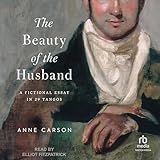
- Audible Audiobook
- Anne Carson (Author) - Elliot Fitzpatrick (Narrator)
- English (Publication Language)
- 02/10/2026 (Publication Date) - Tantor Media (Publisher)
2. Deconstruct the Structure: Pay close attention to the division into “acts” and prose sections.
- What to look for: How each structural unit isolates and dissects a specific aspect of the marital dynamic, creating a mosaic of inquiry.
- Mistake: Treating the text as a continuous, unbroken flow; the divisions are crucial to Carson’s method of analysis.
3. Analyze the “Cross-Examinations”: Identify and engage with the sections that function as direct questioning or debate.
- What to look for: The intellectual sparring, the attempts to define and pin down elusive truths, and the inherent difficulties in achieving objective understanding within a relationship.
- Mistake: Dismissing these as mere academic exercises; they are central to the book’s argument about knowledge and love.
4. Contextualize Allusions: Note the references to classical mythology, philosophy, and art.
- What to look for: How these allusions inform, complicate, or enrich the contemporary marital situation being explored.
- Mistake: Ignoring these references; they provide essential layers of meaning and intellectual grounding for Carson’s thematic explorations.
5. Examine the Husband’s Portrayal: Consider how the husband is presented and interrogated.
- What to look for: The ways his actions, perceived character, and motivations are dissected, questioned, and often rendered enigmatic.
- Mistake: Falling into a simple binary of villain or victim; Carson deliberately complicates any such straightforward categorization.
6. Integrate the Commentary: Recognize the significance of Carson’s own analytical interjections.
- What to look for: How her commentary guides, challenges, or deepens the reader’s interpretation of the events and themes.
- Mistake: Viewing these sections as tangential; they are integral to the work’s overarching argument.
7. Interpret “Beauty”: Reflect on what constitutes “beauty” within the context of this analytical and often painful exploration.
- What to look for: Whether beauty resides in the intellectual pursuit, the honesty of dissection, or a more complex, perhaps tragic, aesthetic.
- Mistake: Searching for conventional notions of beauty in the subject matter itself, rather than in the artistic rendering and intellectual honesty.
The Beauty Of The Husband by Anne Carson: A Critical Examination
The Beauty Of The Husband by Anne Carson stands as a testament to Anne Carson’s singular ability to dissect the intricacies of human relationships with both profound intellectual rigor and raw emotional honesty. This work, presented as a sequence of twenty-nine “acts,” eschews traditional narrative for a fragmented, analytical approach that interrogates the very foundations of marriage. It functions less as a story and more as a sustained philosophical inquiry into love, betrayal, and the complex quest for knowledge within intimacy.
Carson’s method involves a meticulous deconstruction of a marital relationship, employing a style that blends poetic prose with the structure of a philosophical treatise or a legal cross-examination. This fragmentation is not arbitrary; it mirrors the often disjointed and painful process of understanding a partnership, especially one marked by infidelity and intellectual conflict. For example, the “Acts” might present a specific observation or incident, while the interspersed prose offers a more abstract or analytical commentary. This creates a dynamic interplay between the concrete and the conceptual, positioning the reader as an active observer in this dissection of love, desire, and betrayal.
Exploring Thematic Nuances in The Beauty Of The Husband by Anne Carson
The thematic core of The Beauty Of The Husband by Anne Carson is the inherent difficulty, perhaps impossibility, of truly knowing another person, particularly within the confines of marriage. Carson probes the nature of truth, fidelity, and the intellectual justifications individuals construct to navigate complex emotional landscapes. She utilizes the marital relationship as a laboratory for exploring philosophical concepts, posing profound questions about human connection and the elusive nature of “beauty” in such a context.
A potent example of this thematic exploration lies in Carson’s depiction of the husband’s “otherness.” He is not presented as a fully realized character with consistent motivations but rather as an enigma, a subject of constant intellectual debate. The wife’s attempts to comprehend him, and by extension, the marriage, become a form of intellectual warfare. This is evident in sections that resemble academic debates, where definitions are challenged and logical fallacies are exposed, reflecting the intellectual battles that can occur within a relationship.
BLOCKQUOTE_0
This quote encapsulates Carson’s central concern: the relationship between intellect, desire, and the pursuit of understanding within intimate bonds. It highlights how the very act of thinking about another person, of trying to know them, is itself a form of love or longing.
Common Mistakes
- Mistake: Expecting a linear plot.
- Why it matters: This leads to frustration and a failure to grasp Carson’s structural intent, which is to dissect and analyze rather than to narrate sequentially.
- Fix: Approach the book as an analytical poem or philosophical inquiry, focusing on recurring themes, ideas, and the interplay of voices.
- Mistake: Overlooking the classical and philosophical allusions.
- Why it matters: These references are not merely decorative; they provide crucial layers of meaning and context for Carson’s examination of marital dynamics.
- Fix: Research unfamiliar allusions or accept that some layers of meaning may remain implicit, focusing on the intellectual and emotional resonance they create.
- Mistake: Seeking straightforward emotional catharsis.
- Why it matters: Carson’s work prioritizes intellectual dissection and the often painful beauty of honest inquiry over providing easy emotional release.
- Fix: Embrace the intellectual challenge and the complex emotional landscape, recognizing that insight and understanding are the primary rewards.
- Mistake: Treating the husband as a simple antagonist.
- Why it matters: Carson complicates any clear good-versus-evil narrative, presenting him as a subject of intense scrutiny and intellectual debate, rather than a definitively characterized figure.
- Fix: Engage with the husband as a complex, often enigmatic, entity whose motivations and character are constantly being questioned and redefined by the wife and the narrator.
Expert Tips
- Tip 1: Engage with the Structure as Argument.
- Actionable Step: Pay close attention to how Carson shifts between narrative fragments, philosophical exegesis, and direct questioning. Identify how these structural movements contribute to the overall argument about the nature of marriage and knowledge.
- Common Mistake to Avoid: Skimming over the structural divisions or treating them as arbitrary breaks; they are integral to her analytical process.
- Tip 2: Treat the Text as a Philosophical Debate.
- Actionable Step: When encountering the “cross-examination” sections, consider the underlying philosophical questions about truth, perception, and the self that Carson is posing.
- Common Mistake to Avoid: Reading these sections as simple dialogues; they are intellectual duels designed to expose the limits of understanding within relationships.
- Tip 3: Embrace Ambiguity as a Feature, Not a Flaw.
- Actionable Step: Allow yourself to sit with unresolved questions and multiple interpretations. Recognize that the poem’s power often lies in its refusal to offer definitive answers.
- Common Mistake to Avoid: Seeking concrete resolutions or definitive characterizations. Carson’s work thrives on complexity and the inherent elusiveness of definitive truth in human relationships.
Common Myths
- Myth 1: The Beauty Of The Husband by Anne Carson is a straightforward memoir about a failed marriage.
- Correction: While informed by personal experience, the work is a highly stylized and intellectualized exploration of marital dynamics. It employs classical allusions and philosophical inquiry rather than a direct autobiographical account, functioning more as a deconstruction of marriage as a concept than a simple recounting of events.
- Myth 2:
Quick Comparison
| Option | Best for | Pros | Watch out |
|---|---|---|---|
| Quick Answer | General use | <em>The Beauty Of The Husband by Anne Carson</em> is an intellectually demanding, fr… | Mistake: Expecting a clear plot arc or character development akin to a novel;… |
| Who This Is For | General use | It is not a traditional narrative and requires active reader engagement to gr… | Mistake: Treating the text as a continuous, unbroken flow; the divisions are… |
| What to Check First | General use | Its primary strength lies in its unflinching examination of love, betrayal, a… | Mistake: Dismissing these as mere academic exercises; they are central to the… |
| Step-by-Step Plan Engaging with The Beauty Of The Husband by Anne Carson | General use | Readers who appreciate Anne Carson’s distinctive, intellectually dense, and e… | Mistake: Ignoring these references; they provide essential layers of meaning… |
Decision Rules
- If reliability is your top priority for The Beauty Of The Husband by Anne Carson, choose the option with the strongest long-term track record and support.
- If value matters most, compare total ownership cost instead of headline price alone.
- If your use case is specific, prioritize fit-for-purpose features over generic ‘best overall’ claims.