Allison Pugh Discusses The Last Human Job
Quick Answer
- “The Last Human Job” by Allison Pugh explores how automation impacts employment, identifying roles that rely on uniquely human skills like empathy, creativity, and complex judgment.
- Pugh posits that these “last human jobs” are not only resilient to automation but may increase in value as technology advances.
- The book offers a framework for understanding which professions are least susceptible to AI and why, providing insights into the future of work.
Who This Is For
- Professionals and individuals concerned about the impact of automation on their careers and seeking to identify future-proof skills.
- Academics, policymakers, and students interested in sociological and economic shifts driven by technological advancement.
What to Check First
- Current Automation Trajectories: Review reports from organizations like the U.S. Bureau of Labor Statistics (BLS) or McKinsey Global Institute regarding the pace and scope of automation across industries.
- Defining “Human” Skills: Understand the specific attributes Pugh emphasizes, such as emotional intelligence, critical thinking, creativity, and complex social interaction, which are challenging for AI to replicate.
- Economic Sector Vulnerability: Assess which sectors are most likely to be disrupted by AI and which are predicted to see growth in human-centric roles, referencing industry analyses.
- Author’s Academic Context: Familiarize yourself with Allison Pugh’s background in sociology and her previous research on labor, technology, and social change to contextualize her arguments.
Navigating The Last Human Job by Allison Pugh
This section provides a structured approach to understanding the core arguments and implications of “The Last Human Job” by Allison Pugh, focusing on critical analysis and practical takeaways.
1. Deconstruct the “Last Human Job” Framework:
- Action: Identify the defining characteristics of a “last human job” as presented by Pugh. Focus on skills that require deep human understanding, subjective judgment, and intricate social dynamics.
- What to Look For: Specific examples Pugh uses, such as roles in therapy, creative arts, strategic leadership, or complex caregiving, and the underlying skills they demand.
- Mistake: Assuming any job not currently automated is inherently a “last human job” without verifying it aligns with Pugh’s criteria for complex human capabilities.
2. Evaluate the Resilience of Human Competencies:
- Action: Examine Pugh’s evidence for why certain human skills are resistant to automation. Consider the current limitations of AI in replicating genuine empathy, ethical reasoning, and spontaneous creativity.
- What to Look For: Case studies or research findings that illustrate AI’s challenges in areas like nuanced emotional interpretation, complex moral decision-making, or generating truly novel artistic concepts.
- Mistake: Underestimating the potential for future AI advancements to encroach upon domains previously considered exclusively human, particularly in areas of pattern recognition and sophisticated simulation.
3. Analyze Economic and Societal Shifts:
- Action: Consider the potential economic consequences of a workforce increasingly composed of “last human jobs.” Look for Pugh’s insights into potential shifts in labor demand, wage structures, and societal value.
- What to Look For: Pugh’s projections on how these roles might influence economic inequality, the demand for specialized services, and the overall nature of work satisfaction.
- Mistake: Focusing solely on job displacement without accounting for the potential for job evolution, the creation of new service-based economies, and the increased premium placed on human interaction.
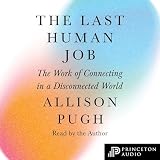
- Audible Audiobook
- Allison J. Pugh (Author) - Allison J. Pugh (Narrator)
- English (Publication Language)
- 06/04/2024 (Publication Date) - Princeton University Press (Publisher)
4. Identify Counterarguments and Nuances:
- Action: Critically assess potential counterpoints to Pugh’s thesis. Consider how AI might augment, rather than entirely replace, professionals in these “last human jobs.”
- What to Look For: Discussions on AI-powered tools that could assist in tasks like data analysis for consultants or diagnostic support for physicians, thereby changing the nature of the human role.
- Mistake: Treating “last human jobs” as static categories, failing to acknowledge that technological integration can alter the skill requirements and operational methods within these roles.
5. Consider Educational and Training Imperatives:
- Action: Determine the implications of Pugh’s findings for education and workforce development. Identify how learning institutions and training programs should adapt.
- What to Look For: Pugh’s implicit or explicit recommendations for educational systems to prioritize critical thinking, creativity, emotional intelligence, and complex communication skills.
- Mistake: Continuing to emphasize rote memorization and technical skills that are highly susceptible to automation, neglecting the cultivation of uniquely human competencies.
6. Reflect on the Evolving Definition of Work:
- Action: Ponder the broader societal implications of a future where “last human jobs” are more prominent. Consider how this might affect well-being, social connection, and individual fulfillment.
- What to Look For: Pugh’s insights into how a focus on human-centric work could redefine societal values around productivity, care, and human contribution.
- Mistake: Overlooking the potential for increased societal stratification if access to these highly valued, human-centric roles becomes unevenly distributed, exacerbating existing inequalities.
Common Myths Addressed
- Myth: “The Last Human Job” implies that only a handful of jobs will remain for humans.
- Correction: Pugh’s thesis focuses on the quality and nature of work, identifying roles that are resistant to automation due to their reliance on complex human skills. It does not suggest a drastic reduction in overall employment but rather a shift in the types of skills that will be most valued. The book highlights that these roles may even see increased demand and value.
- Myth: “Last human jobs” are entirely immune to technological advancement.
- Correction: Pugh’s research indicates that these jobs are resistant to current and near-future automation, primarily because they involve deep empathy, subjective judgment, and complex social interaction. However, AI is constantly evolving, and many of these roles will likely be augmented by technology, rather than replaced entirely. The focus remains on the irreplaceable human element.
Expert Tips for Navigating The Future of Work
- Tip 1: Cultivate Empathy and Emotional Intelligence.
- Actionable Step: Actively seek opportunities to practice active listening and understanding diverse perspectives in your daily interactions. Engage in roles or volunteer work that requires deep interpersonal connection.
- Common Mistake to Avoid: Believing that technical proficiency alone is sufficient for long-term career security. Neglecting the development of soft skills that foster trust and understanding is a significant oversight.
- Tip 2: Develop Advanced Critical Thinking and Problem-Solving Skills.
- Actionable Step: Tackle complex, ambiguous problems that require synthesizing information from multiple sources and considering ethical implications. Practice breaking down intricate issues into manageable components.
- Common Mistake to Avoid: Relying on superficial analysis or accepting pre-packaged solutions without rigorous evaluation. Over-reliance on AI for answers without critical human oversight can lead to errors.
- Tip 3: Foster Creativity and Adaptability.
- Actionable Step: Engage in creative pursuits outside of your professional life, such as art, writing, or music. Be open to learning new skills and adapting to evolving job requirements and technologies.
- Common Mistake to Avoid: Resisting change or adhering rigidly to established methods. A lack of adaptability in the face of technological shifts can render skills obsolete.
The Last Human Job by Allison Pugh: A Contrarian Perspective
While much discussion centers on the inevitability of AI taking over jobs, Pugh’s work offers a more nuanced view. The contrarian angle here is not that AI won’t advance, but that the very advancement of AI may inadvertently increase the value and demand for specific human capabilities. This is because as AI handles routine and predictable tasks, the remaining work will likely require the complex, often messy, and inherently human skills that AI struggles to replicate. The “last human job” isn’t about a scarcity of work, but a premium on distinctly human contributions.
BLOCKQUOTE_0
Decision Rules
- If reliability is your top priority for The Last Human Job by Allison Pugh, choose the option with the strongest long-term track record and support.
- If value matters most, compare total ownership cost instead of headline price alone.
- If your use case is specific, prioritize fit-for-purpose features over generic ‘best overall’ claims.
FAQ
- Q: Does “The Last Human Job” by Allison Pugh suggest that AI will make most jobs obsolete?
- A: No, Pugh’s research indicates that jobs requiring deep human skills like empathy, creativity, and complex judgment are highly resilient to automation. The book argues these roles will remain crucial and may even grow in importance, rather than becoming obsolete.
- Q: How can I identify if my current job is a “last human job”?
- A: Assess if your role heavily relies on nuanced emotional intelligence, complex ethical decision-making, creative problem-solving, and intricate interpersonal interactions. Jobs involving significant human connection, subjective interpretation, or novel ideation are more likely to fit Pugh’s definition.
- Q: What are the primary limitations of AI that make certain jobs “human” according to Pugh?
- A: AI currently struggles with genuine empathy, subjective ethical reasoning, spontaneous creativity, and understanding complex, ambiguous social contexts. These are the core human competencies that Pugh identifies as being most resistant to automation.
- Q: Will AI tools eventually be able to replicate the skills found in “last human jobs”?
- A: While AI is rapidly advancing, replicating the depth of human consciousness, emotional understanding, and truly novel creativity remains a significant challenge. Pugh’s work suggests these are the most robust areas of human capability, though continuous monitoring of AI development is essential.
| Skill Type | Resistance to Automation | Core Human Element | AI Challenge |
|---|---|---|---|
| Emotional Intelligence | High | Genuine empathy, nuanced emotional understanding | Replicating authentic feelings and building deep trust. |
| Creativity & Innovation | High | Novel conceptual |