Understanding Your Idiot Brain: A Humorous Look At Our Minds
Quick Answer
- Dean Burnett’s “The Idiot Brain” offers an accessible, humorous, and scientifically informed examination of the human brain’s inherent quirks and irrational tendencies.
- The book systematically debunks common, often idealized, notions about human rationality by explaining the evolutionary and neurological underpinnings of cognitive biases and emotional responses.
- It is designed for a general readership interested in psychology and neuroscience, providing practical insights into why we think and behave the way we do, without requiring prior scientific expertise.
Who This Is For
- Readers who are curious about the gap between our self-perception as rational beings and our often illogical actions and decisions.
- Individuals who appreciate science communication that balances accuracy with engaging storytelling and a lighthearted, yet critical, perspective.
What To Check First
- Author’s Credibility: Dean Burnett is a neuroscientist and educator with a proven track record in communicating complex brain science to the public. His background ensures a foundation of scientific rigor beneath the humor.
- The “Idiot” Premise: The book’s central thesis is not that we are unintelligent, but that our brains, shaped by evolution, employ shortcuts and heuristics that can lead to predictable errors. This is a critical framing device to understand.
- Accessibility of Style: Burnett employs a conversational and witty tone, using analogies and relatable examples to explain intricate neurological concepts. Assess if this style resonates with your preferred reading experience for non-fiction.
- Scope of Topics: The book covers a broad range of cognitive phenomena, from memory and perception to emotions and social cognition. Confirm if the breadth of these topics aligns with your current interests.
Step-by-Step Plan: Navigating The Idiot Brain by Dean Burnett
1. Understand the Evolutionary Context:
- Action: Begin by carefully reading the chapters that establish the evolutionary history of the brain.
- What to Look For: Explanations of how survival pressures favored quick, often imperfect, decision-making mechanisms over slow, perfectly rational ones. Burnett emphasizes that many of these “flaws” were once adaptive advantages.
- Mistake: Viewing the brain’s “errors” as purely negative without appreciating their historical functional role. This can lead to an overly critical and less nuanced understanding of our own cognitive architecture.
2. Deconstruct Cognitive Biases as Shortcuts:
- Action: Dedicate time to the sections detailing specific cognitive biases, such as confirmation bias or the availability heuristic.
- What to Look For: Concrete, everyday examples that illustrate how these mental shortcuts lead to systematic deviations from logical reasoning. Burnett uses relatable scenarios to demonstrate these principles in action.
- Mistake: Dismissing these biases as rare occurrences or solely applicable to others. The book’s strength lies in showing their pervasive influence on universal human experience.
3. Analyze the Interplay of Emotion and Logic:
- Action: Focus on the chapters that explore the relationship between the brain’s emotional centers and its more rational processing areas.
- What to Look For: Insights into how emotions frequently influence, and sometimes override, logical thought, leading to decisions that may not appear rational in retrospect. Burnett highlights that emotion is not the enemy of reason, but an integral, albeit sometimes disruptive, component.
- Mistake: Trying to entirely suppress emotions to achieve rationality. The book suggests that understanding and managing emotional influence is more realistic than elimination.
4. Examine the Fallibility of Memory:
- Action: Pay close attention to the discussions surrounding memory formation, storage, and retrieval.
- What to Look For: Evidence presented by Burnett that demonstrates memory is not a perfect recording device but a reconstructive process susceptible to distortion, suggestion, and the integration of new information.
- Mistake: Trusting personal recollections implicitly without acknowledging the inherent unreliability of memory, which can lead to disputes and misinterpretations of past events.
5. Appreciate the Social Brain’s Quirks:
- Action: Review the sections dedicated to social cognition, including topics like groupthink, conformity, and stereotyping.
- What to Look For: Explanations of how our social nature, while essential for cooperation, can also lead to collective irrationality and biased perceptions of others.
- Mistake: Believing that individual intelligence inoculates one from the influence of social dynamics. Burnett illustrates how even smart people can fall prey to group-driven errors.
6. Integrate Self-Awareness with Book Concepts:
- Action: After reading, reflect on personal experiences and decision-making processes in light of the book’s concepts.
- What to Look For: Opportunities to identify instances where your own thinking might have been influenced by the biases and emotional responses discussed. This is the practical application of Burnett’s work.
- Mistake: Reading the book as a purely academic exercise without attempting to apply its insights to one’s own life. The true value lies in enhanced self-understanding.
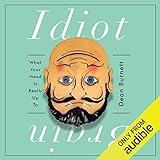
Idiot Brain: What Your Head Is Really up To
- Audible Audiobook
- Dean Burnett (Author) - John Keating (Narrator)
- English (Publication Language)
- 07/26/2016 (Publication Date) - Audible Studios (Publisher)
7. Consider the “Why” Behind the Limitations:
- Action: Revisit sections that explain the adaptive reasons for these cognitive limitations.
- What to Look For: The author’s arguments for why these “idiotic” mechanisms, while problematic today, may have served crucial functions in our evolutionary past, such as rapid threat assessment.
- Mistake: Judging the brain’s historical adaptations solely by modern standards of optimal cognitive performance, missing the context of its development.
Common Myths Addressed in The Idiot Brain by Dean Burnett
- Myth: Humans are fundamentally rational beings, and our decisions are primarily driven by logic and evidence.
- Why it Matters: This misconception leads to an overestimation of our own objectivity and an inability to recognize when our judgments are being swayed by emotional impulses or unconscious biases. It can foster a false sense of control over our decision-making processes.
- Fix: Recognize that emotions and cognitive shortcuts are integral to brain function, often preceding or significantly influencing rational thought. Actively practice questioning your initial assumptions and emotional responses, seeking objective evidence where possible.
- Myth: Memory functions like a precise recording device, accurately storing and retrieving past events without alteration.
- Why it Matters: A belief in perfect recall can lead to significant personal and interpersonal conflicts, as individuals may insist on the absolute truth of their memories, even when they are inaccurate. It hinders the ability to acknowledge personal fallibility and learn from past experiences.
- Fix: Understand that memory is a reconstructive process, prone to distortion, embellishment, and the incorporation of external influences. Approach your own recollections with a degree of skepticism and be open to corroborating evidence or alternative perspectives.
- Myth: The human brain is a highly optimized and error-free machine that has achieved peak evolutionary efficiency.
- Why it Matters: This view fails to account for the brain’s inherent limitations and its tendency to employ energy-saving heuristics, which can result in predictable errors in judgment and perception. It can lead to frustration with oneself and others when these predictable errors occur.
- Fix: Embrace the understanding that the brain is a product of evolutionary compromise, often prioritizing speed and immediate survival over absolute accuracy. This perspective fosters greater patience and self-compassion, acknowledging that these “imperfections” are part of the human behavior.
Expert Tips for Understanding Your Brain
- Tip 1: Cultivate Skepticism Towards Your Own Certainty.
- Actionable Step: When you find yourself absolutely certain about a belief or a memory, pause and consciously ask yourself, “What evidence would convince me otherwise?” This exercise can reveal the limits of your conviction.
- Common Mistake to Avoid: Dismissing any information that challenges your strongly held beliefs, a behavior indicative of confirmation bias.
- Tip 2: Practice Mindful Emotional Assessment Before Decisions.
- Actionable Step: Before making a significant decision, especially under pressure, take a moment to identify the primary emotion driving your inclination. Ask: “Am I acting out of fear, excitement, anger, or a calm assessment of facts?”
- Common Mistake to Avoid: Allowing strong emotions to dictate immediate actions without a period of reflection, leading to impulsive and potentially regrettable choices.
- Tip 3: Seek Out Disconfirming Evidence.
- Actionable Step: Make a conscious effort to find information that contradicts your existing opinions or beliefs, particularly on topics you feel strongly about. This could involve reading opposing viewpoints or consulting sources known for their critical stance.
- Common Mistake to Avoid: Primarily consuming media and information that reinforces your current perspective, thereby strengthening confirmation bias and limiting intellectual growth.
Decision Rules
- If the primary goal is to understand the neurological basis of common human irrationalities, “The Idiot Brain by Dean Burnett” provides a comprehensive yet accessible overview.
- If you are seeking actionable strategies to overcome cognitive biases, apply the principles of self-awareness outlined in the book’s practical sections.
- If your interest lies in the humor and accessibility of complex scientific topics, Burnett’s engaging writing style makes this book an excellent choice.
Quick Comparison
| Option | Best for | Pros | Watch out |
|---|---|---|---|
| Quick Answer | General use | Dean Burnett’s “The Idiot Brain” offers an accessible, humorous, and scientif… | Mistake: Viewing the brain’s “errors” as purely negative without appreciating… |
| Who This Is For | General use | The book systematically debunks common, often idealized, notions about human… | Mistake: Dismissing these biases as rare occurrences or solely applicable to… |
| What To Check First | General use | It is designed for a general readership interested in psychology and neurosci… | Mistake: Trying to entirely suppress emotions to achieve rationality. The boo… |
| Step-by-Step Plan Navigating The Idiot Brain by Dean Burnett | General use | Readers who are curious about the gap between our self-perception as rational… | Mistake: Trusting personal recollections implicitly without acknowledging the… |
FAQ
- Q: Does “The Idiot Brain” imply that we are unintelligent or incapable?
- A: No, the title “The Idiot Brain” is a deliberate, humorous provocation. Dean Burnett uses this term to describe the brain’s inherent tendency to rely on evolutionary shortcuts and heuristics that can lead to predictable errors, not to label individuals as unintelligent. Even brilliant minds are subject to these cognitive quirks.
- Q: Is a background in neuroscience required to enjoy or understand this book?
- A: Absolutely not. Dean Burnett excels at translating complex scientific concepts into easily digestible language, using relatable examples and a conversational tone. The book is specifically crafted for a general audience with a curiosity about psychology and how the mind works.
- Q: How can understanding my “idiot brain” practically benefit me?
- A: By recognizing the predictable ways your brain can