Understanding James Joyce’s ‘Finnegans Wake
Finnegans Wake by James Joyce: Quick Answer
- Finnegans Wake by James Joyce is a notoriously complex novel characterized by its multilingual puns, dreamlike narrative, and experimental language.
- It is not a book to be read for plot in a conventional sense, but rather for its sonic, linguistic, and thematic exploration of history, myth, and the human subconscious.
- Success with Finnegans Wake hinges on managing expectations and employing specific reading strategies, rather than expecting immediate comprehension.
Who This Is For
- Readers deeply interested in linguistic experimentation and the boundaries of literary form.
- Scholars and dedicated students of James Joyce’s work and modernist literature.
What to Check First
Before embarking on Finnegans Wake, it is crucial to establish realistic expectations and gather necessary resources. This is not a text that yields its secrets easily or quickly.
- Understand the Premise: Recognize that the narrative is not linear or plot-driven. It operates on dream logic, cycles, and associative leaps, often described as the dream of H.C.E. (Humphrey Chimpden Earwicker).
- Prepare for Linguistic Density: The novel employs a highly inventive, portmanteau-laden language, blending numerous global languages and creating new words. Expect to encounter unfamiliar terms and grammatical structures.
- Gather Supporting Materials: A good scholarly companion or annotated edition is almost essential. Resources like Roland McHugh’s Annotations to Finnegans Wake or the Wake Newslitter can provide critical context and explanations.
- Acknowledge the “Failure Mode”: Many readers approach Finnegans Wake expecting to “understand” it like a traditional novel. The primary failure mode is an overreliance on linear comprehension and a subsequent frustration with the lack of conventional narrative progression and linguistic accessibility. Detecting this early involves recognizing that comprehension will be partial, iterative, and often achieved through immersion rather than direct decoding.
Step-by-Step Plan for Approaching Finnegans Wake
Engaging with Finnegans Wake requires a structured, yet flexible, approach. The goal is not to “finish” it in a single pass, but to engage with its unique textual ecosystem.
1. Start with a Companion Text: Begin by reading a reputable scholarly introduction or annotated edition.
- Action: Select a guide like Finnegans Wake: A Reader’s Guide by Whit and H.J. Jackson, or a similar resource.
- What to Look For: Explanations of key characters, recurring motifs, and the book’s cyclical structure.
- Mistake to Avoid: Trying to read the Wake without any external aid; this leads to immediate disorientation.
2. Read Aloud: The text is designed to be heard as much as read.
- Action: Read passages aloud, either by yourself or with others.
- What to Look For: The musicality, rhythm, and sonic qualities of Joyce’s invented language.
- Mistake to Avoid: Reading silently and attempting to parse every word; this ignores the phonetic and auditory dimensions crucial to the text.
3. Focus on Recurring Passages: Identify and return to key sections that are revisited in various forms throughout the book.
- Action: Pay attention to the opening (“riverrun, past Eve and Adam’s…”) and closing phrases, which are cyclical.
- What to Look For: The evolution and variation of themes and language across different cycles.
- Mistake to Avoid: Getting bogged down in a single, opaque paragraph and assuming it represents the entirety of the difficulty.
4. Embrace Ambiguity and Multiple Meanings: Do not seek a single, definitive interpretation.
- Action: Allow words and phrases to resonate with multiple potential meanings simultaneously.
- What to Look For: The layered allusions, puns, and cultural references that create a broad range of interpretation.
- Mistake to Avoid: Insisting on a literal or singular meaning for every sentence, which is counterproductive in this text.
5. Engage with Specific Themes: Instead of trying to grasp the whole, focus on individual thematic threads.
- Action: Track themes such as the fall of man, family dynamics, or historical cycles.
- What to Look For: How these themes are expressed through different characters and linguistic transformations.
- Mistake to Avoid: Attempting to map out a coherent plot or character arc; the book resists such linear analysis.
6. Join a Reading Group or Discussion: External perspectives can illuminate dense passages.
- Action: Participate in online forums or local reading groups dedicated to Finnegans Wake.
- What to Look For: Shared insights and diverse interpretations from fellow readers.
- Mistake to Avoid: Isolating oneself with the text; the collaborative aspect is a recognized method for navigating its complexity.
If you’re ready to dive into the deep end of literary experimentation, the original text of Finnegans Wake by James Joyce is an essential, albeit challenging, experience.
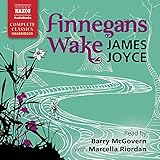
- Audible Audiobook
- James Joyce (Author) - Barry McGovern, Marcella Riordan (Narrators)
- English (Publication Language)
- 06/16/2021 (Publication Date) - Naxos AudioBooks (Publisher)
Finnegans Wake by James Joyce: A Linguistic Labyrinth
This section delves into the unique linguistic architecture of Finnegans Wake by James Joyce, a cornerstone of its challenge and its brilliance. The text’s construction is less about narrative progression and more about an immersive experience of language itself.
- Example: The opening sentence, “riverrun, past Eve and Adam’s, from swerve of shore to bend of bay, brings us by a commodius vicus of recirculation back to Howth Castle and Environs,” is a prime example. It introduces themes of cyclical time, the fall, and geography, all within a dense, word-blended phrase. The “commodius vicus” itself is a pun on Giambattista Vico’s cyclical theory of history and “Vico’s road.”
- Takeaway: Understanding that the book is a linguistic experiment, rather than a story in the traditional sense, is crucial for initial engagement. The meaning is embedded in the sound, the etymology of words, and the interplay of multiple languages.
Common Myths About Finnegans Wake
- Myth 1: Finnegans Wake is intentionally incomprehensible.
- Correction: While exceedingly difficult, it is not intentionally opaque. Joyce aimed to create a language that reflected the universality of human experience and the dream state. The difficulty arises from its radical linguistic innovation, not from a desire to exclude readers. Evidence lies in the extensive scholarly work dedicated to deciphering its layers, suggesting a discoverable, albeit complex, system.
- Myth 2: You must understand every word to appreciate the book.
- Correction: Appreciation comes from immersion in the text’s sonic and associative qualities, not from complete lexical mastery. Joyce himself suggested that readers should approach the Wake as they would a piece of music. The goal is to experience the flow, the rhythm, and the evocative power of the language, even if individual words remain obscure. Many readers find clear insights by focusing on recurring patterns and emotional resonance rather than precise translation.
- Myth 3: Finnegans Wake is a failure of a novel.
- Correction: This perspective misunderstands Joyce’s artistic intent. Finnegans Wake is a radical departure from the novel form, pushing its boundaries to explore consciousness, myth, and history in unprecedented ways. Its “success” is measured by its profound influence on experimental literature and its status as a unique artistic achievement, rather than by conventional narrative standards. Its enduring legacy and the ongoing scholarly engagement serve as evidence of its artistic merit.
Expert Tips for Navigating Finnegans Wake
BLOCKQUOTE_0
- Tip 1: Embrace the “Vico Road” Cycle.
- Action: Understand that the book is structured around Giambattista Vico’s theory of historical cycles (divine, heroic, human, chaotic). Recognize that the narrative is not linear but cyclical, with events and themes repeating and transforming.
- Mistake to Avoid: Trying to force a chronological plot. The “story” is the eternal recurrence of human experience.
- Tip 2: Prioritize Sound and Rhythm.
- Action: Read passages aloud. Listen for the music, the puns, and the multilingual echoes. Joyce called it a “phonetic” book.
- Mistake to Avoid: Getting stuck on the visual appearance of words. The auditory experience is paramount to unlocking meaning and atmosphere.
- Tip 3: Consult Annotations Strategically.
- Action: Use a good annotated edition or companion guide for specific passages that are particularly baffling. Do not try to look up every word.
- Mistake to Avoid: Over-reliance on annotations, which can disrupt the flow and turn reading into a chore. Use them as occasional signposts, not a crutch.
Decision Rules
- If reliability is your top priority for Finnegans Wake by James Joyce, choose the option with the strongest long-term track record and support.
- If value matters most, compare total ownership cost instead of headline price alone.
- If your use case is specific, prioritize fit-for-purpose features over generic ‘best overall’ claims.
FAQ
- Q: Is it possible to “finish” Finnegans Wake?
A: Yes, in the sense of reading through the text from beginning to end. However, “finishing” in the sense of fully understanding every nuance is virtually impossible, even for seasoned scholars. The goal is often engagement and partial comprehension over complete mastery.
- Q: What is the primary subject matter of Finnegans Wake?
A: It broadly explores themes of human history, mythology, family, guilt, resurrection, and the nature of consciousness, all filtered through a dreamlike state and a revolutionary linguistic approach. It is less about a specific plot and more about the universal human behavior.
- Q: How much knowledge of other languages do I need to read Finnegans Wake?
A: No prior knowledge of the many languages Joyce incorporates is strictly necessary. The multilingual wordplay is designed to create suggestive associations and sonic textures, even for readers unfamiliar with the source languages. Companion guides often explain the etymological roots of these portmanteaus.
- Q: Where should I start if I want to read Finnegans Wake?
A: Begin with a well-regarded annotated edition or a scholarly introduction. Reading aloud and focusing on recurring motifs are also highly recommended initial strategies. It is not a book to be approached casually or without preparation.
| Aspect | Description | Impact on Reader |
|---|---|---|
| <strong>Linguistic Density</strong> | Portmanteaus, multilingual puns, neologisms, complex grammar. | Can cause initial confusion and a feeling of being overwhelmed; requires patience and active engagement. |
| <strong>Dream Logic Narrative</strong> | Non-linear, associative, cyclical structure mirroring subconscious thought. | Challenges conventional expectations of plot and character development; encourages fluid interpretation. |
| <strong>Cyclical Structure</strong> | The opening and closing phrases connect, suggesting an endless loop of history and experience (Vico). | Reinforces themes of recurrence and eternity; implies that understanding is an ongoing process, not a final state. |
| <strong>Sonic Emphasis</strong> | The text is designed to be heard, with attention to rhythm, rhyme, and phonetic play. | Enhances the immersive quality; reading aloud is often recommended for full appreciation. |
| <strong>Mythic Underpinnings</strong> | Draws heavily on world mythology, folklore, and historical events, often recontextualized. | Adds layers of allusion and intertextuality; enriches the thematic depth for those familiar with the sources. |