Understanding Arthurian Legend in Malory’s Le Morte d’Arthur
Thomas Malory’s Le Morte d’Arthur is a cornerstone of English literature, a sprawling prose compilation that has profoundly shaped our understanding of King Arthur, his knights, and the ideals of chivalry. This guide offers a structured approach to navigating its complex narratives and thematic richness, designed for readers seeking a deeper appreciation of this seminal work.
Le Morte d’Arthur by Thomas Malory: Quick Answer
- Le Morte d’Arthur by Thomas Malory is a 15th-century English prose compilation of Arthurian romances, synthesizing earlier French and English tales.
- Understanding Malory involves recognizing its episodic structure, its exploration of chivalric ideals and their eventual tragic corruption, and its foundational role in the Arthurian canon.
- Key to comprehension is tracing the thematic arcs of Camelot’s rise and fall, and the intertwined destinies of its central figures.
Le Morte d’Arthur by Thomas Malory: Who This Is For
- Students and scholars of medieval literature aiming to grasp Malory’s synthesis and its position within the Arthurian tradition.
- General readers interested in the origins of the King Arthur mythos and its enduring literary and cultural significance.
What to Check First
Before delving into Malory’s extensive text, consider these foundational elements:
- The Nature of Compilation: Malory was an editor and adapter, drawing from numerous existing stories. Understanding this means appreciating the text as a deliberate arrangement and synthesis, not a single author’s sole invention.
- Historical and Social Context: Written during the turbulent Wars of the Roses, Malory’s work reflects 15th-century concerns about kingship, loyalty, and the fragility of social order, which can inform interpretations of Camelot’s eventual collapse.
- Thematic Pillars: Identify the core themes: chivalry, courtly love, faith, sin, honor, and the inevitable tragic consequences of human passion and betrayal.
- Key Character Dynamics: Familiarize yourself with the central figures—Arthur, Lancelot, Guinevere, Merlin, Gawain, Mordred—and their intricate relationships, which drive the narrative’s conflicts.
Step-by-Step Plan for Understanding Le Morte d’Arthur
To engage effectively with Le Morte d’Arthur by Thomas Malory, follow these recommended steps:
1. Begin with Arthur’s Establishment: Focus on the early books detailing Arthur’s ascension, the founding of the Round Table, and the initial ideals of Camelot.
- Action: Read Books I-IV, noting the emphasis on justice, fellowship, and the establishment of a unified kingdom.
- What to Look For: The nascent ideals of chivalry and the creation of a seemingly perfect court.
- Mistake: Assuming the later conflicts and betrayals are present from the start; the early books depict a more idealistic vision.
2. Trace the Lancelot-Guinevere Relationship: Observe the development and impact of the affair between Lancelot, Arthur’s greatest knight, and Queen Guinevere.
- Action: Pay close attention to the narrative’s portrayal of their secret love and its gradual revelation.
- What to Look For: The internal conflict within Lancelot and Guinevere, and the growing strain on their loyalty to Arthur.
- Mistake: Underestimating the affair’s central role; it is a primary catalyst for the kingdom’s unraveling.
3. Analyze the Quest for the Holy Grail: Understand its spiritual significance and how it serves as a moral crucible for the knights.
- Action: Examine which knights undertake the quest and their motivations and outcomes.
- What to Look For: The contrast between spiritual purity (Galahad, Percival, Bors) and earthly desires, and how the quest exposes the knights’ spiritual shortcomings.
- Mistake: Treating the Grail Quest as a mere adventure; it is a profound test of virtue and a turning point for Camelot.
4. Examine the Erosion of Chivalric Ideals: Track the increasing instances of internal conflict, feuds, and moral compromises among the knights.
- Action: Identify specific acts of betrayal, vengeance, and the breakdown of the Round Table’s unity.
- What to Look For: The escalating disputes, the rise of personal vendettas over collective good, and the weakening of Arthur’s authority.
- Mistake: Believing that the knights’ adherence to chivalry remains constant; Malory depicts its gradual corruption.
5. Focus on the Tragic Climax: Understand the final books detailing Arthur’s downfall, the battle against Mordred, and the dissolution of the Round Table.
- Action: Read Books XIX-XXI with an awareness of the cumulative consequences of past actions.
- What to Look For: The final, devastating conflict, Arthur’s mortal wounding, and the scattering of the knights.
- Mistake: Attributing the fall solely to Mordred; Malory emphasizes the internal decay and past sins that made the kingdom vulnerable.
6. Appreciate Malory’s Narrative Craft: Recognize that Malory is an editor and synthesizer, shaping his sources into a cohesive, albeit episodic, prose epic.
- Action: Note recurring motifs, character archetypes, and the overall tone of tragic inevitability.
- What to Look For: The blend of heroic action, moral reflection, and the sense of destiny.
- Mistake: Expecting a modern novel’s tight plot; Malory’s strength lies in his arrangement and thematic resonance across disparate tales.
7. Consider the Work’s Legacy: Understand how Malory’s version became the dominant English Arthurian narrative, influencing countless adaptations.
- Action: Reflect on the enduring power of the characters and themes Malory popularized.
- What to Look For: The archetypes of the noble king, the flawed hero, and the tragic love triangle that have become synonymous with Arthurian legend.
- Mistake: Overlooking Malory’s pivotal role in shaping the modern perception of Arthurian myth.
To fully immerse yourself in the world Malory created, having a reliable edition of Le Morte d’Arthur is essential. This classic compilation has shaped the Arthurian legend for centuries.
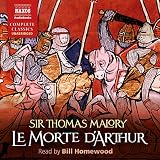
- Audible Audiobook
- Sir Thomas Malory (Author) - Bill Homewood (Narrator)
- English (Publication Language)
- 10/26/2020 (Publication Date) - Naxos AudioBooks (Publisher)
Common Myths About Le Morte d’Arthur
- Myth: King Arthur was a historical figure whose life Malory accurately recorded.
- Correction: Arthur is a legendary figure whose origins lie in early British folklore and poetry. Malory compiled and adapted existing romances, blending historical speculation with imaginative narrative. His work is a literary synthesis, not a historical chronicle. The text serves as a mythic exploration of kingship and chivalry.
- Myth: The primary theme is the triumph of good over evil.
- Correction: Le Morte d’Arthur is fundamentally a tragedy. While it presents noble ideals, it emphasizes the corrupting influence of human passion, sin, and betrayal. The text explores the inevitable downfall that results from the failure to uphold these ideals, highlighting moral ambiguity and the destructive consequences of flawed human nature.
- Myth: Lancelot is portrayed as a simple villain who destroyed Camelot.
- Correction: Malory presents Lancelot as a complex character, the greatest knight in the world, deeply loyal to Arthur yet tormented by his forbidden love for Guinevere. His affair is depicted as a tragic flaw that contributes to Camelot’s ruin, but he is also shown wrestling with his conscience and seeking spiritual redemption. His character arc is one of profound internal conflict.
Expert Tips for Engaging with Le Morte d’Arthur
- Tip: Embrace the Episodic Structure.
- Actionable Step: Read each major section or tale (e.g., the story of Lancelot and Guinevere, the Quest for the Holy Grail) as a distinct, yet interconnected, narrative unit that builds towards the larger thematic arc.
- Common Mistake to Avoid: Expecting a modern, linear plot with continuous forward momentum; Malory’s compilation style involves parallel narratives and shifts in focus.
- Tip: Identify Thematic Echoes and Contrasts.
- Actionable Step: Actively look for recurring motifs, character archetypes, and moral dilemmas across different sections of the text to draw comparisons and contrasts that illuminate Malory’s thematic concerns.
- Common Mistake to Avoid: Reading each episode in isolation without recognizing how Malory uses repetition and variation to develop themes like loyalty, betrayal, and the nature of sin.
- Tip: Pay Attention to Malory’s Framing and Commentary.
- Actionable Step: Note narrative asides, character reflections, and the overall tone Malory adopts when describing events or characters, as these often reveal his moral or thematic judgments and guide the reader’s interpretation.
- Common Mistake to Avoid: Treating all characters and events as neutral occurrences; Malory’s editorial hand subtly shapes the reader’s understanding of the characters’ virtues and flaws.
Frequently Asked Questions
- Q: Is Le Morte d’Arthur a single, original story by Malory?
- A: No, Le Morte d’Arthur is a compilation. Malory synthesized and adapted numerous existing French and English Arthurian romances into a comprehensive prose narrative, creating the definitive English version of the cycle for his time.
- Q: What is the overarching message of Le Morte d’Arthur?
- A: A central message is the tragic arc of chivalric ideals and the inherent fragility of even the noblest kingdoms. The text explores how human passion, sin, and betrayal can corrupt virtue and lead to inevitable downfall, even amidst great heroism and spiritual quests.
- Q: How did Malory’s version become so influential?
- A: Malory’s Le Morte d’Arthur was the first comprehensive prose Arthurian legend in English. It consolidated disparate tales, established key character archetypes and narrative conventions, and profoundly shaped subsequent English literature’s understanding and portrayal of King Arthur.
- Q: What is the role of the Holy Grail quest in the narrative?
- A: The Quest for the Holy Grail serves as a spiritual and moral test for the Knights of the Round Table. It highlights the difference between earthly chivalry and divine purity, exposing the knights’ spiritual shortcomings and marking a turning point that foreshadows Camelot’s decline.
- Q: Why is the Lancelot-Guinevere affair so critical to the story’s tragedy?
- A: This affair represents a profound betrayal of loyalty and trust between Arthur’s queen and his foremost knight. Malory uses it to illustrate how personal sins and passions can corrupt the highest ideals of chivalry and shatter the foundations of the kingdom, directly leading to civil war and the end of the Round Table.
| Aspect of Understanding | Key Focus Area | Potential Pitfall |
|---|---|---|
| <strong>Narrative Structure</strong> | Episodic tales, interconnected arcs | Expecting a modern, linear plot; missing thematic links between sections. |
| <strong>Character Arcs</strong> | Development of knights’ virtues and flaws | Viewing characters as static archetypes; ignoring internal conflicts and changes. |
| <strong>Thematic Depth</strong> | Chivalry, sin, fate, loyalty, betrayal | Oversimplifying themes; missing the tragic undertones and moral ambiguity. |
| <strong>Malory’s Role</strong> | Compiler, synthesizer, shaper of legend | Attributing all content solely to Malory’s invention; overlooking his sources. |
| <strong>Impact and Legacy</strong> | Influence on subsequent Arthurian literature | Failing to recognize Malory’s work as the foundational English version of the cycle. |
Decision Rules
- If reliability is your top priority for Le Morte d’Arthur by Thomas Malory, choose an edition with extensive scholarly notes and a reputable academic publisher.
- If your primary goal is accessibility for a first-time reader, prioritize modern translations or abridged versions that maintain thematic integrity.
- If you are focused on historical linguistic study, seek out early printed editions or facsimiles of Caxton’s original printing.