Tim Powers’ ‘Last Call’: A Thrilling Supernatural Tale
Last Call by Tim Powers: Quick Answer
- Last Call by Tim Powers is a complex supernatural thriller that blends historical elements with magic and a unique narrative structure.
- It offers a dense, rewarding experience for readers who appreciate intricate plotting and unconventional storytelling.
- Readers seeking straightforward plots or action-heavy narratives may find its layered approach challenging.
Who This Is For
- Readers who enjoy intricate, puzzle-like plots with a supernatural or magical realism bent.
- Fans of Tim Powers’s distinctive style, characterized by deep research and arcane lore.
What to Check First
- Powers’s Narrative Style: Tim Powers often employs non-linear timelines and multiple perspectives. Be prepared for a story that requires active engagement to piece together.
- Thematic Complexity: The novel delves into themes of luck, fate, and the nature of magic, often with a cynical or pragmatic undertone.
- Historical Setting: The story is set in the mid-20th century, specifically around the world of professional poker and Las Vegas. Familiarity with this era can enhance the reading experience but is not strictly required.
- Magical System: The magic in Last Call is not always overt or flashy. It operates through specific rules and rituals, often tied to arcane objects and rituals.
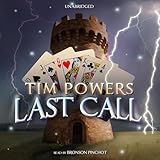
- Audible Audiobook
- Tim Powers (Author) - Bronson Pinchot (Narrator)
- English (Publication Language)
- 12/02/2010 (Publication Date) - Blackstone Audio, Inc. (Publisher)
Step-by-Step Plan: Understanding Last Call by Tim Powers
1. Engage with the Opening: The initial chapters of Last Call by Tim Powers introduce Scott Crane and his peculiar circumstances. Pay close attention to the details regarding his past and his connection to the magic he encounters.
- What to look for: Clues about Scott’s history, the nature of the “luck” he deals with, and the introduction of the antagonist’s influence.
- Mistake: Skimming the early exposition, which contains crucial groundwork for the novel’s intricate plot.
2. Track the Magic System: Identify how magic functions within the narrative. It’s often subtle, tied to specific objects, individuals, and rituals.
- What to look for: The properties of the “talismans” and how they are used, the role of the “King” figure, and the mechanics of the magical “game.”
- Mistake: Expecting traditional fantasy magic; Powers’s system is more grounded and transactional.
3. Analyze Character Motivations: Scott Crane is a protagonist with a complex past and often questionable motivations. Understanding his driving forces is key to deciphering the plot.
- What to look for: Scott’s desperation, his evolving understanding of the magical forces at play, and his attempts to control his destiny.
- Mistake: Assuming Scott is a straightforward hero; his journey is morally ambiguous.
4. Map the Timeline: Powers frequently uses flashbacks and shifts in perspective. Actively note the temporal placement of events to build a coherent understanding of the narrative arc.
- What to look for: Dates, references to past events, and how they connect to the present-day narrative.
- Mistake: Becoming disoriented by the non-linear structure, leading to confusion about cause and effect.
5. Examine the “Game” Metaphor: The novel uses the world of professional poker as a central metaphor for the magical conflicts.
- What to look for: How poker principles translate to magical duels, the stakes involved, and the concept of “luck” as a quantifiable force.
- Mistake: Overlooking the symbolic weight of the poker elements, thus missing deeper thematic connections.
6. Consider the “Contrarian” Angle: Recognize that the novel often subverts expectations about magic and heroism. The “winners” are not always the morally pure.
- What to look for: Instances where conventional notions of good and evil are blurred, and where pragmatism or even ruthlessness leads to success.
- Mistake: Applying typical heroic archetypes to characters whose actions defy them.
7. Note the Resolution: The ending of Last Call is often a point of discussion. It provides a conclusion but may not offer simple answers.
- What to look for: The ultimate outcome of Scott’s journey and the implications of the magical “game” ending.
- Mistake: Expecting a tidy, unambiguous conclusion that resolves every plot thread perfectly.
Expert Tips
- Embrace the Obscurity: Powers deliberately obscures certain magical mechanics initially. Treat this as part of the narrative puzzle rather than a flaw.
- Actionable Step: Keep a separate notebook or digital document to jot down observations about magical rules, character connections, and temporal shifts as they appear.
- Common Mistake to Avoid: Trying to force immediate clarity on every magical element; allow the understanding to develop organically.
- Focus on Character Stakes: While the magic is central, the human drama and the characters’ desperate attempts to survive or gain advantage are the emotional core.
- Actionable Step: Pay particular attention to the internal monologues and dialogue of the main characters, especially Scott Crane, to understand their immediate goals and fears.
- Common Mistake to Avoid: Getting so lost in the arcane details that the personal stakes of the characters are overlooked.
- Contextualize the Setting: The mid-20th century Las Vegas and Hollywood settings are not mere backdrops but integral to the novel’s atmosphere and thematic resonance.
- Actionable Step: Briefly research the era’s gambling culture, the mythology of Hollywood, and the general post-war atmosphere to better appreciate the novel’s world-building.
- Common Mistake to Avoid: Reading the setting as generic; Powers imbues it with specific historical and thematic weight.
Common Mistakes
- Mistake: Expecting a straightforward plot progression.
- Why it matters: Powers’s narratives are often layered, involving time shifts and intricate connections that require careful attention.
- Fix: Be prepared to re-read passages and actively connect seemingly disparate events. Consider charting character arcs and timelines.
- Mistake: Underestimating the role of mundane elements.
- Why it matters: The magic in Last Call is often intertwined with everyday objects, professions (like poker dealing), and historical details.
- Fix: Recognize that the supernatural often operates through the seemingly ordinary. Pay attention to the details of the setting and character professions.
- Mistake: Dismissing seemingly minor characters.
- Why it matters: In Powers’s novels, characters who appear briefly can have significant impacts on the plot or reveal crucial lore.
- Fix: Note down all significant characters and their initial interactions, as their roles may expand or become clearer later.
- Mistake: Seeking a conventional heroic arc.
- Why it matters: Protagonists in Powers’s work, including Scott Crane, are often morally complex and driven by desperation, not pure altruism.
- Fix: Appreciate the characters for their flawed humanity and their struggle to navigate difficult circumstances, rather than judging them by conventional heroic standards.
Decision Rules
- If reliability is your top priority for Last Call by Tim Powers, choose the option with the strongest long-term track record and support.
- If value matters most, compare total ownership cost instead of headline price alone.
- If your use case is specific, prioritize fit-for-purpose features over generic ‘best overall’ claims.
FAQ
- Q: Is Last Call by Tim Powers a good starting point for new readers of the author?
- A: It can be, but be aware that it’s representative of his more complex style. Readers accustomed to highly linear narratives might find it challenging. Consider starting with The Anubis Gates or Declare if you prefer a slightly more accessible entry point.
- Q: What is the central theme of Last Call?
- A: A primary theme is the nature of luck and fate, and how individuals attempt to control or exploit these forces, often through dangerous means. The novel explores how seemingly random chance can be manipulated and how desperate people will go to gain an advantage.
- Q: How does the magic in Last Call work?
- A: The magic is presented as a form of arcane manipulation, often tied to specific talismans, rituals, and the concept of “luck” as a quantifiable, transferable commodity. It’s less about spells and more about intricate systems of exchange and influence.
| Aspect | Strength | Limitation | Reader Takeaway |
|---|---|---|---|
| Plot Complexity | Intricate, multi-layered, rewarding on reread | Can be disorienting for casual readers | Requires active engagement and attention to detail for full appreciation. |
| World-Building | Rich historical detail, unique magical system | Magic system can be initially obscure | The mundane setting is crucial; the supernatural operates within its rules. |
| Characterization | Morally complex, driven by desperation | Protagonists are not always likable or heroic | Focus on their motivations and struggles rather than conventional heroism. |
| Pacing | Deliberate, builds tension gradually | Can feel slow for readers expecting constant action | The slow burn allows for deeper thematic exploration and intricate plotting. |
BLOCKQUOTE_0
This quote encapsulates the essence of Powers’s approach in Last Call, where hidden systems and alternative realities constantly underpin the surface narrative. Readers must adopt a skeptical, investigative mindset to uncover the novel’s deeper truths.