The Last Wish: Witcher Tales By Andrzej Sapkowski
The Last Wish by Andrzej Sapkowski: Quick Answer
- “The Last Wish” by Andrzej Sapkowski is a collection of interconnected short stories that introduce Geralt of Rivia and the Witcher universe, functioning as a foundational text.
- It leverages familiar folklore and fairy tales, subverting them to explore themes of morality, destiny, and the nature of monstrosity, often blurring the lines between human and creature.
- Readers expecting a straightforward, action-heavy fantasy novel may find its episodic structure and morally ambiguous protagonists to be a departure from conventional genre expectations.
Who This Is For
- Newcomers to The Witcher franchise seeking an entry point to Geralt’s character and the world’s lore before engaging with subsequent novels or games.
- Readers who appreciate dark fantasy narratives that deconstruct classic tales and present complex ethical dilemmas without clear-cut solutions.
What to Check First
- Episodic Structure: This collection is not a single, linear novel. It comprises several distinct short stories linked by a frame narrative.
- Geralt’s Pragmatism: Geralt is a Witcher, a professional monster hunter. His motivations are often contractual and pragmatic, not necessarily heroic in a traditional sense.
- Folklore Subversion: Sapkowski deliberately twists well-known fairy tales and myths. Recognizing these as deliberate inversions is key to understanding the stories’ deeper commentary.
- Moral Ambiguity: The narrative consistently explores shades of gray. Monsters are often less monstrous than the humans who fear or exploit them, and Geralt himself operates within a complex ethical framework.
- The Frame Narrative: The introductory and concluding sections featuring the druid Mousesack and Geralt’s injured state are crucial for understanding the context and thematic resonance of the individual tales.
Step-by-Step Plan for Reading “The Last Wish”
1. Initiate with “The Voice of Reason.”
- Action: Read this story first, as it establishes the present-day setting and Geralt’s immediate circumstances.
- What to Look For: Observe Geralt’s physical state and his interactions, which set the stage for his reflections on past events.
- Mistake: Treating this as mere exposition and rushing through it, thereby missing the thematic connective tissue that binds the subsequent stories.
2. Engage with “The Witcher.”
- Action: Proceed to this story, which details Geralt’s first significant contract.
- What to Look For: Analyze Geralt’s professional methods in dealing with a striga and the societal reactions he encounters.
- Mistake: Expecting Geralt to behave as a traditional knight errant; his approach is contractual and often detached.
3. Examine “A Grain of Truth.”
- Action: Read this tale, a dark reimagining of “Beauty and the Beast.”
- What to Look For: Identify how appearances are deceiving and how “monstrosity” can be a subjective human construct.
- Mistake: Dismissing it as a simple retelling, failing to grasp its commentary on prejudice and the nature of inner demons.
4. Analyze “The Lesser Evil.”
- Action: Read this story, which introduces the sorceress Yennefer.
- What to Look For: Pay attention to Geralt’s encounter with Yennefer and the pivotal role of the djinn and its wish.
- Mistake: Underestimating the significance of the djinn’s wish; its implications profoundly shape Geralt’s destiny and his relationship with Yennefer.
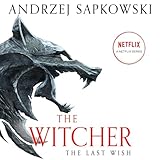
- Audible Audiobook
- Andrzej Sapkowski (Author) - Peter Kenny (Narrator)
- English (Publication Language)
- 05/05/2015 (Publication Date) - Orbit (Publisher)
5. Understand “A Question of Price.”
- Action: Read this story, focusing on the “Law of Surprise.”
- What to Look For: Grasp the concept of the Law of Surprise as a binding, often fated, agreement that influences future events.
- Mistake: Failing to recognize the Law of Surprise as a fundamental plot device that establishes crucial connections and obligations within the saga.
6. Conclude with “The Last Wish.”
- Action: Read the titular story, which further develops Geralt and Yennefer’s relationship.
- What to Look For: Observe the exploration of desire, sacrifice, and the consequences of wishes.
- Mistake: Viewing this as a definitive ending; the stories are designed to set up future narrative arcs rather than provide complete closure.
Common Mistakes
- Myth: “The Last Wish” is a typical action-oriented fantasy novel.
- Why it matters: This expectation can lead to disappointment due to the book’s episodic structure and its focus on moral complexity over constant combat.
- Fix: Understand that the book is a collection of short stories, each with its own narrative arc, linked by a framing device. The emphasis is on character, theme, and world-building through these individual encounters.
- Myth: Geralt is a straightforward hero fighting unambiguous evil.
- Why it matters: This mischaracterization ignores Sapkowski’s nuanced portrayal of Geralt as a pragmatic, often morally conflicted professional. His actions are driven by contracts and survival, not necessarily altruism.
- Fix: Recognize Geralt as a Witcher, a mutated monster slayer for hire. His internal struggles and the gray morality of his world are central to his character; he is not a simple champion of good.
- Myth: The monsters are the primary antagonists.
- Why it matters: This perspective overlooks Sapkowski’s thematic depth. Literal monsters often serve as catalysts to explore human failings, prejudices, and the darker aspects of human nature.
- Fix: Focus on the human characters and societal conflicts within each story. The true “monsters” are frequently revealed to be human greed, fear, and malice.
- Myth: The stories are simple retellings of classic fairy tales.
- Why it matters: This view fails to appreciate Sapkowski’s skill in deconstructing and subverting these narratives to explore more complex and mature themes.
- Fix: Identify the original folklore inspiration for each story and analyze how Sapkowski twists or subverts its familiar elements to comment on human nature and societal issues.
Expert Tips for Reading “The Last Wish”
- Tip: Appreciate the thematic significance of the framing narrative.
- Actionable Step: Dedicate attention to the dialogue and events in “The Voice of Reason.” This section provides crucial context for Geralt’s internal reflections and enhances the emotional impact of the subsequent tales.
- Common Mistake to Avoid: Skimming the frame story, treating it as mere connective tissue. This overlooks its role in establishing Geralt’s current state and the thematic underpinnings of the collection.
- Tip: Analyze Geralt’s professional detachment and code.
- Actionable Step: When Geralt encounters a challenge, observe his methodical approach, his focus on the contract, and his internal monologue regarding the pragmatic aspects of his profession, rather than expecting an emotional response.
- Common Mistake to Avoid: Projecting modern heroic archetypes onto Geralt. His Witcher training emphasizes detachment and efficiency, which is a survival mechanism in his world.
- Tip: Identify and analyze folklore subversions.
- Actionable Step: If a story’s premise feels familiar, research its fairy tale or folklore origin (e.g., “Beauty and the Beast” for “A Grain of Truth”). This allows for a deeper appreciation of Sapkowski’s thematic twists.
- Common Mistake to Avoid: Overlooking the inversions. Recognizing the original tale highlights how Sapkowski uses familiar narratives to explore darker, more complex themes about humanity and societal hypocrisy.
Frequently Asked Questions
- Q: Is “The Last Wish” by Andrzej Sapkowski a good starting point for newcomers to The Witcher?
A: Yes, it is specifically designed as an introduction. It establishes Geralt, his profession, the world’s tone, and key characters and concepts before the main saga begins.
- Q: Do I need to have prior knowledge of the Witcher games or show to understand this book?
A: No. “The Last Wish” serves as the origin point. While familiarity with other media might offer additional context, it is not required for comprehension. The book often provides a deeper, more nuanced perspective on characters and events.
- Q: How does the structure of “The Last Wish” differ from a typical novel?
A: This book is a collection of interconnected short stories, framed by a present-day narrative. Each story functions as a self-contained adventure or encounter, contributing to a larger tapestry of Geralt’s life and the Witcher universe, rather than following a single linear plot.
- Q: What is the significance of the “Law of Surprise” within the Witcher lore?
A: The Law of Surprise is a form of destiny or fate within the Witcher universe. It dictates that a person who provides unexpected aid is owed a debt, often claimed by what the recipient finds upon returning home. This concept is a critical plot device that establishes significant connections and obligations.
- Q: Are the stories in “The Last Wish” always grim and dark?
A: While the tone is mature and often bleak, Sapkowski incorporates elements of dark humor, complex character interactions, and philosophical contemplation. The stories explore moral gray areas where good and evil are not always clearly defined, offering a nuanced perspective.
BLOCKQUOTE_0
“The Last Wish” by Andrzej Sapkowski: A Comparative Analysis
| Feature | “The Last Wish” by Andrzej Sapkowski | “Sword of Destiny” (Witcher Collection) | “Blood of Elves” (Witcher Novel) |
|---|
Decision Rules
- If reliability is your top priority for The Last Wish by Andrzej Sapkowski, choose the option with the strongest long-term track record and support.
- If value matters most, compare total ownership cost instead of headline price alone.
- If your use case is specific, prioritize fit-for-purpose features over generic ‘best overall’ claims.