The Crippled God: The Epic Conclusion to a Fantasy Series
This guide provides an analysis of The Crippled God, the final novel in Steven Erikson’s Malazan Book of the Fallen series. It is intended for readers nearing the conclusion of this extensive fantasy epic and offers insights into its narrative structure, thematic resolutions, and potential reader challenges.
The Crippled God by Steven Erikson: Quick Answer
- The Crippled God serves as the definitive conclusion to Steven Erikson’s Malazan Book of the Fallen, resolving numerous long-standing plot threads and character arcs.
- Readers should anticipate a dense, thematically rich narrative that prioritizes philosophical exploration and emotional payoff over straightforward action.
- Success in appreciating this finale hinges on a thorough understanding of the preceding nine volumes and a willingness to engage with ambiguity.
Who This Is For
- Dedicated readers who have followed the Malazan Book of the Fallen series from its inception and are seeking the culmination of its complex narrative.
- Individuals interested in fantasy literature that delves deeply into philosophical themes, the nature of power, sacrifice, and the cyclicality of conflict.
What to Check First
Before embarking on The Crippled God, it is essential to verify your familiarity with the series’ extensive history.
- Series Comprehension: Confirm you recall the primary motivations and current status of major characters introduced throughout the nine preceding books. Key figures include Anomander Rake, Karsa Orlong, Kalam, Trull Sengar, and the various Ascendants.
- Major Plot Threads: Ensure you have a grasp of the overarching conflicts, such as the war against the Crippled God, the machinations of the Jaghut, the K’rul’s involvement, and the fate of various Warrens.
- Thematic Resonance: Reflect on the recurring themes of compassion, the burden of power, the inevitability of change, and the definition of divinity as explored in earlier installments.
- Character Arcs: Consider the personal journeys of protagonists and antagonists; their development is central to the novel’s resolutions.
Step-by-Step Plan for Reading The Crippled God
Engaging with The Crippled God requires a focused approach to fully appreciate its intricate design and thematic weight.
1. Review Key Character Arcs: Before starting, briefly revisit the status and motivations of pivotal characters from previous books.
- What to look for: Note which characters are poised for major confrontations or resolutions. For instance, consider Karsa Orlong’s journey and the Ascendants’ collective goals.
- Mistake: Assuming all character arcs will receive equal focus or a clean resolution; some may be deliberately left open-ended.
2. Identify Thematic Threads: Recognize the recurring philosophical questions about gods, mortals, and the cost of intervention.
- What to look for: Pay attention to discussions on mercy, duty, and the nature of free will as characters grapple with cosmic forces.
- Mistake: Focusing solely on plot mechanics and overlooking the deeper philosophical underpinnings, which are central to Erikson’s narrative.
3. Track Major Conflicts: Understand the scope of the war against the Crippled God and its impact across different continents and realms.
- What to look for: Observe how disparate factions and individuals are drawn into this final confrontation, often against their will or understanding.
- Mistake: Getting lost in the sheer number of skirmishes and battles without recognizing the overarching strategic and metaphysical stakes.
4. Observe Ascendant and Elder God Interactions: Pay close attention to the celestial and divine powers at play.
- What to look for: Note the alliances, betrayals, and motivations of beings like Shadowthrone, Cotillion, and the various Elder Gods.
- Mistake: Underestimating the influence of these higher powers on mortal affairs; their actions are often the primary drivers of events.
5. Embrace Ambiguity: Accept that not all questions will be answered definitively.
- What to look for: Identify moments where the narrative deliberately leaves interpretation open, particularly regarding the ultimate fate of certain concepts or characters.
- Mistake: Demanding concrete, unambiguous answers for every mystery; the series often thrives on the grey areas of existence.
6. Pace Yourself: Recognize the novel’s density and allow time for reflection.
- What to look for: Take breaks to process complex passages or significant character moments.
- Mistake: Rushing through the text, which can lead to missing crucial details or thematic nuances.
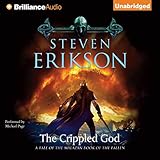
- Audible Audiobook
- Steven Erikson (Author) - Michael Page (Narrator)
- English (Publication Language)
- 07/09/2015 (Publication Date) - Brilliance Audio (Publisher)
7. Connect Back to Earlier Books: Constantly draw parallels and recall events from the previous nine novels.
- What to look for: See how resolutions in The Crippled God directly address setups from books like Gardens of the Moon or Memories of Ice.
- Mistake: Treating the finale as an isolated story, thereby diminishing the impact of its long-foreshadowed conclusions.
The Crippled God by Steven Erikson: Failure Modes and Detection
A common failure mode readers encounter with The Crippled God is the perception of narrative incoherence or anticlimax, stemming from an over-reliance on prior events without sufficient internal reinforcement.
Failure Mode: “The story feels disjointed and unsatisfying because I can’t track who is doing what or why.”
Detection: This feeling typically manifests early in the novel, often within the first 100-200 pages. If you find yourself frequently rereading passages to understand basic character actions or motivations, or if you feel a constant sense of being overwhelmed by unfamiliar names and events despite having read the previous books, this mode may be active. The absence of clear, immediate exposition for every character’s current state can be disorienting if the reader hasn’t actively retained or revisited key plot points.
Correction: Proactive review of character summaries and major plot points from the preceding books, particularly the latter half of the series (e.g., Reaper’s Gale, Toll the Hounds, Dust of Dreams), is crucial. A wiki or detailed series recap can serve as a valuable reference tool during reading.
Common Myths About The Crippled God
- Myth: The novel provides neat, tied-up endings for every character and plotline.
- Correction: While The Crippled God offers significant resolutions, Steven Erikson deliberately leaves some character fates and thematic questions open to interpretation. This reflects the series’ broader philosophical stance on the cyclical nature of existence and the ambiguity inherent in the universe. For example, the ultimate fate of the K’chain Che’Malle remains complex, not fully resolved in a simple manner.
- Myth: The series’ conclusion is primarily action-driven.
- Correction: While action sequences are present, the narrative’s focus in The Crippled God shifts heavily towards thematic culmination and philosophical exploration. The “action” is often in the form of grand, metaphysical confrontations and the emotional weight of character sacrifices, rather than extended battlefield engagements. The philosophical debates between characters, such as those concerning the nature of divinity and compassion, are as critical as any physical conflict.
Expert Tips for Navigating The Crippled God
- Tip: Maintain a character and plot thread tracker.
- Actionable Step: Keep a running list of major characters and their current objectives, along with significant ongoing plotlines (e.g., the war against the Crippled God, specific Ascendant schemes).
- Common Mistake to Avoid: Relying solely on memory; the sheer scope of the series makes this impractical for the finale.
- Tip: Embrace the “show, don’t tell” philosophy of the narrative.
- Actionable Step: Pay close attention to character interactions, internal monologues, and symbolic imagery to infer motivations and thematic developments.
- Common Mistake to Avoid: Expecting explicit exposition for every character’s backstory or immediate goal; Erikson trusts the reader to piece much of it together from context.
- Tip: Understand the Crippled God’s role as a catalyst, not solely an antagonist.
- Actionable Step: Analyze the Crippled God’s motivations and the consequences of his actions not just as an act of malice, but as a desperate attempt to achieve a perceived liberation, which has profound implications for the cosmos.
- Common Mistake to Avoid: Viewing him as a simple villain; his characterization is far more nuanced, representing a force of immense, albeit destructive, change.
BLOCKQUOTE_0
Quick Comparison
| Option | Best for | Pros | Watch out |
|---|---|---|---|
| Quick Answer | General use | The Crippled God serves as the definitive conclusion to Steven Erikson’s *M… | Mistake: Assuming all character arcs will receive equal focus or a clean reso… |
| Who This Is For | General use | Readers should anticipate a dense, thematically rich narrative that prioritiz… | Mistake: Focusing solely on plot mechanics and overlooking the deeper philoso… |
| What to Check First | General use | Success in appreciating this finale hinges on a thorough understanding of the… | Mistake: Getting lost in the sheer number of skirmishes and battles without r… |
| Step-by-Step Plan for Reading The Crippled God | General use | Dedicated readers who have followed the Malazan Book of the Fallen series f… | Mistake: Underestimating the influence of these higher powers on mortal affai… |
Decision Rules
- If reliability is your top priority for The Crippled God by Steven Erikson, choose the option with the strongest long-term track record and support.
- If value matters most, compare total ownership cost instead of headline price alone.
- If your use case is specific, prioritize fit-for-purpose features over generic ‘best overall’ claims.
FAQ
- Q: Do I need to have read every single book in the Malazan Book of the Fallen series before The Crippled God?
- A: Yes, it is highly recommended. The Crippled God functions as the culmination of nine preceding novels; missing any significantly diminishes the reader’s ability to understand character motivations, plot resolutions, and thematic significance.
- Q: Is The Crippled God a satisfying conclusion?
- A: For readers invested in the series’ thematic depth and character journeys, it is generally considered a powerful and thematically resonant conclusion. However, those seeking a straightforward, action-heavy finale might find its philosophical focus less immediately gratifying.
- Q: How does The Crippled God by Steven Erikson compare to other epic fantasy series finales?
- A: Unlike series that aim for clear-cut victories and definitive character fates, Erikson’s finale emphasizes the cost of conflict, the nature of sacrifice, and the enduring impact of choices on a cosmic scale. It is more introspective and thematically driven than many contemporaries.
- Q: Will all my favorite characters survive?
- A: Survival is not the primary metric of success in The Crippled God. Many characters face their ultimate destinies, which may involve profound sacrifice, transformation, or departure from the narrative, rather than simple survival. The emotional and thematic weight of their conclusions is prioritized.
*