Stefan Zweig’s Memoir: ‘The World of Yesterday
This review examines Stefan Zweig’s memoir, “The World of Yesterday,” offering a critical perspective on its historical significance and literary merits. It aims to provide readers with a nuanced understanding of the work’s strengths and limitations, guiding their decision on whether to engage with this seminal text.
Quick Answer
- “The World of Yesterday” by Stefan Zweig is a poignant memoir reflecting on the cultural and intellectual milieu of pre-World War I Europe, offering a personal yet broad historical perspective.
- It is essential reading for those interested in European history, the decline of the Austro-Hungarian Empire, and the psychological impact of societal upheaval.
- While lauded for its evocative prose, the memoir’s subjective lens and retrospective idealism warrant critical engagement.
Who This Is For
- Readers seeking a deeply personal account of a bygone era, rich with cultural observation and intellectual reflection.
- Individuals interested in understanding the societal and psychological forces that led to the cataclysm of World War I, as experienced by a prominent European intellectual.
What to Check First
- Author’s Context: Stefan Zweig was a celebrated Austrian-born novelist, playwright, and journalist, deeply embedded in the intellectual and artistic circles of Europe before his exile and eventual suicide in 1942. Understanding his life provides crucial context for his reflections.
- Historical Period: The memoir focuses on the period from Zweig’s youth in the late 19th century up to the outbreak of World War I, a time of immense cultural flowering and underlying political tension in Europe.
- Nostalgic Idealism: Zweig’s narrative, while compelling, is inherently nostalgic. It presents a romanticized view of the “peaceful world” before the war, which may not fully account for the societal fissures present even then.
- Subjectivity: As a memoir, the account is inherently subjective. Zweig’s personal experiences and interpretations shape the narrative, meaning it should be read as one perspective among many.
To truly immerse yourself in Stefan Zweig’s reflections, securing a copy of ‘The World of Yesterday’ is the first crucial step. This memoir offers an unparalleled window into his experiences.
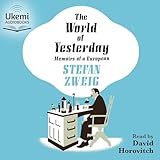
- Audible Audiobook
- Stefan Zweig (Author) - David Horovitch (Narrator)
- English (Publication Language)
- 05/10/2017 (Publication Date) - Ukemi Audiobooks from W. F. Howes Ltd (Publisher)
Step-by-Step Plan: Engaging with The World Of Yesterday by Stefan Zweig
1. Initiate with Biographical Context: Begin by understanding Stefan Zweig’s life and his position within European intellectual society.
- What to look for: Zweig’s early life, his literary successes, and his experiences as a refugee.
- Mistake to avoid: Assuming Zweig’s perspective is universally representative of all Europeans during that period.
2. Read the Early Chapters: Focus on Zweig’s depiction of his upbringing and the cultural landscape of Vienna.
- What to look for: The portrayal of intellectual freedom, artistic vibrancy, and the perceived stability of the Austro-Hungarian Empire.
- Mistake to avoid: Accepting the description of this era as purely idyllic without considering undercurrents of nationalism or social stratification.
3. Analyze the Transition to War: Pay close attention to Zweig’s account of the shift from peace to the onset of World War I.
- What to look for: The psychological impact of the war’s declaration on individuals and society, and Zweig’s personal sense of loss.
- Mistake to avoid: Overlooking the potential for Zweig to frame the pre-war period as more perfect in retrospect than it truly was.
4. Examine Cultural Observations: Note Zweig’s detailed observations on art, literature, music, and philosophy.
- What to look for: Specific examples of artists, writers, and thinkers he encountered or admired, and the cultural movements he describes.
- Mistake to avoid: Treating his cultural commentary as exhaustive; recognize it reflects his personal intellectual sphere.
5. Consider the Counterpoint: Acknowledge the inherent nostalgia and potential for idealization in the memoir.
- What to look for: Instances where Zweig might gloss over pre-war tensions or present a less critical view of the old order.
- Mistake to avoid: Reading “The World of Yesterday” as an objective historical document rather than a deeply personal reflection colored by loss.
6. Evaluate Literary Style: Appreciate Zweig’s eloquent prose and narrative skill.
- What to look for: The effectiveness of his language in evoking atmosphere and emotion.
- Mistake to avoid: Focusing solely on the narrative flow without engaging with the critical historical and psychological themes.
7. Reflect on The World Of Yesterday by Stefan Zweig’s Legacy: Consider the memoir’s enduring relevance.
- What to look for: How Zweig’s reflections on cultural identity, societal change, and the fragility of peace resonate today.
- Mistake to avoid: Dismissing the memoir as merely a historical artifact; its insights into human nature and societal dynamics remain pertinent.
The World Of Yesterday by Stefan Zweig: A Critical Perspective
Stefan Zweig’s “The World of Yesterday” is often lauded as a definitive portrait of a lost Europe. However, a closer examination reveals its subjective nature and the inherent biases of retrospective narration. While Zweig masterfully captures the cultural effervescence and intellectual vibrancy of the Belle Époque, particularly in Vienna, his depiction is filtered through the profound trauma of exile and the cataclysm of two world wars. The memoir functions as a eulogy for a world he perceived as irrevocably shattered, leading to a narrative that, while beautiful, leans towards idealization.
The strength of Zweig’s work lies in its evocative prose and its intimate portrayal of a specific intellectual and artistic milieu. He writes with a deep affection for the European culture that shaped him, detailing encounters with figures like Sigmund Freud and Arthur Schnitzler, and articulating a sense of shared European identity that transcended national borders. This personal connection makes his lament for the lost world palpable. However, this very intimacy also constitutes a limitation. Zweig’s focus is largely on the educated elite, and his portrayal of the pre-war era as a golden age of peace and enlightenment can overshadow the significant social, political, and ethnic tensions that simmered beneath the surface of the Austro-Hungarian Empire and wider Europe. A more comprehensive understanding of the period would require supplementing Zweig’s personal narrative with broader historical accounts.
Common Myths About The World Of Yesterday
- Myth 1: “The World of Yesterday” is a purely objective historical account of pre-war Europe.
- Why it matters: This misconception can lead readers to accept Zweig’s nostalgic portrayal as unvarnished fact, overlooking the inherent subjectivity of memory and personal experience.
- Fix: Approach the memoir as a deeply personal reflection and a work of literary art, rather than a dry historical chronicle. Cross-reference Zweig’s observations with other historical sources to gain a more balanced perspective.
- Myth 2: Zweig’s memoir exclusively focuses on the decline of the Austro-Hungarian Empire.
- Why it matters: While the empire is a significant backdrop, Zweig’s reflections extend to broader European cultural and intellectual trends, as well as his personal journey and eventual disillusionment.
- Fix: Recognize that the memoir encompasses a wider canvas of European intellectual life and the personal impact of societal collapse on an individual, not just a singular political entity.
- Myth 3: The memoir offers a comprehensive view of all European societies before WWI.
- Why it matters: Zweig’s perspective is primarily that of an educated, cosmopolitan European intellectual. His narrative may not fully represent the experiences of other social classes or national groups within the continent.
- Fix: Be aware that the “world” Zweig describes is largely his own social and intellectual circle. Seek out other narratives to understand the diverse experiences of the era.
Expert Tips for Reading “The World of Yesterday”
- Tip 1: Contextualize Zweig’s Exile: Understand that Zweig wrote this memoir while in exile, facing the loss of his homeland and a profound sense of displacement.
- Actionable step: Before or during reading, familiarize yourself with the timeline of Zweig’s exile and the circumstances of his death.
- Common mistake to avoid: Reading the memoir without acknowledging the author’s personal tragedy, which inevitably colors his recollections and interpretations.
- Tip 2: Identify the “Golden Age” Fallacy: Be critical of Zweig’s idealized portrayal of the pre-war era.
- Actionable step: Actively look for evidence of pre-war tensions, social inequalities, or political unrest within Zweig’s descriptions, even if he presents them as minor or easily overcome.
- Common mistake to avoid: Accepting the romanticized vision of a perfect, stable past without questioning its historical accuracy or completeness.
- Tip 3: Focus on Psychological Impact: Appreciate Zweig’s insights into the human psyche under duress.
- Actionable step: Pay attention to how Zweig describes the emotional and psychological responses of individuals and societies to the collapse of their familiar world.
- Common mistake to avoid: Treating the memoir solely as a historical recounting of events, rather than a profound exploration of human experience and the fragility of civilization.
BLOCKQUOTE_0
The World Of Yesterday by Stefan Zweig: Key Themes and Takeaways
Stefan Zweig’s memoir delves into several profound themes that continue to resonate. A central theme is the fragility of civilization. Zweig meticulously reconstructs a world that appeared stable and prosperous, only to witness its swift and brutal collapse. This serves as a stark reminder that cultural achievements and societal order are not immutable. Another key theme is cultural identity, particularly the cosmopolitan ideal of a unified European intellectual and artistic community that transcended nationalistic divides. Zweig mourns the loss of this interconnectedness, which he saw as a casualty of the war. Finally, the memoir powerfully explores nostalgia and memory, not as simple longing for the past, but as a complex psychological response to loss and trauma. Zweig’s recollection is not just a record but an act of preservation, a testament to a world that, in his eyes, represented a peak of humanistic achievement.
| Theme | Description | Concrete Takeaway |
|---|---|---|
| Fragility of Civilization | The sudden and violent destruction of a seemingly stable and prosperous era. | Societal progress and peace are not guaranteed and can be swiftly undone by conflict. |
| Cultural Identity | The ideal of a unified, cosmopolitan European intellectual and artistic community. | The importance of shared cultural values and the detrimental impact of nationalistic divisions. |
| Nostalgia and Memory | The complex psychological process of remembering and preserving a lost world in the face of trauma and loss. | Memory is a powerful tool for understanding the past, but it is also subjective and influenced by present pain. |
Decision Rules
- If reliability is your top priority for The World Of Yesterday by Stefan Zweig, choose the option with the strongest long-term track record and support.
- If value matters most, compare total ownership cost instead of headline price alone.
- If your use case is specific, prioritize fit-for-purpose features over generic ‘best overall’ claims.
FAQ
- Q: Is “The World of Yesterday” a reliable historical source?
A: “The World of Yesterday” is a powerful personal memoir, not a strictly objective historical account. It offers invaluable insights into the subjective experience of a particular time and place but should be read alongside other historical works for a balanced view.
- Q: Who were some of the key figures Stefan Zweig discusses in his memoir?
A: Zweig references numerous influential figures from the arts and sciences, including Sigmund Freud, Arthur Schnitzler, Gustav Klimt, and Richard Strauss, providing glimpses into his intellectual circles.
- Q: What is the primary emotion conveyed in “The World of Yesterday”?
A: The memoir is imbued with a profound sense of loss and nostalgia for a bygone era, coupled with an elegy for the cultural and intellectual world that was destroyed by the advent of World War I.
- Q: Should I read “The World of Yesterday” before or after reading other Zweig works?
A: While not strictly necessary, reading “The World of Yesterday” can provide valuable context for understanding Zweig’s fictional works, as it reveals the personal experiences and worldview that shaped his fiction. A review of The World Of Yesterday by Stefan Zweig can offer further perspective.