Sarah J. Maas’ A Court Of Thorns And Roses
A Court Of Thorns And Roses by Sarah J. Maas: Quick Answer
- Genre: Blends high fantasy with significant romantic development, drawing inspiration from fairy tales.
- Target Audience: Primarily young adult readers interested in fantasy, romance, and mythical creatures.
- Premise: A mortal woman is drawn into the fae world, navigating magical dangers and evolving romantic entanglements.
Who This Is For
- Readers seeking “romantasy” – a genre combining magic, mythical beings, and substantial romantic development.
- Individuals who appreciate fairy tale retellings with darker themes and character transformations.
What to Check First
- Fae World Rules: Assess the consistency and impact of established rules and social structures within the fae society.
- Romantic Pacing: Evaluate the development of the central romance for organic progression and believability.
- Protagonist’s Agency: Examine Feyre’s decision-making process and her overall character arc for consistent development.
- World-Building Depth: Investigate the complexity of Prythian’s history, politics, and magic for narrative immersion.
Step-by-Step Plan for Evaluating A Court of Thorns and Roses
1. Initial Immersion: Begin by reading the opening chapters.
- Action: Focus on Feyre’s life in poverty and the event leading to her interaction with the fae.
- What to Look For: The stark contrast between human and fae worlds, and Feyre’s initial survival motivations.
- Mistake to Avoid: Skipping descriptive passages; these establish the setting and Feyre’s early mindset.
2. The Fae Bargain: Analyze Feyre’s transition to the fae realm.
- Action: Pay attention to the circumstances of her capture and the terms of her stay with Tamlin.
- What to Look For: The initial power dynamics and underlying tension or intrigue surrounding the fae.
- Mistake to Avoid: Underestimating the foundational role of the initial “bargain” in driving the plot.
3. Relationship Dynamics Analysis: Observe Feyre’s interactions with Tamlin.
- Action: Track their evolving relationship, noting moments of conflict, curiosity, and developing connection.
- What to Look For: The progression of the “enemies-to-lovers” trope and the authenticity of their dialogue.
- Mistake to Avoid: Expecting immediate romantic chemistry; the foundation is often built on tension and misunderstanding.
4. Prythian’s Central Conflict: Investigate the unfolding mystery and curse.
- Action: Focus on the lore surrounding the blight, Amarantha’s curse, and its impact on the fae.
- What to Look For: How fae mythology and the stakes of the curse are integrated into the narrative.
- Mistake to Avoid: Overlooking fantasy plot elements in favor of romance; they are intrinsically linked.
5. Feyre’s Character Arc: Evaluate Feyre’s role in the latter half of the book.
- Action: Examine her actions and decisions as narrative stakes increase towards the climax.
- What to Look For: Evidence of her personal growth and whether her choices stem from internal development or external plot demands.
- Mistake to Avoid: Perceiving Feyre as purely reactive; look for instances where she actively influences events.
6. Climax and Resolution Review: Read through the concluding chapters.
- Action: Analyze the confrontation with Amarantha and the subsequent resolution.
- What to Look For: Thematic coherence of the ending and its effectiveness in concluding the immediate arc while setting up future installments.
- Mistake to Avoid: Expecting a simple resolution without acknowledging the narrative’s established complexities and consequences.
For those seeking a quick overview of Sarah J. Maas’s popular novel, ‘A Court of Thorns and Roses’ offers a captivating blend of fantasy and romance.
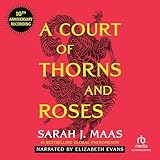
- Audible Audiobook
- Sarah J. Maas (Author) - Elizabeth Evans (Narrator)
- English (Publication Language)
- 05/30/2025 (Publication Date) - Recorded Books (Publisher)
Common Mistakes
- Mistake: Expecting a fast-paced, action-heavy plot from the very beginning.
- Why it Matters: The initial chapters establish Feyre’s bleak reality and introduce the fae world, leading to a slower narrative pace.
- Fix: Exercise patience; the narrative builds momentum as Feyre integrates into the fae realm and the central conflict unfolds.
- Mistake: Disregarding the importance of the fae lore and its rules.
- Why it Matters: The intricacies of fae society, their magic, and history are fundamental to understanding character motivations and plot developments.
- Fix: Engage with the world-building details; they provide context for character actions and narrative stakes.
- Mistake: Viewing the book solely as a “Beauty and the Beast” retelling.
- Why it Matters: While inspired by the fairy tale, A Court of Thorns and Roses by Sarah J. Maas develops its own unique mythology, characters, and thematic depth.
- Fix: Appreciate the foundational inspiration while recognizing the distinct elements and original contributions Maas brings to the narrative.
- Mistake: Underestimating the presence of mature themes and darker elements.
- Why it Matters: The book contains instances of violence, peril, and complex emotional situations integral to the story’s stakes and character development.
- Fix: Be prepared for a narrative that balances romantic elements with significant conflict and high stakes, consistent with the fantasy genre.
A Court of Thorns and Roses by Sarah J. Maas: Decision Criteria
The primary decision criterion that alters the recommendation for A Court of Thorns and Roses is reader tolerance for explicit romantic content interwoven with high fantasy.
- For readers prioritizing romance: If a significant, developing romantic arc is a key driver for enjoyment, this book is highly recommended. The romantic development is central to Feyre’s journey and the narrative’s progression.
- For readers prioritizing pure fantasy: If the expectation is a fantasy novel with minimal or secondary romantic elements, this book might be less suitable. The romance is not merely a subplot but a core component, and its integration may detract from a reader seeking solely epic quests or political intrigue without a strong romantic focus.
Expert Tips
- Tip: Pay close attention to the nuances of fae etiquette and social hierarchies.
- Actionable Step: When reading descriptions of interactions between fae characters or Feyre’s attempts to navigate fae society, note specific customs, titles, and implied power dynamics.
- Common Mistake to Avoid: Glossing over these details as mere flavor text; they often foreshadow character relationships and plot developments, such as the strict rules governing interactions with the High Lord.
- Tip: Track Feyre’s emotional and psychological transformation alongside the plot.
- Actionable Step: Make mental notes or brief annotations of Feyre’s feelings, fears, and evolving perceptions of the fae and her situation.
- Common Mistake to Avoid: Focusing solely on external events; Feyre’s internal journey is as critical as the external conflicts and is essential for understanding her motivations and growth.
- Tip: Recognize the symbolic weight of the magical elements and curses.
- Actionable Step: Consider what the magical afflictions, enchanted objects, or specific fae powers might represent thematically. For instance, the curse on Amarantha and its spread can be seen as a metaphor for corruption and despair.
- Common Mistake to Avoid: Treating magic as purely functional plot devices without considering their deeper symbolic meaning within the narrative’s themes of sacrifice, love, and redemption.
Critical Comparison of Fantasy Romances
| Book Title & Author | Primary Audience | Key Strengths | Potential Weaknesses |
|---|---|---|---|
| A Court of Thorns and Roses by Sarah J. Maas | Young Adult Fantasy Romance readers | Immersive world-building, strong romantic development, compelling protagonist arc. | Pacing can be slow initially; mature themes may require reader discretion. |
| From Blood and Ash by Jennifer L. Armentrout | Adult Fantasy Romance readers | Fast-paced plot, explicit romance, focus on mystery. | World-building can be less intricate than ACOTAR; character motivations sometimes unclear. |
| Serpent & Dove by Shelby Mahurin | Young Adult Fantasy readers with romantic elements | Unique magic system (witchcraft), strong female lead, enemies-to-lovers trope. | Romance can feel secondary to plot for some readers; pacing can be uneven. |
Decision Rules for Book Selection
- If immersion in a richly detailed magical world with a central romantic plot is your priority for A Court Of Thorns And Roses by Sarah J. Maas, this book is a strong candidate.
- If a fast-paced plot with immediate romantic tension is preferred, consider alternatives like From Blood and Ash.
- If a focus on magical systems and a more balanced fantasy-romance ratio is desired, Serpent & Dove might be a better fit.
FAQ
- Q: Is A Court of Thorns and Roses suitable for young adult readers?
- A: Yes, it is categorized as Young Adult (YA) fantasy romance. However, it contains mature themes, violence, and peril, so parental guidance may be advisable depending on the reader’s age and maturity level.
- Q: How does A Court of Thorns and Roses by Sarah J. Maas compare to other fae fantasies?
- A: It distinguishes itself by integrating a prominent romantic arc directly into the high fantasy setting. While many fae fantasies focus more on political intrigue or epic quests, Maas places a strong emphasis on the development of romantic relationships as a driving force, often employing “Beauty and the Beast” inspired dynamics.
- Q: Does the book require prior knowledge of other Sarah J. Maas series?
- A: No, A Court of Thorns and Roses is the inaugural book in its own series and establishes its world and characters independently. It can be read without prior knowledge of Maas’s other works