Robert A. Heinlein’s Citizen Of The Galaxy Explained
Quick Answer
- Core Conflict: Explores the journey of an orphaned boy, Thorby, sold into servitude, as he navigates a complex interstellar society and confronts the meaning of freedom and responsibility.
- Key Themes: Focuses on the nature of freedom, the ethics of slavery, societal structures, prejudice, and the concept of citizenship across diverse alien cultures.
- Narrative Style: Combines adventure, philosophical inquiry, and social commentary through the eyes of a young protagonist learning about the galaxy.
Who This Is For
- Readers seeking classic science fiction that critically examines societal norms and ethical dilemmas.
- Individuals interested in coming-of-age narratives that blend adventure with philosophical exploration of freedom and responsibility.
What to Check First
- Author’s Context: Robert A. Heinlein is known for exploring themes of individualism, self-reliance, and libertarian principles in his works.
- Publication Era: Published in 1957, the novel reflects mid-20th-century science fiction’s engagement with societal structures and technological advancement.
- Narrative Perspective: The story is primarily told from the viewpoint of Thorby, allowing readers to experience his gradual understanding of the galactic world.
- Societal Commentary: The book uses alien societies and human interactions to critique various forms of governance and social stratification.
Citizen Of The Galaxy by Robert A. Heinlein: A Deep Dive
Citizen Of The Galaxy by Robert A. Heinlein centers on Thorby, an orphan whose life is irrevocably altered when he is sold into indentured servitude. His subsequent journey across a vast and varied galaxy serves as a crucible for Heinlein’s examination of freedom, responsibility, and the often-arbitrary nature of societal hierarchies. The narrative challenges the reader to question what constitutes genuine liberty and the obligations that accompany it, presenting a stark contrast between different forms of social organization.
The story’s structure follows Thorby’s progressive understanding of the universe, from the brutal realities of the slave trade to the intricate customs of alien civilizations. Guided by the mysterious and competent “Old Ben,” Thorby learns to observe, adapt, and critically analyze the worlds he encounters. Heinlein does not shy away from depicting the harshness of systems like slavery, using Thorby’s initial predicament as a powerful catalyst for his intellectual and moral development.
Step-by-Step Plan: Deconstructing Thorby’s Galactic Journey
1. The Sale into Servitude: Examine the initial circumstances of Thorby’s transaction.
- Action: Note the legal and social frameworks that permit the sale of individuals.
- What to Look For: The dehumanizing aspects of treating sentient beings as commodities and the immediate loss of autonomy.
- Mistake: Underestimating the significance of this event as the primary driver for Thorby’s subsequent quest for understanding freedom.
2. Life Aboard the Forward: Observe Thorby’s adaptation to his new environment.
- Action: Identify the key figures and the ship’s role as a microcosm of galactic society.
- What to Look For: The introduction of Old Ben and the early signs of Thorby’s analytical mind and resilience.
- Mistake: Dismissing Old Ben’s influence as mere protection rather than deliberate, subtle instruction.
3. Encountering the Ktharr: Analyze Thorby’s interactions with this dominant alien species.
- Action: Study their social structure, customs, and their views on other species.
- What to Look For: The rigid, hierarchical nature of Ktharr society and their inherent belief in their own supremacy.
- Mistake: Accepting the Ktharr’s self-proclaimed status without recognizing it as a constructed societal norm.
4. Mentorship and Education: Track the lessons imparted by Old Ben.
- Action: Identify specific instances of teaching or philosophical discourse.
- What to Look For: Emphasis on self-reliance, critical thinking, and understanding power dynamics.
- Mistake: Believing Old Ben’s purpose is solely to safeguard Thorby, rather than to equip him with the knowledge to navigate complex systems.
For a classic science fiction journey that delves into freedom and responsibility, Robert A. Heinlein’s ‘Citizen Of The Galaxy’ is a must-read. This novel offers a compelling exploration of societal structures and ethical dilemmas through the eyes of its young protagonist.
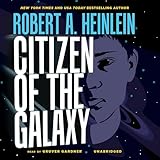
- Audible Audiobook
- Robert A. Heinlein (Author) - Grover Gardner (Narrator)
- English (Publication Language)
- 12/06/2013 (Publication Date) - Blackstone Audio, Inc. (Publisher)
5. Unraveling His Heritage: Follow Thorby’s investigation into his past.
- Action: Note the clues and discoveries related to his lineage and its implications.
- What to Look For: The connections between his personal history and the broader political landscape of the galaxy.
- Mistake: Viewing his heritage as mere biographical detail, rather than a key to understanding galactic conflicts and power structures.
6. Contrasting “Free Worlds”: Compare the various governance models Thorby encounters.
- Action: Analyze the freedoms, restrictions, and social controls in different locations.
- What to Look For: The spectrum of societal organization, from oppressive to ostensibly free, and the responsibilities associated with each.
- Mistake: Overlooking Heinlein’s subtle argument that true freedom requires active participation and responsibility, not just the absence of chains.
7. Embracing True Citizenship: Assess Thorby’s final understanding and actions.
- Action: Observe his decisions regarding his identity, his future, and his role in the galactic community.
- What to Look For: His acceptance of his past and his commitment to responsible action based on his acquired knowledge.
- Mistake: Failing to recognize that Thorby’s arc culminates in an active embrace of his responsibilities as a citizen, not a passive acceptance of his circumstances.
Citizen Of The Galaxy by Robert A. Heinlein: Countering Common Misconceptions
This section addresses prevalent misunderstandings regarding Citizen Of The Galaxy by Robert A. Heinlein, offering a more precise interpretation of its core messages and thematic depth.
- Myth: The novel is a simple adventure story aimed solely at young adults with superficial themes.
- Why it Matters: This perspective diminishes the profound philosophical and sociological commentary embedded within the narrative, overlooking its relevance for mature readers.
- Fix: Recognize that while it contains adventure elements, the story functions as a serious exploration of ethics, governance, and prejudice, offering substantial thematic weight.
- Myth: Heinlein advocates for a society devoid of structure or external authority, promoting pure anarchy.
- Why it Matters: This misinterprets Heinlein’s emphasis on individual competence and responsibility as a foundation for order, not as a rejection of all societal organization.
- Fix: Understand that Heinlein champions self-governance and personal accountability within a framework that respects individual rights, not the absence of all guiding principles.
- Myth: Thorby is a passive character, shaped entirely by external forces and the actions of others.
- Why it Matters: This overlooks Thorby’s inherent agency, his developing capacity for critical thought, and the conscious choices he makes throughout his journey.
- Fix: Acknowledge Thorby’s evolving decision-making processes, his intellectual curiosity, and his eventual assumption of responsibility, highlighting his active growth rather than passive reception of events.
Expert Tips for Deeper Appreciation
To fully grasp the nuances of Citizen Of The Galaxy by Robert A. Heinlein, consider these practical insights for a more critical reading experience:
- Tip 1: Analyze Societal Systems Rigorously.
- Actionable Step: For each society Thorby encounters, systematically document its primary governing principle, its methods of social control, and the resulting impact on individual autonomy and dignity.
- Common Mistake to Avoid: Accepting the superficial description of a society without probing its underlying mechanisms or questioning the hidden costs associated with its order or perceived freedom.
- Tip 2: Focus on Heinlein’s “Competent Man” Philosophy.
- Actionable Step: Identify specific instances where Thorby, or characters like Old Ben, demonstrate self-reliance, effective problem-solving, and moral clarity when faced with challenging circumstances.
- Common Mistake to Avoid: Overlooking the crucial role of competence as a prerequisite for freedom and responsible action within Heinlein’s fictional universe.
- Tip 3: Trace the Evolution of the Concept of “Freedom.”
- Actionable Step: Map Thorby’s evolving understanding of freedom, from his initial lack of it as a slave to his eventual realization of its complexities and inherent responsibilities.
- Common Mistake to Avoid: Equating freedom solely with the absence of external constraint, neglecting Heinlein’s emphasis on the internal capacity for responsible choice and action as integral to true liberty.
Decision Framework
- For foundational science fiction: Prioritize works that established key themes and narrative structures within the genre.
- For character-driven narratives: Select stories featuring protagonists who undergo significant personal development and intellectual growth.
- For thematic depth: Choose books that engage with philosophical and societal questions, offering complex ideas beyond simple plot mechanics.
Decision Rules
- If reliability in understanding Heinlein’s themes is your top priority for Citizen Of The Galaxy by Robert A. Heinlein, choose analyses that provide detailed textual evidence.
- If value in appreciating the novel’s impact matters most, compare its influence on later science fiction rather than just its plot.
- If your use case is specific to understanding Heinlein’s political philosophy, prioritize interpretations that focus on his libertarian underpinnings.
Quick Comparison
| Option | Best for | Pros | Watch out |
|---|---|---|---|
| Quick Answer | General use | Core Conflict: Explores the journey of an orphaned boy, Thorby, sold into ser… | Mistake: Underestimating the significance of this event as the primary driver… |
| Who This Is For | General use | Key Themes: Focuses on the nature of freedom, the ethics of slavery, societal… | Mistake: Dismissing Old Ben’s influence as mere protection rather than delibe… |
| What to Check First | General use | Narrative Style: Combines adventure, philosophical inquiry, and social commen… | Mistake: Accepting the Ktharr’s self-proclaimed status without recognizing it… |
| Citizen Of The Galaxy by Robert A Heinlein A Deep Dive | General use | Readers seeking classic science fiction that critically examines societal nor… | Mistake: Believing Old Ben’s purpose is solely to safeguard Thorby, rather th… |
FAQ
- Q: Is Citizen of the Galaxy a standalone novel, or part of a series?
A: Citizen of the Galaxy is a standalone novel and does not require prior reading of other works by Robert A. Heinlein.
- Q: What are the primary philosophical questions explored in the book?
A: The novel critically examines the nature of freedom, the ethics of slavery, the pervasive impact of prejudice, the definition of citizenship, and the inherent responsibilities that accompany individual liberty.
- Q: Which alien species plays the most significant role in the narrative?
A