Paul Harding’s ‘This Other Eden’: A Literary Analysis
This analysis critically examines Paul Harding’s novel, ‘This Other Eden,’ focusing on its narrative construction, thematic depth, and suitability for specific readers. It adopts a discerning perspective, highlighting potential interpretive challenges alongside the work’s significant literary achievements. The novel is best approached by readers prepared for a dense, atmospheric, and thematically rich experience.
Who This Is For
- Readers who appreciate literary fiction that prioritizes lyrical prose and thematic exploration over conventional plot mechanics.
- Individuals interested in novels that engage with complex themes of race, displacement, community, and the enduring legacy of historical injustice in America.
What to Check First
- Narrative Structure: Harding employs a non-linear, mosaic-like structure, weaving together multiple perspectives and temporal strands. Assess your comfort with this approach.
- Prose Density: The novel is characterized by its rich, often dense, and highly descriptive language. Determine if this stylistic intensity aligns with your reading preferences.
- Thematic Focus: The core themes revolve around the forced removal of a mixed-race community from an island, exploring identity, belonging, and historical trauma. Consider if these weighty subjects resonate with your current reading interests.
- Pacing: The narrative pace is deliberate, emphasizing atmosphere, character interiority, and the evocation of place rather than rapid plot advancement.
Step-by-Step Plan for Engaging with This Other Eden by Paul Harding
1. Initial Immersion (First 50 Pages):
- Action: Begin reading, focusing on absorbing the atmosphere and the distinct linguistic texture Harding establishes. Pay attention to the initial introduction of characters and the setting of Acre, Maine.
- What to Look For: The unique cadence of the prose, the establishment of the island community, and early hints of the central conflict and historical context.
- Mistake to Avoid: Expecting a traditional, linear plot. Harding’s approach is impressionistic; focus on the sensory experience and the emerging voices.
2. Character and Setting Mapping (First 100 Pages):
- Action: Start noting key individuals and their relationships, and begin to visualize the island community and its geography as described.
- What to Look For: Subtle character revelations through dialogue, internal thought, and fragmented memories. Identify recurring motifs and the sense of place Harding cultivates.
- Mistake to Avoid: Dismissing characters who appear briefly or whose roles are not immediately clear. Many contribute to the novel’s mosaic of interconnected lives.
3. Navigating the Narrative Structure (Ongoing):
- Action: Actively acknowledge and track shifts in perspective and time. Do not force a chronological order where none is explicitly provided.
- What to Look For: Thematic connections Harding draws between disparate moments and individuals. Observe how past events and memories inform the present situation on Acre.
- Mistake to Avoid: Becoming frustrated by the narrative’s fragmented nature. These shifts are integral to the novel’s exploration of memory, legacy, and the persistence of history.
4. Thematic Deep Dive (Mid-Novel):
- Action: Reflect on the recurring themes of race, displacement, exile, and the search for belonging. Consider how these abstract concepts are embodied by specific characters and events.
- What to Look For: The novel’s nuanced engagement with the historical reality of forced relocation and its profound impact on marginalized communities.
- Mistake to Avoid: Focusing solely on plot resolution. The novel’s power and lasting impact lie in its thematic resonance and emotional depth, rather than a straightforward narrative arc.
5. Appreciating the Prose (Ongoing):
- Action: Savor Harding’s distinctive prose, rereading passages that strike you with their imagery, emotional resonance, or sonic qualities.
- What to Look For: Deliberate word choices, sentence rhythm, and evocative descriptions that create a palpable sense of place and mood.
- Mistake to Avoid: Skimming descriptive passages. The language itself is a crucial element of the novel’s artistry and contributes significantly to its overall impact.
6. Contextualizing the Narrative (Toward the End):
- Action: Consider the historical inspirations behind the novel, particularly the story of Malaga Island, Maine.
- What to Look For: How Harding fictionalizes and expands upon historical events to create a narrative about human resilience, the costs of prejudice, and the erasure of history.
- Mistake to Avoid: Treating the novel as pure historical reportage. It is a work of fiction that uses historical events as a foundation for exploring broader human experiences.
7. Final Reflection (Post-Reading):
- Action: Ponder the novel’s lasting impressions and its commentary on American identity, community, and memory.
- What to Look For: Lingering questions, the emotional weight the novel leaves with the reader, and its contribution to contemporary American literature.
- Mistake to Avoid: Expecting neat conclusions or definitive answers. Harding’s work often leaves readers with ambiguity and a call for continued contemplation.
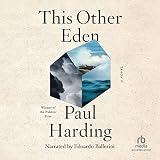
- Audible Audiobook
- Paul Harding (Author) - Edoardo Ballerini (Narrator)
- English (Publication Language)
- 01/24/2023 (Publication Date) - Recorded Books (Publisher)
Understanding This Other Eden by Paul Harding
Paul Harding’s novel is deeply rooted in the historical reality of the forced removal of residents from Malaga Island, Maine, in the early 20th century. This island community, notably comprised of both Black and white individuals, was deemed undesirable by the state, leading to the dispersal of its inhabitants. Harding employs this historical event as a prism, refracting it through a series of interconnected narratives to construct a tapestry of lives impacted by this act of erasure. The novel prioritizes the lingering echoes of such injustices, the fragmentation of memory, and the enduring human spirit over a linear retelling of events. The prose itself functions as a vital element, dense with imagery and a profound sense of place, mirroring the deep roots and subsequent upheaval of the island’s inhabitants.
Common Myths About This Other Eden
- Myth: The novel is a straightforward historical account of Malaga Island.
- Why it Matters: This misconception can lead to disappointment if readers expect a factual, chronological narrative, overlooking the fictional and thematic intentions.
- Correction: While inspired by historical events, ‘This Other Eden’ is a work of fiction. Harding uses the historical context of Malaga Island as a springboard for exploring broader themes of identity, memory, and displacement through a fictionalized lens. The characters and specific events are Harding’s creations, designed to evoke emotional and thematic resonance rather than strict historical accuracy.
- Myth: The fragmented structure is a flaw that hinders understanding.
- Why it Matters: Readers may abandon the book believing it is poorly constructed or inaccessible, missing the deliberate artistic purpose of its form.
- Correction: The non-linear and multi-perspective structure is a deliberate artistic choice. It mirrors the fractured nature of memory, the persistence of the past in the present, and the collective yet distinct experiences of the island’s residents. Engaging with this structure actively enhances the reader’s understanding of the novel’s thematic concerns.
Expert Tips for Reading This Other Eden
- Tip: Embrace the lyrical prose.
- Actionable Step: Read passages aloud to appreciate the rhythm, sonic qualities, and layered meanings within Harding’s language.
- Common Mistake to Avoid: Skimming descriptive passages, which can lead to missing the emotional depth and thematic undertones embedded within the sentences.
- Tip: Keep track of characters and timelines.
- Actionable Step: Maintain a simple list of characters and their primary associations or temporal settings as they are introduced, rather than trying to force a linear narrative.
- Common Mistake to Avoid: Becoming overwhelmed by the shifting perspectives and trying to impose a chronological order too early in the reading process, which can obstruct appreciation of the novel’s structure.
- Tip: Consider the historical context as a thematic anchor, not a plot driver.
- Actionable Step: Briefly research Malaga Island, Maine, before or during reading to understand the historical backdrop and the real-world events that inspired the novel.
- Common Mistake to Avoid: Approaching the novel as a history lesson and expecting every detail to be factually verifiable, which can detract from its fictional and artistic merits.
Decision Criterion: Reader Constraint
When deciding whether ‘This Other Eden’ is the right book for you at this moment, consider your tolerance for narrative ambiguity. If you require a clear, resolution-driven plot with distinct character arcs that tie up neatly, this novel may present a challenge. However, if you are drawn to works that linger, provoke thought, and explore the complexities of human experience through evocative language and a mosaic of perspectives, then ‘This Other Eden’ offers a deeply rewarding, albeit demanding, reading experience.
Comparative Strengths and Limitations
| Aspect | Strength | Limitation |
|---|---|---|
| Prose | Lyrical, evocative, and deeply atmospheric, creating a profound sense of place and emotional resonance. | Can be dense and demanding, potentially slowing down readers who prefer direct, unadorned narrative. |
| Structure | Fragmented and multi-perspectival, effectively mirroring the nature of memory, historical fragmentation, and collective experience. | Requires active reader engagement to piece together connections and timelines, which may be taxing for some. |
| Thematic Exploration | Profound and nuanced engagement with race, displacement, identity, and the enduring legacy of historical injustice. | The weight and complexity of the themes may be challenging for readers seeking lighter or more escapist fare. |
| Historical Basis | Grounds the narrative in significant, albeit often overlooked, American history, lending it a powerful sense of verisimilitude and purpose. | The fictionalization means it is not a substitute for direct historical accounts and may not satisfy those seeking purely factual reporting. |
Decision Rules
- If reliability is your top priority for This Other Eden by Paul Harding, choose the option with the strongest long-term track record and support.
- If value matters most, compare total ownership cost instead of headline price alone.