Nikos Kazantzakis’ Zorba the Greek: Life and Philosophy
Nikos Kazantzakis’s Zorba the Greek is a novel that has resonated with readers for decades, often provoking strong reactions. This guide provides a precise breakdown of its thematic core, narrative structure, and potential reader engagement points, focusing on actionable insights for those approaching the text. It is for readers interested in philosophical fiction that challenges conventional societal norms and explores human behavior.
Zorba the Greek by Nikos Kazantzakis: Quick Answer
- Thematic Focus: Explores the dichotomy between intellectualism and instinctual living, advocating for embracing life’s fullness.
- Narrative Strength: Character-driven, with Zorba as a vibrant embodiment of uninhibited existence.
- Reader Engagement: Requires an openness to confronting existential questions and unconventional philosophies.
Who This Is For
- Readers interested in philosophical fiction that challenges conventional societal norms and explores human behavior.
- Individuals seeking a narrative that contrasts intellectual pursuits with visceral, instinctual living.
What to Check First
- Author’s Philosophical Stance: Kazantzakis infused his work with his own complex spiritual and philosophical journey, evident in the text.
- Central Conflict: The novel hinges on the dynamic between the unnamed narrator’s intellectual detachment and Zorba’s unbridled passion for life.
- Symbolism: Pay attention to recurring symbols like the sea, music, and dance, which are integral to the novel’s themes.
- Narrative Tone: The tone shifts between introspective analysis and exuberant celebration, reflecting the characters’ internal and external worlds.
Step-by-Step Plan for Engaging with Zorba the Greek
1. Initial Reading for Narrative Flow: Read the novel through once to grasp the plot and character interactions.
- Action: Read from beginning to end without excessive annotation.
- What to Look For: The unfolding relationship between the narrator and Zorba, and the key events that shape their journey.
- Mistake to Avoid: Getting bogged down in every philosophical nuance on the first pass, which can hinder overall comprehension.
2. Identify the Narrator’s Arc: Focus on the narrator’s transformation from a detached intellectual to someone more open to life’s experiences.
- Action: Note specific instances where the narrator’s perspective shifts or is challenged by Zorba.
- What to Look For: Moments of internal conflict, hesitation, and eventual embrace of Zorba’s philosophy.
- Mistake to Avoid: Overlooking the narrator’s passive role as a foil to Zorba’s active engagement with life.
3. Analyze Zorba’s Philosophy: Examine Zorba’s core beliefs and how he embodies them through his actions and words.
- Action: Highlight quotes and scenes that define Zorba’s approach to living.
- What to Look For: His emphasis on the present moment, the importance of simple pleasures, and his rejection of rigid dogma.
- Mistake to Avoid: Dismissing Zorba’s philosophy as mere hedonism without understanding its deeper existential underpinnings.
For those looking to dive directly into the essence of Kazantzakis’ masterpiece, the novel itself is an essential starting point.
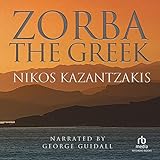
- Audible Audiobook
- Nikos Kazantzakis (Author) - George Guidall (Narrator)
- English (Publication Language)
- 07/27/2011 (Publication Date) - Recorded Books (Publisher)
4. Explore Thematic Contrasts: Identify and analyze the core dichotomies presented in the novel.
- Action: List the primary thematic oppositions (e.g., reason vs. instinct, spirit vs. flesh, despair vs. joy).
- What to Look For: How these contrasts are illustrated through character interactions and plot developments.
- Mistake to Avoid: Treating these themes as separate entities rather than intertwined forces shaping the narrative.
5. Consider the Novel’s Ending: Reflect on the conclusion and its implications for the narrator and the reader.
- Action: Re-read the final chapters and the narrator’s reflections.
- What to Look For: The lasting impact of Zorba’s influence and the narrator’s ultimate outlook.
- Mistake to Avoid: Interpreting the ending as a simple resolution, rather than an ongoing process of integration.
Zorba the Greek by Nikos Kazantzakis: Failure Mode Analysis
A significant failure mode readers encounter with Zorba the Greek by Nikos Kazantzakis is misinterpreting Zorba’s vitality as mere recklessness or nihilism. This occurs when readers, accustomed to more conventional moral frameworks, view Zorba’s uninhibited embrace of life as a lack of responsibility or a denial of suffering.
- Detection: This misinterpretation often surfaces in reader discussions or internal monologues where Zorba’s actions are framed as chaotic or self-destructive, rather than as a conscious choice to prioritize immediate experience and joy over societal expectations or future anxieties. Look for phrases that describe Zorba as “irresponsible,” “childish,” or “dangerously impulsive” without acknowledging the underlying philosophy of embracing the present.
- Fix: To counteract this, readers should actively seek out the moments where Zorba articulates his worldview. Kazantzakis carefully crafts Zorba’s dialogue to reveal a profound, albeit unconventional, wisdom. Focusing on Zorba’s acceptance of impermanence and his belief that true freedom lies in experiencing life fully, with all its joys and sorrows, can reframe his actions not as recklessness, but as a radical form of authenticity. The goal is to see his “madness” as a deliberate choice to live fully, rather than a surrender to chaos.
Common Myths
- Myth 1: Zorba’s philosophy is simply about hedonism and immediate gratification.
- Evidence: While Zorba enjoys life’s pleasures, his philosophy extends to a profound acceptance of existence, including its suffering and impermanence. He advocates for experiencing life fully, not just seeking pleasure. His dancing, for example, is not just enjoyment but an expression of his engagement with the world.
- Correction: Zorba’s approach is about embracing the totality of life, not just its superficial delights. It’s a form of existential affirmation.
- Myth 2: The novel is purely an endorsement of Zorba’s lifestyle, with the narrator serving as a passive observer.
- Evidence: The narrator’s internal struggle and eventual integration of Zorba’s lessons are central to the narrative. The novel explores the tension between different ways of living, and the narrator’s journey is one of significant, albeit subtle, transformation.
- Correction: The narrator’s intellectualism provides a crucial counterpoint, and the novel’s power lies in the dialogue and contrast between these two perspectives, rather than a one-sided endorsement.
Expert Tips for Engaging with the Text
- Tip 1: Embrace the “Dance” of Life: Recognize that Zorba’s dancing is a metaphor for fully engaging with life’s challenges and joys.
- Actionable Step: When encountering difficult passages or philosophical concepts, try to find the underlying “rhythm” or emotional truth rather than solely relying on intellectual analysis.
- Common Mistake to Avoid: Dismissing Zorba’s exuberance as superficial or escapist; instead, look for the deep connection to existence it represents.
- Tip 2: Understand the “Kafé” as a Microcosm: The village kafé serves as a stage for human interaction, revealing both the best and worst of humanity.
- Actionable Step: Observe the interactions within the kafé scenes closely. Note how different characters react to Zorba and the narrator, and what these reactions reveal about societal pressures and individual freedom.
- Common Mistake to Avoid: Focusing only on the plot points occurring in the kafé without appreciating its symbolic role in depicting the community’s collective consciousness and its resistance to change.
- Tip 3: Question Intellectual Detachment: The narrator’s initial state is one of intellectual detachment, which the novel critiques.
- Actionable Step: Be critical of the narrator’s tendency to analyze rather than feel. Consider how this detachment prevents him from fully experiencing life.
- Common Mistake to Avoid: Identifying too strongly with the narrator’s intellectualism without recognizing its limitations as presented by Kazantzakis.
Decision Rules
- If reliability is your top priority for Zorba the Greek by Nikos Kazantzakis, choose the option with the strongest long-term track record and support.
- If value matters most, compare total ownership cost instead of headline price alone.
- If your use case is specific, prioritize fit-for-purpose features over generic ‘best overall’ claims.
FAQ
- Q1: Is Zorba the Greek a difficult book to read?
- A1: The language is generally accessible, but the philosophical depth and exploration of existential themes can be challenging for some readers. Its difficulty lies more in grappling with its ideas than its prose.
- Q2: What is the primary message of Zorba the Greek?
- A2: The novel’s primary message centers on the importance of embracing life with all its complexities, advocating for an instinctual, passionate engagement with existence over purely intellectual or ascetic pursuits.
- Q3: How does Zorba’s philosophy differ from nihilism?
- A3: While both might question traditional values, Zorba’s philosophy is life-affirming. Nihilism often leads to despair and inaction, whereas Zorba’s approach encourages active participation in life, finding meaning and joy in the present moment, even amidst suffering.
- Q4: Should I read Zorba the Greek if I prefer straightforward plots?
- A4: If your preference is strictly for linear, plot-driven narratives without significant philosophical exploration, you might find Zorba the Greek less engaging. Its strength lies in character development and thematic resonance.
| Aspect of Zorba’s Philosophy | Description | Reader Takeaway |
|---|---|---|
| Embrace the Present Moment | Living fully in the here and |