Nietzsche’s Twilight of the Idols and The Antichrist
The Twilight of the Idols and The Antichrist by Friedrich Nietzsche: Quick Answer
- Core Function: A profound philosophical interrogation and dismantling of Western morality, religion, and ingrained societal values.
- Primary Output: Provocation of radical self-examination and a call for a “revaluation of all values.”
- Target Audience: Advanced philosophical readers prepared for intense, polemical arguments that challenge foundational beliefs.
Who This Is For
- Scholars and students seeking to engage with the foundational texts of existentialism and critical theory.
- Individuals committed to rigorous intellectual inquiry who are ready to confront challenging critiques of established moral and religious frameworks.
What to Check First
- Author’s Intent: Friedrich Nietzsche’s works are polemical and designed to provoke rather than merely inform. Expect a confrontational style aimed at deconstructing established norms.
- Philosophical Context: These texts are late-period works, building upon and refining earlier Nietzschean concepts. Understanding his broader philosophical project, including the “will to power” and the “death of God,” is essential.
- Targeted Institutions: Nietzsche directs his most potent critiques at Christianity and Platonic philosophy, viewing them as life-denying forces that have corrupted Western culture.
- Reading Difficulty: Both The Twilight of the Idols and The Antichrist are dense, aphoristic, and often employ biting sarcasm. A prior familiarity with philosophical discourse is highly recommended.
Step-by-Step Plan for Engaging with The Twilight of the Idols and The Antichrist by Friedrich Nietzsche
1. Acquire a Reliable Edition: Select a scholarly edition with robust footnotes and introductions, such as the Cambridge Texts in the History of Philosophy edition.
- Action: Purchase or borrow a well-annotated version of The Twilight of the Idols and The Antichrist.
- What to Look For: Editions that provide historical context, explain complex terminology, and offer critical commentary.
- Mistake to Avoid: Relying on abridged or poorly translated versions that can distort Nietzsche’s complex arguments.
2. Establish Foundational Knowledge: Briefly review key Nietzschean concepts like the “death of God,” “ressentiment,” and the “will to power.”
- Action: Read introductory material or consult a reliable philosophical lexicon for definitions.
- What to Look For: Clear explanations of terms that are central to Nietzsche’s critique.
- Mistake to Avoid: Attempting to read these texts without any prior understanding of Nietzsche’s broader philosophical framework.
For those seeking a direct entry into Nietzsche’s radical thought, this edition of The Twilight of the Idols and The Antichrist provides a foundational experience.
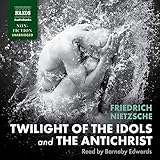
- Audible Audiobook
- Friedrich Nietzsche (Author) - Barnaby Edwards (Narrator)
- English (Publication Language)
- 04/11/2019 (Publication Date) - Naxos AudioBooks (Publisher)
3. Read The Twilight of the Idols First: This work serves as a programmatic introduction to Nietzsche’s critiques, often described as his “autobiography.”
- Action: Read The Twilight of the Idols section by section, pausing to process each aphorism or argument.
- What to Look For: Nietzsche’s self-proclaimed “revaluation of all values” and his critique of the “idols” of Western thought (e.g., reason, truth, morality).
- Mistake to Avoid: Skimming through the text; Nietzsche’s points are often concentrated and require careful consideration.
4. Engage with The Antichrist: This work is a more direct and virulent attack on Christianity, its origins, and its impact on civilization.
- Action: Read The Antichrist with an awareness of the specific targets Nietzsche is addressing.
- What to Look For: Nietzsche’s arguments for Christianity being a “slave morality” and his contrast between Christian values and what he terms “noble” values.
- Mistake to Avoid: Taking Nietzsche’s rhetoric at face value without understanding his philosophical project; his aim is deconstruction, not necessarily a simple replacement.
5. Annotate and Reflect: Actively engage with the text by highlighting key passages, noting questions, and writing down your initial reactions.
- Action: Use a pen or digital annotation tools to mark significant statements and your thoughts.
- What to Look For: Passages that resonate, challenge, or confuse you, as these are often the most fertile ground for understanding.
- Mistake to Avoid: Passive reading without active engagement; this can lead to superficial comprehension.
6. Consult Secondary Sources: After an initial reading, engage with scholarly commentaries and analyses to deepen your understanding.
- Action: Read articles or book chapters that discuss The Twilight of the Idols and The Antichrist.
- What to Look For: Diverse interpretations that can illuminate Nietzsche’s complex and often controversial ideas.
- Mistake to Avoid: Relying solely on secondary sources without first engaging with the primary texts yourself.
7. Consider the Historical and Cultural Impact: Reflect on how Nietzsche’s ideas have influenced subsequent philosophy, literature, and cultural movements.
- Action: Research the reception and legacy of these works.
- What to Look For: Connections to figures like Sartre, Foucault, and Derrida, as well as the ongoing debates surrounding Nietzsche’s philosophy.
- Mistake to Avoid: Isolating these texts from their historical impact and ongoing relevance.
The Twilight of the Idols and The Antichrist by Friedrich Nietzsche: Common Philosophical Myths
- Myth: Nietzsche advocates for a nihilistic worldview where nothing matters.
- Why it Matters: This misunderstanding misrepresents Nietzsche’s core project, which is a critique of existing values, not an endorsement of meaninglessness. His goal is to clear the ground for new, life-affirming values.
- Fix: Understand that Nietzsche’s “death of God” signifies the collapse of traditional, transcendent sources of meaning, necessitating humanity’s creation of its own values. His critique of nihilism is central to his work.
- Myth: Nietzsche’s critique of Christianity is a simple attack on religion.
- Why it Matters: While he is virulently anti-Christian, Nietzsche’s critique extends beyond religious dogma to the underlying moral framework he believes Christianity has imposed on Western civilization, which he sees as inherently life-denying and promoting weakness.
- Fix: Recognize that Nietzsche’s focus is on the morality derived from Christianity, which he labels “slave morality,” and its opposition to what he considers “noble” or life-affirming values.
- Myth: Nietzsche’s “will to power” is about brute force or domination.
- Why it Matters: This is a gross oversimplification that ignores the nuanced philosophical concept. It is not merely about physical power but about the fundamental drive of all living things to grow, overcome, and express their strength in various forms, including creativity and self-mastery.
- Fix: Interpret the “will to power” as a drive for self-overcoming, growth, and the enhancement of life, rather than a simplistic desire for political or physical control.
Expert Tips for Engaging with Nietzsche’s Core Works
- Tip: Embrace the polemical nature of the texts; do not expect objective, detached analysis.
- Actionable Step: Read Nietzsche’s critiques of philosophers and institutions as provocations designed to shatter complacency, not as dispassionate academic assessments. For instance, his attacks on Socrates in The Twilight of the Idols are intended to dismantle the very foundation of Western rationalism as he sees it.
- Common Mistake to Avoid: Trying to find neutrality or balanced argumentation where Nietzsche deliberately employs extreme rhetoric to shock the reader into re-evaluation.
- Tip: Recognize the strategic use of aphorisms and fragmented arguments.
- Actionable Step: Treat each aphorism or short section as a self-contained unit of thought that requires careful unpacking, rather than a linear progression of an argument. Consider how the aphorism in “Maxims and Arrows” from The Twilight of the Idols (“What is done out of love always takes place beyond good and evil”) functions as a standalone challenge to conventional morality.
- Common Mistake to Avoid: Expecting a systematic, chapter-by-chapter development of ideas; Nietzsche often circles his themes, offering variations and sharp insights from different angles.
- Tip: Understand that Nietzsche’s “revaluation of all values” is a process, not an immediate outcome.
- Actionable Step: View the texts as diagnostic tools that expose the perceived weaknesses and life-denying aspects of current values, thereby creating the necessary space for the possibility of new values to emerge, rather than dictating what those values should be. His critique of Christian morality in The Antichrist is a prime example of this diagnostic approach.
- Common Mistake to Avoid: Assuming Nietzsche provides a complete blueprint for a new moral system; his work is primarily critical and preparatory for future creation.
The Twilight of the Idols and The Antichrist by Friedrich Nietzsche: Key Philosophical Ideas
Nietzsche’s The Twilight of the Idols and The Antichrist represent a culmination of his critique of Western civilization, targeting its foundational moral and philosophical underpinnings. These works are characterized by their aggressive style and radical propositions.
- The “Idols” of Western Thought: In The Twilight of the Idols, Nietzsche identifies and attempts to shatter what he considers to be the false idols that have guided Western thought, particularly Christianity and Platonic philosophy. He argues these systems promote a contempt for life and the natural world, prioritizing abstract ideals over empirical reality and instinctual drives. For example, his critique of the Platonic “true world” in “How the ‘True World’ Finally Became a Fable” from The Twilight of the Idols illustrates this, arguing that the concept of a transcendent realm devalues this, the only world we possess.
- Critique of Christian Morality: The Antichrist is perhaps Nietzsche’s most direct and vit
Quick Comparison
| Option | Best for | Pros | Watch out |
|---|---|---|---|
| The Twilight of the Idols and The Antichrist by Friedrich Nietzsche Quick Answer | General use | Core Function: A profound philosophical interrogation and dismantling of West… | Mistake to Avoid: Relying on abridged or poorly translated versions that can… |
| Who This Is For | General use | Primary Output: Provocation of radical self-examination and a call for a “rev… | Mistake to Avoid: Attempting to read these texts without any prior understand… |
| What to Check First | General use | Target Audience: Advanced philosophical readers prepared for intense, polemic… | Mistake to Avoid: Skimming through the text; Nietzsche’s points are often con… |
| Step-by-Step Plan for Engaging with The Twilight of the Idols and The Antichrist by Friedrich Nietzsche | General use | Scholars and students seeking to engage with the foundational texts of existe… | Mistake to Avoid: Taking Nietzsche’s rhetoric at face value without understan… |
Decision Rules
- If reliability is your top priority for The Twilight of the Idols and The Antichrist by Friedrich Nietzsche, choose the option with the strongest long-term track record and support.
- If value matters most, compare total ownership cost instead of headline price alone.
- If your use case is specific, prioritize fit-for-purpose features over generic ‘best overall’ claims.