Nagarjuna’s Buddhist Philosophy: The Fundamental Wisdom
This analysis focuses on The Fundamental Wisdom Of The Middle Way by Nagarjuna, a foundational text in Mahayana Buddhist philosophy. It examines Nagarjuna’s arguments concerning emptiness and dependent origination, his dialectical method, and common reader pitfalls. The goal is to clarify its core principles and their implications for understanding reality and achieving liberation.
Who This Is For
- Students of Mahayana Buddhism: Individuals seeking to engage with a foundational text that articulates the Madhyamaka perspective and its philosophical underpinnings.
- Philosophically inclined readers: Those interested in rigorous critiques of inherent existence, the nature of reality, and the philosophical basis for liberation from suffering.
What to Check First
Before engaging with The Fundamental Wisdom Of The Middle Way by Nagarjuna, consider these essential elements:
- Translator’s Introduction: This section is crucial for understanding the historical context, key philosophical interpretations, and the translator’s approach to rendering Nagarjuna’s complex arguments.
- Prasangika Madhyamaka Methodology: Recognize that Nagarjuna’s primary method, prasanga, involves refuting an opponent’s view by showing its logical inconsistencies, rather than asserting a positive thesis of his own.
- Concept of Emptiness (Shunyata): Understand that emptiness signifies the absence of inherent, independent existence (svabhava), not a denial of conventional reality or a nihilistic void.
- Dependent Origination (Pratītyasamutpāda): Grasp that emptiness is intrinsically linked to dependent origination; phenomena are empty precisely because they arise in dependence on causes, conditions, and parts.
Step-by-Step Plan for Engaging with The Fundamental Wisdom Of The Middle Way by Nagarjuna
Engaging with Nagarjuna’s seminal work requires a structured approach to grasp its intricate philosophical deconstruction.
1. Begin with Chapter 1: Examination of Causality.
- Action: Read the verses and accompanying commentary that deconstruct the nature of cause and effect.
- What to look for: Nagarjuna’s argument that neither the cause, the effect, nor the process of causation can be established as having inherent existence.
- Mistake to avoid: Assuming that “emptiness” here implies that nothing exists; focus on the lack of independent, self-sufficient being.
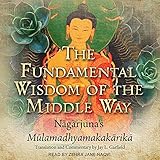
- Audible Audiobook
- Nāgārjuna (Author) - Zehra Jane Naqvi (Narrator)
- English (Publication Language)
- 07/13/2021 (Publication Date) - Tantor Audio (Publisher)
2. Analyze Chapter 2: Examination of the Effects of Causality.
- Action: Study the verses concerning the arising and ceasing of conditioned phenomena.
- What to look for: How the absence of inherent causality leads to the absence of inherent arising and ceasing, reinforcing the concept of dependent origination.
- Mistake to avoid: Interpreting dependent origination as a simple, linear sequence; Nagarjuna emphasizes the interconnected and interdependent nature of all factors.
3. Examine Chapter 3: Examination of the Elements of Existence.
- Action: Review Nagarjuna’s critique of the inherent nature of the constituent elements (dharmas) of experience.
- What to look for: The argument that these elements, like causes and effects, lack intrinsic self-nature and arise dependently.
- Mistake to avoid: Concluding that this negates conventional reality or our experience; the critique targets ultimate, inherent existence, not functional existence.
4. Engage with Chapter 4: Examination of the Elements of Being.
- Action: Read the verses that address the inherent nature of substantial existence.
- What to look for: The dismantling of any concept of an underlying, independent “substance” that constitutes reality.
- Mistake to avoid: Equating “non-substantiality” with mere illusion; the point is the absence of inherent, independent being.
5. Study Chapter 15: Examination of the Self.
- Action: Focus on Nagarjuna’s analysis of the concept of a permanent, independent self or soul.
- What to look for: The argument that the self, like all phenomena, is dependently arisen and thus empty of inherent existence.
- Mistake to avoid: Believing this negates personal identity or the conventional experience of selfhood; it targets an ultimate, unchanging self.
6. Consider Chapter 27: Examination of the Extent of the Tathagata.
- Action: Analyze the verses discussing the nature of a Buddha or the Tathagata after enlightenment.
- What to look for: How the enlightened state, like all phenomena, is characterized by emptiness and dependent origination, transcending conventional existence and non-existence.
- Mistake to avoid: Imagining a transcendental, inherently existing Buddha separate from the conditioned world; enlightenment is understood through the lens of ultimate truth.
7. Review the Concluding Chapters.
- Action: Read the final chapters that summarize the implications of the Madhyamaka view.
- What to look for: The ultimate goal of this philosophical deconstruction: liberation from suffering through the realization of emptiness.
- Mistake to avoid: Treating the text as a purely intellectual exercise; its aim is soteriological—leading to the cessation of suffering.
Common Mistakes
- Mistake: Equating emptiness (shunyata) with nihilism or non-existence.
- Why it matters: This is the most pervasive misunderstanding and leads to a distorted view of Nagarjuna’s philosophy, potentially fostering cynicism or despair. It misses the crucial distinction between conventional reality and ultimate reality.
- Fix: Emphasize that emptiness signifies the lack of inherent, independent existence, not the absence of all phenomena. Things exist conventionally, dependently.
- Mistake: Interpreting dependent origination as a simple linear cause-and-effect chain.
- Why it matters: This overlooks the intricate web of interdependence that Nagarjuna describes. A linear view fails to capture the dynamic and relational nature of phenomena.
- Fix: Understand dependent origination as a complex interplay of factors where nothing exists in isolation. Each element arises in dependence on all others.
- Mistake: Assuming Nagarjuna denies the validity of conventional reality or everyday experience.
- Why it matters: This leads to an impractical and unlivable philosophy, disconnected from human experience. Nagarjuna distinguishes between two truths: conventional and ultimate.
- Fix: Recognize that the critique of inherent existence applies to the ultimate level of reality. Conventional designations and experiences remain valid within their own framework.
- Mistake: Reading The Fundamental Wisdom Of The Middle Way by Nagarjuna without sufficient background in Buddhist philosophy.
- Why it matters: The text assumes familiarity with concepts like the aggregates (skandhas), the four noble truths, and basic Buddhist cosmology. Without this, the arguments can appear baseless or overly abstract.
- Fix: Before engaging with Nagarjuna, study introductory texts on Buddhism, particularly Mahayana philosophy, to build a necessary conceptual framework.
Expert Tips for Understanding The Fundamental Wisdom Of The Middle Way
- Tip 1: Focus on the “Prasanga” Method.
- Actionable Step: When reading a chapter, identify the specific view Nagarjuna is refuting. Trace how he uses the opponent’s own premises to demonstrate a logical contradiction.
- Common Mistake to Avoid: Trying to find Nagarjuna’s positive assertions about what is real. His method is primarily deconstructive; he shows what cannot be real in an ultimate sense.
- Tip 2: Distinguish Conventional and Ultimate Truth.
- Actionable Step: After deconstructing a concept, ask: “How does this appear conventionally, and how is it ultimately empty?”
- Common Mistake to Avoid: Conflating the two truths. Believing that because something lacks inherent existence, it ceases to function or appear in the conventional world.
- Tip 3: Read with a Commentarial Tradition.
- Actionable Step: Utilize commentaries from established Madhyamaka scholars (e.g., Chandrakirti, Tsongkhapa) to clarify difficult passages and understand the historical interpretation of Nagarjuna’s verses.
- Common Mistake to Avoid: Attempting to interpret the text solely on its own, without the benefit of centuries of scholastic engagement. This can lead to misinterpretations of subtle points.
Frequently Asked Questions
- Q: Does Nagarjuna’s concept of emptiness mean that nothing exists?
A: No. Emptiness refers to the lack of inherent, independent existence. Phenomena exist conventionally, dependently, but they do not possess an unchanging, self-sufficient nature.
- Q: How does The Fundamental Wisdom Of The Middle Way by Nagarjuna relate to the Buddha’s teachings?
A: Nagarjuna considered himself an expositor of the Buddha’s core teachings, particularly the doctrine of dependent origination, which he elaborated extensively through the lens of emptiness.
- Q: Is this text only for Buddhists?
A: While rooted in Buddhist tradition, the philosophical rigor and critique of inherent existence offered by Nagarjuna have profound implications for anyone interested in metaphysics, epistemology, and the nature of reality, making it relevant to secular philosophical inquiry.
- Q: What is the primary goal of understanding emptiness according to Nagarjuna?
A: The primary goal is liberation from suffering. By realizing that phenomena lack inherent existence, one can overcome attachment and aversion, which are rooted in the mistaken belief in inherently existing entities.
Understanding The Fundamental Wisdom Of The Middle Way by Nagarjuna
Nagarjuna’s The Fundamental Wisdom Of The Middle Way by Nagarjuna (Mūlamadhyamakakārikā) stands as a monumental work in Mahayana Buddhist philosophy, primarily known for its rigorous articulation of the Madhyamaka (“Middle Way”) school. The text’s central thesis is that all phenomena are “empty” (shunya) of inherent existence (svabhava). This emptiness is not a void but a
Quick Comparison
| Option | Best for | Pros | Watch out |
|---|---|---|---|
| Who This Is For | General use | Students of Mahayana Buddhism: Individuals seeking to engage with a foundatio… | Mistake to avoid: Assuming that “emptiness” here implies that nothing exists;… |
| What to Check First | General use | Philosophically inclined readers: Those interested in rigorous critiques of i… | Mistake to avoid: Interpreting dependent origination as a simple, linear sequ… |
| Step-by-Step Plan for Engaging with The Fundamental Wisdom Of The Middle Way by Nagarjuna | General use | Translator’s Introduction: This section is crucial for understanding the hist… | Mistake to avoid: Concluding that this negates conventional reality or our ex… |
| Expert Tips for Understanding The Fundamental Wisdom Of The Middle Way | General use | Prasangika Madhyamaka Methodology: Recognize that Nagarjuna’s primary method,… | Mistake to avoid: Equating “non-substantiality” with mere illusion; the point… |
Decision Rules
- If reliability is your top priority for The Fundamental Wisdom Of The Middle Way by Nagarjuna, choose the option with the strongest long-term track record and support.
- If value matters most, compare total ownership cost instead of headline price alone.
- If your use case is specific, prioritize fit-for-purpose features over generic ‘best overall’ claims.