Miguel de Cervantes’ Exemplary Stories: A Collection
Quick Answer
- Core Function: A collection of twelve distinct short narratives offering varied explorations of human nature, morality, and societal observation.
- Primary Appeal: Showcases Cervantes’s early prose mastery, innovative storytelling techniques, and sharp wit, predating Don Quixote.
- Key Consideration: The thematic and stylistic diversity means reader engagement will vary; not all stories achieve the same impact.
Who This Is For
- Readers interested in the foundational works of Miguel de Cervantes and the evolution of the short story form in early modern Europe.
- Individuals seeking morally complex narratives that explore the nuances of human behavior, often with a satirical or cautionary bent.
What to Check First
- Publication Date: These stories were published in 1613, positioning them as Cervantes’s initial foray into the short fiction genre.
- Thematic Range: Be aware of the broad spectrum of themes, from romantic entanglements and adventurous escapades to tales of deception and social commentary.
- Narrative Structure: Each story is a self-contained unit, allowing for flexible reading schedules and varied levels of engagement.
- Translator’s Influence: The chosen translation significantly impacts the accessibility and stylistic fidelity of the original Spanish.
Step-by-Step Plan: Engaging with Exemplary Stories by Miguel de Cervantes
1. Initiate with “The Glass Graduate” (El licenciado Vidriera):
- Action: Begin with this story to encounter one of Cervantes’s most introspective characters.
- What to look for: Analyze how the protagonist’s perceived madness serves as a vehicle for social critique, exploring the porous boundaries between sanity and folly.
- Mistake: Treating the character’s mental state as a literal affliction without recognizing its symbolic function for commentary on society.
2. Proceed to “The Spanish Englishwoman” (La española inglesa):
- Action: Engage with this narrative, which features elements of adventure and romantic pursuit.
- What to look for: Observe Cervantes’s descriptive prose and the intricate plotting, noting the story’s movement between different settings and social strata.
- Mistake: Underestimating the story’s critique of cultural misunderstandings and the constraints faced by women in its historical context.
3. Analyze “The Force of Blood” (La fuerza de la sangre):
- Action: Read this story to examine Cervantes’s treatment of honor, justice, and the possibility of reconciliation after trauma.
- What to look for: Pay attention to the moral complexities and the narrative’s attempt to balance societal expectations with the resolution of a profound injustice.
- Mistake: Anticipating a straightforward moral conclusion; Cervantes often complicates ethical dilemmas, offering no easy answers.
4. Consider “The Impertinent Curious Man” (El curioso impertinente):
- Action: Engage with this story, often anthologized within Don Quixote, as an independent narrative.
- What to look for: Focus on the psychological experiment of a husband’s jealousy and its devastating consequences, serving as a potent cautionary tale.
- Mistake: Viewing this tale solely as a digression from Don Quixote, thereby diminishing its intrinsic thematic weight and narrative skill.
5. Examine “Rinconete and Cortadillo”:
- Action: Read this story about two young vagrants navigating the urban landscape of Seville.
- What to look for: Appreciate the vivid depiction of city life and the characters’ development from petty criminals to members of a respectable guild.
- Mistake: Dismissing this story as mere lighthearted entertainment; it contains significant social realism and astute observations of human adaptation.
For those new to Cervantes’s short fiction, the ‘Exemplary Stories’ offer a fantastic entry point. This collection showcases his early prose mastery and sharp wit, predating his more famous works.
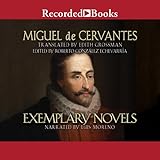
- Audible Audiobook
- Miguel de Cervantes (Author) - Luis Moreno (Narrator)
- English (Publication Language)
- 12/29/2016 (Publication Date) - Recorded Books (Publisher)
6. Review the remaining stories:
- Action: Read tales such as “The Deceitful Marriage” (El casamiento engañoso) and “The Lady of Madrid” (La patrona de Madrid).
- What to look for: Compare their distinct narrative approaches, thematic concerns, and the effectiveness of their resolutions.
- Mistake: Assuming a uniform tone or style across the entire collection; Cervantes intentionally experimented with diverse forms and perspectives.
Counterpoint: The “Exemplary” Nature of Cervantes’s Tales
A common assumption is that Exemplary Stories are uniformly didactic, offering clear moral blueprints. This perspective, however, overlooks Cervantes’s sophisticated use of irony and ambiguity. While many tales do present cautionary elements, their true strength lies in their nuanced portrayal of human psychology and societal dynamics, which often defies simple moral categorization.
Consider “The Impertinent Curious Man.” While framed as a warning against jealousy, its compelling exploration of the characters’ psychological unraveling can overshadow its explicit moral. Similarly, “Rinconete and Cortadillo” vividly depicts the lives of young rogues, and while it concludes with their respectable integration, the narrative’s energy and sympathetic portrayal of their initial lives challenge a purely didactic reading. The “exemplary” quality, therefore, is less about providing simple moral lessons and more about offering intricate, often ironic, case studies of human nature that invite critical reflection. This complexity is a defining characteristic of Cervantes’s genius, making the collection a rich subject for nuanced analysis.
Expert Tips for Reading Exemplary Stories
- Tip 1: Prioritize Dialogue Analysis:
- Action: Dedicate attention to the conversations between characters. Cervantes’s skill in crafting natural, revealing dialogue is central to his character development and thematic exposition.
- Common Mistake: Skimming dialogue passages, which leads to missing subtle cues about motivations, social standing, and underlying conflicts.
- Tip 2: Contextualize Moral Frameworks:
- Action: When assessing the moral lessons presented, consider the historical and social milieu of early 17th-century Spain. Ethical standards and societal norms of that era differ from contemporary ones.
- Common Mistake: Applying anachronistic ethical judgments, which can lead to misinterpretations of character actions and narrative intent.
- Tip 3: Recognize Narrative Experimentation:
- Action: Observe Cervantes’s deliberate use of varied narrative techniques, including frame stories, shifts in perspective, and tonal modulation.
- Common Mistake: Expecting a consistent narrative voice or structure throughout the collection; Cervantes was actively exploring the possibilities of short fiction.
Common Mistakes When Reading Exemplary Stories
- Mistake: Expecting uniform brilliance comparable to Don Quixote.
- Why it matters: This sets an unrealistic standard that can diminish appreciation for the collection’s individual merits. The stories served as an experimental ground.
- Fix: Approach each story as a distinct work, evaluating it on its own terms and recognizing the developmental stage of Cervantes’s writing.
- Mistake: Overlooking or dismissing satirical elements.
- Why it matters: Cervantes frequently employed irony and humor to critique societal norms and human foibles. Missing this layer results in a shallower understanding.
- Fix: Read with an awareness of Cervantes’s subtle critiques, looking for ironic juxtapositions and understated commentary on human behavior.
- Mistake: Focusing exclusively on plot over character development.
- Why it matters: While the plots are often engaging, Cervantes’s enduring strength lies in his psychologically astute character portraits and their complex motivations.
- Fix: Allocate analytical effort to understanding characters’ internal lives, their conflicts, and how their personalities shape the narrative’s trajectory.
- Mistake: Assuming a monolithic thematic purpose across the entire collection.
- Why it matters: The stories span a wide array of subjects and tones, from tragic romance to sharp satire.
- Fix: Acknowledge the diversity of themes and narrative strategies; the collection functions more as a mosaic of Cervantes’s interests and skills than a singular thematic treatise.
BLOCKQUOTE_0
Decision Rules for Engaging with the Text
- If your primary goal is to understand the historical context of early Spanish fiction, prioritize the stories that offer the most direct social commentary.
- If you seek narrative innovation, focus on stories where Cervantes experiments with structure or perspective, such as “The Glass Graduate.”
- If moral ambiguity is of interest, select tales like “The Force of Blood” that present complex ethical dilemmas without simple resolutions.
FAQ
- Q: Are the Exemplary Stories essential reading for understanding Cervantes?
A: Yes, they are crucial for appreciating Cervantes’s development as a prose stylist and his thematic preoccupations before and alongside Don Quixote. They demonstrate his versatility and experimental spirit in short fiction.
- Q: Which story is most often highlighted by critics?
A: Critical consensus often points to “The Glass Graduate” for its psychological depth and “Rinconete and Cortadillo” for its vibrant social realism. However, reader preferences vary widely due to the collection’s diversity.
- Q: Can I read these stories in any order?
A: Absolutely. The stories are independent narratives and can be read sequentially or individually. Starting with “The Glass Graduate” can provide a strong initial impression of Cervantes’s character-driven approach.
- Q: What is the meaning of “exemplary” in the title?
A: The term suggests the stories are intended as models or examples, either of moral conduct or of skillful literary technique. However, Cervantes frequently subverts simple didacticism with irony and complexity.
A Comparison Table: Exemplary Stories by Miguel de Cervantes
| Story Title | Primary Theme(s) | Narrative Style | Potential Reading Takeaway |
|---|---|---|---|
| El licenciado Vidriera | Madness, truth, social critique | Psychological, philosophical | The perception of sanity and insanity as tools for societal commentary. |
| La española inglesa | Love, adventure, cultural identity | Romantic, picaresque elements | The challenges of love and identity across cultural divides. |
| La fuerza de la sangre | Honor, justice, reconciliation, trauma | Dramatic, moralistic with complex resolution | The struggle to achieve justice and societal acceptance after profound violation. |
| El casamiento engañoso | Deception, marriage, consequences of deceit | Satirical, cautionary | The dangers of entering into relationships based on false pretenses. |
| Rinconete y Cortadillo | Roguery, urban life, social mobility | Lively, realistic, episodic | The adaptability of individuals within the complex social fabric of a city like Seville. |
| La historia del cautivo | Captivity, freedom, cultural exchange | Autobiographical tone, adventure | The human capacity for resilience and the complexities of inter-cultural relations. |
Reading Context and Further Exploration
For readers seeking a comprehensive understanding of Cervantes’s short fiction, consulting a detailed Exemplary Stories by Miguel de Cervantes review can illuminate critical perspectives and highlight individual story strengths. Examining an Exemplary Stories by Miguel de Cervantes review can also provide context on how these narratives influenced later literary developments. Further exploration into the literary landscape of the Spanish Golden Age will enrich the appreciation of Cervantes’s innovative contributions.