Kurt Vonnegut’s Breakfast of Champions: A Satire
Breakfast of Champions by Kurt Vonnegut: Quick Answer
- Breakfast of Champions by Kurt Vonnegut is a deliberately fragmented, meta-fictional satire that critiques American culture, consumerism, and the nature of consciousness.
- Readers expecting a conventional plot will find the author’s frequent intrusions and experimental structure challenging; those who appreciate Vonnegut’s unique brand of dark humor and philosophical inquiry will likely find it rewarding.
- The novel’s enduring impact stems from its prescient examination of societal absurdities and its questioning of reality itself.
Who This Is For
- Readers who are already familiar with and appreciate Kurt Vonnegut’s distinctive literary style, characterized by satire, science fiction elements, and existential themes.
- Individuals interested in literary experimentation and novels that intentionally subvert traditional narrative conventions to explore complex ideas.
What to Check First
- Narrative Structure: Be prepared for a non-linear, self-aware narrative where the author frequently intrudes. This is a deliberate stylistic choice, not a storytelling flaw.
- Satirical Intent: The novel functions as a sharp critique of American culture, consumerism, and the superficiality of modern life. Understanding this satirical lens is crucial for interpretation.
- Authorial Presence: Vonnegut himself is a character within the novel. His direct commentary and accompanying drawings are integral to the book’s structure and message.
- Philosophical Undertones: Beneath the humor, the book grapples with profound questions about free will, consciousness, and the meaning of existence.
Step-by-Step Plan for Engaging with Breakfast of Champions
Engaging with Breakfast of Champions by Kurt Vonnegut requires a willingness to embrace its unconventional nature. The following steps are designed to maximize comprehension and appreciation of its satirical depth.
1. Begin Reading with an Open Mind:
- Action: Start reading without preconceived notions of a traditional plot structure.
- What to Look For: Notice the author’s direct address to the reader, the inclusion of drawings, and the meta-commentary.
- Mistake: Expecting a linear, cause-and-effect narrative that progresses conventionally. This will lead to frustration with the author’s interruptions and structural choices.
2. Identify the Core Satirical Targets:
- Action: Pay close attention to the targets of Vonnegut’s satire. These include consumer culture, technological advancement without ethical consideration, societal hypocrisy, and the superficiality of American dreams.
- What to Look For: Note recurring motifs like advertisements, mass-produced goods, and the characters’ often absurd motivations and actions. For example, the pervasive presence of the Pontiac car brand serves as a symbol of unchecked consumerism.
- Mistake: Overlooking the satirical intent and taking the characters’ actions or the societal commentary at face value. This misses the critical edge of the novel.
3. Recognize the Role of Kilgore Trout:
- Action: Understand Kilgore Trout as Vonnegut’s recurring science fiction author alter ego, a mouthpiece for his more outlandish and philosophical ideas.
- What to Look For: Observe how Trout’s science fiction concepts, often absurd on their own, are used to illuminate real-world human behavior and societal flaws. His stories within the story often serve as allegories.
- Mistake: Dismissing Kilgore Trout’s narratives as mere digressions or random science fiction elements. They are integral to the novel’s thematic exploration.
4. Appreciate the Meta-Fictional Layer:
- Action: Acknowledge that Vonnegut is not just telling a story but commenting on the act of storytelling and the nature of reality itself.
- What to Look For: Observe instances where the author breaks the fourth wall, discusses his characters as if they are real entities he is creating, or draws attention to the artificiality of the novel.
- Mistake: Getting bogged down in the plot mechanics and failing to see how the author’s interjections contribute to the novel’s critique of constructed realities and belief systems.
5. Analyze the Drawings and Their Purpose:
- Action: Examine the simple, childlike drawings interspersed throughout the text.
- What to Look For: See how these illustrations visually reinforce or satirize specific concepts, characters, or themes. They often provide a blunt, almost primal commentary that text alone might not achieve.
- Mistake: Skipping over the drawings or viewing them as mere decoration. They are functional elements of the narrative, offering a unique layer of interpretation.
6. Consider the “What If” Scenarios:
- Action: Reflect on the hypothetical situations and philosophical questions posed by the novel, particularly concerning free will and determinism.
- What to Look For: Pay attention to the character of Dwayne Hoover and his descent into madness, and how the novel explores the idea of characters gaining consciousness and agency.
- Mistake: Focusing solely on the surface-level absurdity and failing to engage with the deeper philosophical inquiries about consciousness and control.
For those looking to dive into this unique literary experience, you can find Breakfast of Champions by Kurt Vonnegut readily available.
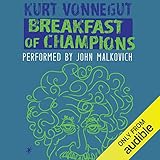
- Audible Audiobook
- Kurt Vonnegut (Author) - John Malkovich (Narrator)
- English (Publication Language)
- 06/23/2015 (Publication Date) - Audible Studios (Publisher)
Breakfast of Champions by Kurt Vonnegut: A Literary Examination
This section delves into the critical reception and thematic significance of Breakfast of Champions by Kurt Vonnegut, offering a deeper understanding of its place in literary history.
Kurt Vonnegut’s Breakfast of Champions is a work that deliberately defies easy categorization. Published in 1973, it arrived at a time of significant cultural upheaval in America, and its chaotic, meta-fictional structure mirrored the era’s sense of disillusionment and questioning of established norms. The novel’s narrative is famously self-aware; Vonnegut himself appears as a character, interacting with his creations and commenting on the process of writing. This approach, while disorienting for some readers, is central to the novel’s purpose: to expose the artificiality of fiction and, by extension, the constructed nature of societal beliefs and realities.
The book’s long-term relevance lies not in its plot, but in its relentless, often bleak, satire. Vonnegut skewers American consumerism, its obsession with technology, its often-unexamined prejudices, and the general absurdity of human existence. The protagonist, Dwayne Hoover, a car dealer in Midland City, is a conduit for much of this critique, his descent into madness serving as a microcosm of societal breakdown. His interactions with characters like the alien-hating Midland City residents and the philosopher-novelist Kilgore Trout highlight Vonnegut’s disdain for conformity and his fascination with the bizarre logic that often governs human behavior.
One failure mode readers often encounter with Breakfast of Champions is the expectation of a conventional narrative arc. The novel’s deliberate fragmentation and the author’s constant interjections can lead to a feeling of being adrift. Detecting this early involves recognizing that the “plot” is less about events and more about ideas being explored and dismantled. When the narrative feels disjointed or the author’s voice intrudes too frequently, it’s a signal that you are engaging with the meta-fictional layer, not a breakdown in storytelling. The fix is to lean into this self-consciousness, viewing the author’s presence as an essential element of the critique, rather than an interruption.
BLOCKQUOTE_0
This quote from Vonnegut himself underscores the author’s active, almost antagonistic, role within his creation. It’s a key insight into why the narrative feels so unconventional.
Common Myths About Breakfast of Champions
- Myth: The book is a poorly constructed novel because the author keeps interrupting the story.
- Why it matters: This misinterprets the author’s intent, viewing a deliberate stylistic choice as a flaw. It leads to frustration and an inability to appreciate the novel’s satirical purpose.
- Fix: Understand that the author’s intrusions are integral to the novel’s meta-fictional nature, serving to critique the very act of storytelling and the construction of reality.
- Myth: Kilgore Trout is just a random, quirky character meant to be funny.
- Why it matters: This overlooks Trout’s function as a philosophical mouthpiece for Vonnegut. Dismissing his stories means missing key thematic explorations.
- Fix: Recognize Kilgore Trout as a recurring avatar for Vonnegut’s own ideas, using his often-absurd science fiction premises to comment on human nature and societal issues.
- Myth: The drawings are just decorative additions to the text.
- Why it matters: This ignores the functional role of the illustrations, which serve as visual punchlines or stark, simplified commentary on the surrounding text.
- Fix: Treat the drawings as an integrated part of the narrative, paying attention to how they visually amplify or satirize the written content, offering a unique layer of interpretation.
Expert Tips for Reading Breakfast of Champions
- Embrace the Absurdity:
- Actionable Step: Do not try to rationalize every event or character motivation. Instead, accept the inherent absurdity as a core component of Vonnegut’s critique of modern life.
- Common Mistake to Avoid: Getting hung up on plot logic or character consistency. The novel deliberately plays with these conventions to expose their limitations.
- Read Aloud Select Passages:
- Actionable Step: When encountering a particularly dense or humorous passage, try reading it aloud. Vonnegut’s prose has a distinct rhythm and cadence that is often best appreciated audibly.
- Common Mistake to Avoid: Reading silently and missing the musicality and comedic timing inherent in Vonnegut’s sentence structure and word choices.
- View the Author as a Character:
- Actionable Step: Actively engage with Vonnegut’s authorial voice as if he were another character in the novel, observing his commentary and his relationship with his creations.
- Common Mistake to Avoid: Treating the author’s interjections as mere editorial notes or technical interruptions, rather than recognizing them as part of the novel’s thematic fabric and a deliberate artistic choice.
Decision Rules
- If reliability is your top priority for Breakfast of Champions by Kurt Vonnegut, choose the option with the strongest long-term track record and support.
- If value matters most, compare total ownership cost instead of headline price alone.
- If your use case is specific, prioritize fit-for-purpose features over generic ‘best overall’ claims.
Quick Comparison
| Option | Best for | Pros | Watch out |
|---|---|---|---|
| Quick Answer | General use | <em>Breakfast of Champions by Kurt Vonnegut</em> is a deliberately fragmented, meta-… | Mistake: Expecting a linear, cause-and-effect narrative that progresses conve… |
| Who This Is For | General use | Readers expecting a conventional plot will find the author’s frequent intrusi… | Mistake: Overlooking the satirical intent and taking the characters’ actions… |
| What to Check First | General use | The novel’s enduring impact stems from its prescient examination of societal… | Mistake: Dismissing Kilgore Trout’s narratives as mere digressions or random… |
| Step-by-Step Plan for Engaging with Breakfast of Champions | General use | Readers who are already familiar with and appreciate Kurt Vonnegut’s distinct… | Mistake: Getting bogged down in the plot mechanics and failing to see how the… |
FAQ
- Q: Is this book difficult to read?
- A: Breakfast of Champions employs a non-traditional, meta-fictional structure that can be challenging for readers accustomed to linear narratives. Its experimental nature requires an open mind and a willingness to engage with the author’s self-aware commentary.
- Q: What is the main message of Breakfast of Champions?
- A: The novel satirizes American culture, consumerism, and the superficiality of modern life, while also exploring profound philosophical questions about consciousness, free will, and the nature of reality. It critiques the absurdity of human behavior and societal constructs.
- Q: Who is Kilgore Trout?
- A: Kilgore Trout is a recurring fictional character created by Kurt Vonnegut, appearing in several of his novels. In Breakfast of Champions, he functions as a science fiction author whose outlandish stories serve as allegories and vehicles for Vonnegut’s philosophical ideas and critiques of society.
- Q: Why are there drawings in the book?
- A: The drawings are an integral part of the novel’s structure and satirical intent. They offer a direct, often crude, visual commentary that complements or contrasts with the text, enhancing the book’s meta-fictional and darkly humorous qualities.