Koushun Takami’s Battle Royale
Quick Answer
- Battle Royale by Koushun Takami is a visceral and philosophically charged Japanese novel that dissects the impact of extreme authoritarian control on adolescent psychology.
- Its primary strength is its relentless, unflinching exploration of survival, morality, and societal breakdown, presented with a stark realism that is both compelling and disturbing.
- This work is recommended for mature readers seeking a challenging, thematically dense narrative that confronts bleak aspects of human nature and state power, and is not for the easily distressed.
Who This Is For
- Readers who appreciate dystopian literature that pushes boundaries and engages in direct social commentary on totalitarianism and human behavior under duress.
- Those looking for a literary work that prioritizes thematic exploration and psychological intensity over comfort or easily digestible conclusions.
What to Check First
- Graphic Content Tolerance: The novel features explicit and frequent depictions of violence, gore, and psychological trauma. Assess your personal comfort level with such material.
- Thematic Rigor: Be prepared for sustained engagement with themes of state control, loss of innocence, and the erosion of morality.
- Narrative Scope: The story involves a large cast of characters with shifting perspectives, requiring sustained attention to track individual arcs and relationships.
- Allegorical Intent: Understand that the “Battle Royale” program functions as a potent metaphor for state-sponsored manipulation and the manufactured conflicts within oppressive systems.
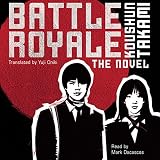
- Audible Audiobook
- Koushun Takami (Author) - Mark Dacascos (Narrator)
- English (Publication Language)
- 09/04/2012 (Publication Date) - Simon & Schuster Audio (Publisher)
Step-by-Step Plan for Understanding Battle Royale by Koushun Takami
1. Internalize the Program’s Premise: Grasp the core concept: a government randomly selects a class of junior high students annually to participate in a mandatory, lethal survival game on a remote island. What to look for: The arbitrary nature of selection and the immediate, brutal enforcement of lethal rules by the state. Mistake to avoid: Underestimating the psychological weight of this decree on adolescents, treating it as a mere plot device rather than a foundational element of societal control.
2. Observe Shifting Social Dynamics: Track how pre-existing friendships, rivalries, and social hierarchies among the students disintegrate and reform under the extreme pressure of survival. What to look for: Fluctuating loyalties, desperate alliances, and the emergence of both profound empathy and extreme selfishness. Mistake to avoid: Assuming characters will act solely on instinct; their actions are frequently dictated by complex emotional responses, past relationships, and immediate fear.
3. Analyze Game Mechanics and Control: Pay close attention to the operational rules of the game, including the mandatory electronic collars and the dynamically shrinking safe zones. What to look for: The systematic dehumanization and the chilling efficiency of the state apparatus in maintaining absolute control through technological means. Mistake to avoid: Focusing solely on the action and missing the critique of totalitarianism embedded within these precise mechanics.
4. Identify Survival Strategies and Leadership: Note which characters emerge as leaders and the varied methods they employ for survival, ranging from strategic planning to brute force. What to look for: Contrasting leadership styles and the moral compromises made in the name of survival. Mistake to avoid: Glorifying violence as the sole effective survival tactic without considering its long-term psychological costs and ethical implications.
5. Engage with Philosophical Underpinnings: Reflect on Takami’s exploration of whether humans are inherently good or evil, and how societal structures can corrupt or reveal these traits. What to look for: Moments that challenge your own moral compass and preconceptions about human nature. Mistake to avoid: Reading the novel as a straightforward thriller without engaging with its deeper thematic questions about human nature, control, and the fragility of civilization.
6. Process the Ambiguous Conclusion: The ending offers little in the way of simple resolution, leaving many questions about the characters’ futures and the state of their society. What to look for: The lingering psychological scars and the potential for the cycle of oppression to continue. Mistake to avoid: Expecting a neat, happy ending; the novel’s power is amplified by its refusal to offer easy closure, reflecting the enduring impact of trauma.
Common Myths About Battle Royale by Koushun Takami
- Myth: The novel is simply gratuitous violence with no deeper purpose.
- Why it matters: This perspective dismisses the profound social and philosophical commentary on authoritarianism, societal control, and the nature of humanity that Takami meticulously weaves into the narrative.
- Fix: Approach the text recognizing its allegorical potential. View the “game” as a metaphor for state-sponsored manipulation and the manufactured conflicts that can arise within oppressive systems designed to maintain power through division.
- Myth: Characters are either purely evil or purely good, making their actions predictable.
- Why it matters: This oversimplifies the complex psychological portraits Takami creates. Characters exhibit a wide spectrum of behaviors, often driven by fear, trauma, and desperation, leading to unpredictable and nuanced actions that defy simple categorization.
- Fix: Pay close attention to individual character arcs, their backstories, and the immediate pressures they face. This allows for a more intricate understanding of their choices and motivations, recognizing the gray areas of human behavior under duress.
- Myth: The story offers no hope, depicting only despair.
- Why it matters: While undeniably bleak, the novel also illustrates acts of profound loyalty, sacrifice, and the enduring human will to survive and connect, even in the most dire circumstances. These moments are crucial counterpoints to the pervasive sense of despair.
- Fix: Actively seek out moments of compassion and resilience amidst the brutality. These instances, however fleeting, provide a crucial counterpoint to the pervasive sense of despair and highlight the persistence of human connection.
Thematic Depth and Literary Merit of Battle Royale by Koushun Takami
Battle Royale by Koushun Takami transcends its premise as a survival thriller by offering a profound and disturbing examination of societal control and the human psyche. The novel’s strength lies not just in its relentless pacing and visceral depictions of violence, but in its unflinching gaze upon the moral compromises individuals make when stripped of their autonomy and forced into a state of primal survival. Takami masterfully illustrates how fear and desperation can dismantle social bonds, revealing both the capacity for unimaginable cruelty and the flicker of enduring humanity. The narrative serves as a potent allegory for authoritarian regimes that manipulate populations through fear and division, forcing readers to question the ethical boundaries of state power and the price of obedience.
Understanding the Narrative Structure
The novel’s structure is crucial to its impact. Takami employs a shifting perspective, allowing readers to witness the unfolding horror from multiple viewpoints. This technique prevents the narrative from becoming a simple hero’s journey and instead emphasizes the collective tragedy and the random nature of survival. The introduction of the “game” mechanics—the collars, the map, the shrinking zones—creates a constant sense of dread and urgency, meticulously designed to maintain control.
Key Elements and Their Significance:
| Element | Description | Reader Takeaway |
|---|---|---|
| The Program | A government-mandated survival game for junior high students. | Demonstrates extreme state control and the manipulation of youth for political ends. |
| The Island | The isolated setting where the game takes place. | Symbolizes a microcosm of society, stripped bare of normal rules and constraints. |
| The Collars | Devices that enforce compliance and trigger death if rules are broken. | Represents the absolute, inescapable nature of the oppressive regime and the suppression of individual will. |
| Shifting Alliances | Students form and break alliances based on survival needs and past dynamics. | Highlights the erosion of trust and the complex, often contradictory, nature of human relationships under duress. |
Contrarian Perspective: The Illusion of Choice
A contrarian view of Battle Royale by Koushun Takami suggests that the narrative, while appearing to focus on individual survival choices, actually underscores the profound lack of genuine agency within a totalitarian system. The “choices” presented to the students—whether to kill, ally, or flee—are all dictated by the parameters of the game and the ever-present threat of the collars. The novel, from this perspective, is less about individual heroism or villainy and more about the devastating effectiveness of a system designed to break down human connection and enforce absolute obedience through manufactured conflict. The true failure mode for readers here is mistaking the surface-level survival narrative for a commentary on individual free will, thereby missing the deeper critique of systemic oppression. Detecting this early requires recognizing that the narrative consistently circles back to the inescapable nature of the program’s rules and the regime’s control, even in moments of apparent defiance.
Strengths and Limitations
Strengths:
- Relentless Pacing: The novel propels the reader forward with a sense of urgency that mirrors the characters’ plight, making it difficult to put down.
- Psychological Depth: Takami excels at portraying the mental and emotional toll of extreme violence and isolation on young minds, offering a disturbing look at trauma.
- Social Commentary: The story serves as a powerful critique of authoritarianism, societal control, and the manufactured nature of conflict, prompting critical thought.
- Unflinching Realism: The depiction of violence and its consequences is graphic and unsparing, adding to its thematic impact and unsettling authenticity.
Limitations:
- Graphic Content: The extreme violence and gore may be off-putting or overwhelming for some readers, potentially hindering engagement with the thematic elements.
- Character Overload: With a large cast of characters and shifting perspectives, it can be challenging for readers to keep track of every individual’s motivations and allegiances, sometimes diluting focus.
- Bleak Outlook: The novel offers a fundamentally dark and often hopeless perspective on human nature and societal structures, which may not appeal to readers seeking uplifting or comforting narratives.
Reading Context and Verdict
Battle Royale by Koushun Takami is not a book to be taken lightly. Its power lies in its raw, unvarnished depiction of a society that has embraced absolute control at the expense of humanity. The novel’s thematic exploration of
Decision Rules
- If reliability is your top priority for Battle Royale by Koushun Takami, choose the option with the strongest long-term track record and support.
- If value matters most, compare total ownership cost instead of headline price alone.
- If your use case is specific, prioritize fit-for-purpose features over generic ‘best overall’ claims.