Kate Raworth’s Economic Model: Doughnut Economics
Doughnut Economics by Kate Raworth: A Framework for a Thriving Economy
Doughnut Economics by Kate Raworth presents a radical reframing of economic goals, moving away from the singular pursuit of Gross Domestic Product (GDP) growth towards a model that ensures human well-being within planetary boundaries. The core of this framework is the “Doughnut,” a visual representation of a “safe and just space for humanity.” This space is defined by an inner ring of social foundations, representing essential human needs, and an outer ring of ecological ceilings, representing planetary limits. The objective is to create economies that are both regenerative and distributive, allowing all people to thrive without depleting the Earth’s life-support systems.
Who This Is For
- Individuals seeking a comprehensive critique of mainstream economic theory and practical alternatives for building a sustainable and equitable future.
- Policymakers, business leaders, and activists looking for a guiding framework to redesign economic systems that prioritize social equity and ecological health.
What to Check First
- The Doughnut’s Boundaries: Understand the distinction between the social foundation (minimum requirements for a dignified life) and the ecological ceiling (planetary boundaries that must not be transgressed).
- Critique of Infinite Growth: Grasp Raworth’s argument that perpetual GDP growth is incompatible with ecological sustainability and often exacerbates social inequality.
- Regenerative and Distributive Principles: Familiarize yourself with these two pillars of the Doughnut model, which aim to restore natural systems and share resources equitably.
- The Concept of “Thriving”: Recognize that the goal is not merely survival or growth, but a state where human societies flourish within ecological limits.
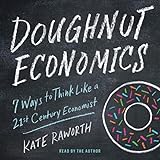
- Audible Audiobook
- Kate Raworth (Author) - Kate Raworth (Narrator)
- English (Publication Language)
- 11/16/2017 (Publication Date) - Chelsea Green Publishing (Publisher)
Step-by-Step Plan: Implementing Doughnut Economics Principles
Applying Doughnut Economics requires a deliberate shift in focus from quantitative expansion to qualitative improvement and system resilience.
1. Establish Local Social Foundations and Ecological Ceilings:
- Action: Identify the specific social needs (e.g., access to healthcare, education, housing, political voice) and critical planetary boundaries (e.g., climate change, biodiversity loss, freshwater use) relevant to your specific context, whether a city, region, or organization.
- What to Look For: Data from sources like the UN Sustainable Development Goals for social indicators and scientific reports from bodies such as the IPCC for ecological limits.
- Mistake: Using generic, global targets without adapting them to local realities, which can lead to misaligned priorities and ineffective solutions.
2. Assess Current Performance Against the Doughnut:
- Action: Develop or adopt metrics to evaluate how your current systems (e.g., government policies, business operations) perform in meeting social foundations and respecting ecological ceilings.
- What to Look For: Indicators that highlight shortfalls in social well-being and overshoots in environmental impact. This may involve creating new measurement frameworks or reinterpreting existing data.
- Mistake: Relying solely on traditional economic indicators like GDP or profit margins, which fail to capture the full picture of performance within the Doughnut.
3. Reorient Goals from Growth to Thriving:
- Action: Shift organizational or policy objectives from maximizing growth (e.g., increasing market share, expanding production) to ensuring that all people thrive within planetary limits.
- What to Look For: Strategies that prioritize human well-being, ecological restoration, and system resilience over sheer economic expansion.
- Mistake: Attempting to “green” existing growth-oriented models without fundamentally questioning the necessity and nature of growth itself.
4. Integrate Regenerative Design:
- Action: Implement business practices and policies that aim to restore, renew, and regenerate natural systems, rather than deplete them.
- What to Look For: Examples of circular economy initiatives, renewable energy adoption, waste reduction programs that aim for net-positive environmental impact.
- Mistake: Focusing only on reducing harm (e.g., pollution control) without actively seeking to improve ecological health.
5. Embed Distributive Design:
- Action: Create economic systems and organizational structures that distribute wealth, opportunity, and power more equitably among all stakeholders.
- What to Look For: Models like worker cooperatives, fair wages, progressive taxation, and inclusive decision-making processes.
- Mistake: Assuming that social equity will automatically follow ecological sustainability without explicit design for distribution.
6. Foster Systems Thinking and Adaptive Governance:
- Action: Cultivate an understanding of the economy as an interconnected system and develop governance structures that can adapt to feedback and complexity.
- What to Look For: Interdisciplinary collaboration, feedback loops in policy implementation, and agile decision-making processes.
- Mistake: Applying siloed thinking or rigid, top-down management that fails to account for the dynamic and interconnected nature of social and ecological systems.
Understanding Doughnut Economics by Kate Raworth
Kate Raworth’s Doughnut Economics: Economics for the 21st Century offers a compelling and accessible framework for reimagining our economic systems. The book’s central contribution is the visual metaphor of the Doughnut, which delineates the “safe and just space for humanity.” The inner boundary represents the social foundation—the minimum conditions required for all individuals to live a dignified life, encompassing essentials like food, clean water, healthcare, education, and political voice. Falling short on these constitutes deprivation. The outer boundary signifies the ecological ceiling, marking the planetary boundaries that, if transgressed, lead to irreversible environmental damage, such as climate change, biodiversity loss, and ocean acidification.
Raworth argues that conventional economics, fixated on maximizing Gross Domestic Product (GDP) growth, has driven both social inequality and ecological degradation. This relentless pursuit of growth, she contends, leads economies to overshoot the ecological ceiling while leaving many below the social foundation. The Doughnut model proposes an alternative: an economy that is designed to thrive, not just grow. It advocates for a shift from linear, extractive models to circular, regenerative systems, and from competitive accumulation to distributive prosperity. The book draws on diverse fields, including ecological economics, feminist economics, and complexity science, to build its case.
The strength of Doughnut Economics lies in its clear articulation of a desirable economic destination and its critique of the flawed metrics and assumptions underpinning current systems. It moves beyond simply identifying problems to offering a conceptual compass for navigating towards a more sustainable and equitable future. The book matters profoundly in an era defined by climate crisis and widening social disparities, offering a hopeful yet grounded vision for humanity’s collective endeavor.
The Counter-Intuitive Case for “Inner-Expanding” Economies
A less frequently discussed aspect of Doughnut Economics is its implicit endorsement of “inner-expanding” economies. While much attention is given to “outer-shrinking” economies (reducing ecological impact), the concept of intentionally expanding the social foundation is equally crucial. This isn’t about growth in the traditional material sense, but about actively raising the minimum standards of well-being for everyone. For example, an “inner-expanding” economy would prioritize universal access to high-quality education, healthcare, and clean energy, not as a byproduct of growth, but as a primary objective. This means designing policies and business models that deliberately work to lift people out of deprivation, ensuring that no one falls below the social minimum. This focus on simultaneously meeting everyone’s needs while respecting planetary limits is a radical departure from models that prioritize aggregate wealth creation, often leaving the most vulnerable behind.
Common Myths About Doughnut Economics
- Myth: Doughnut Economics is an anti-growth ideology that advocates for economic stagnation.
- Why it matters: This mischaracterizes the model as inherently opposed to progress and development.
- Fix: Doughnut Economics distinguishes between different types of growth. It critiques “endless growth” in material and energy throughput but supports “growth” in human well-being, creativity, and the regeneration of natural capital, provided it occurs within the Doughnut’s boundaries. It aims for an economy that thrives, not necessarily one that grows indefinitely in size.
- Myth: The Doughnut model is an impractical, utopian ideal with no real-world application.
- Why it matters: This dismisses the model’s potential for practical implementation and policy guidance.
- Fix: Numerous cities (e.g., Amsterdam, Brussels) and organizations are actively adopting the Doughnut as a framework for policy and strategy. These initiatives demonstrate its utility in guiding decisions toward sustainability and equity.
- Myth: Doughnut Economics is solely focused on environmental issues and neglects social justice.
- Why it matters: This overlooks the model’s dual focus on both ecological limits and social foundations.
- Fix: The Doughnut explicitly defines both the ecological ceiling and the social foundation. It posits that true sustainability requires meeting the needs of all people (social justice) without overshooting the planet’s life-support systems (environmental sustainability).
Expert Tips for Applying Doughnut Economics
- Tip: Prioritize systems thinking and interconnectedness in all decision-making.
- Actionable Step: When analyzing a problem or proposing a solution, map out the potential impacts on both social well-being and ecological systems, identifying feedback loops and unintended consequences.
- Common Mistake to Avoid: Addressing social or environmental issues in isolation, leading to solutions that may exacerbate other problems.
- Tip: Redefine success metrics beyond financial performance.
- Actionable Step: Develop and track a balanced scorecard that includes indicators for social equity (e.g., income distribution, access to services) and ecological health (e.g., carbon footprint, biodiversity impact) alongside financial indicators.
- Common Mistake to Avoid: Continuing to use GDP or profit maximization as the sole or primary measure of organizational or societal success.
- Tip: Foster adaptive and participatory governance structures.
- Actionable Step: Establish mechanisms for diverse stakeholders to be involved in decision-making processes, allowing for continuous learning and adjustment based on real-world feedback.
- Common Mistake to Avoid: Implementing rigid, top-down plans that
Quick Comparison
| Option | Best for | Pros | Watch out |
|---|---|---|---|
| Doughnut Economics by Kate Raworth A Framework for a Thriving Economy | General use | Individuals seeking a comprehensive critique of mainstream economic theory an… | Mistake: Using generic, global targets without adapting them to local realiti… |
| Who This Is For | General use | Policymakers, business leaders, and activists looking for a guiding framework… | Mistake: Relying solely on traditional economic indicators like GDP or profit… |
| What to Check First | General use | The Doughnut’s Boundaries: Understand the distinction between the social foun… | Mistake: Attempting to “green” existing growth-oriented models without fundam… |
| Step-by-Step Plan Implementing Doughnut Economics Principles | General use | Critique of Infinite Growth: Grasp Raworth’s argument that perpetual GDP grow… | Mistake: Focusing only on reducing harm (e.g., pollution control) without act… |
Decision Rules
- If reliability is your top priority for Doughnut Economics by Kate Raworth, choose the option with the strongest long-term track record and support.
- If value matters most, compare total ownership cost instead of headline price alone.
- If your use case is specific, prioritize fit-for-purpose features over generic ‘best overall’ claims.