Jan Kott’s ‘Shakespeare Our Contemporary’: A Modern Interpretation
Quick Answer
- Shakespeare Our Contemporary by Jan Kott offers a radical reinterpretation of Shakespeare’s plays, viewing them through the lens of 20th-century political and existential realities, emphasizing themes of power, violence, and historical determinism.
- This work is essential for academics, literary scholars, and readers interested in the philosophical and political dimensions of literary interpretation, particularly how historical context shapes our understanding of classic texts.
- Those seeking traditional character studies, performance-focused criticism, or purely aesthetic appreciation may find Kott’s dense, politically charged, and often bleak perspective challenging or less immediately applicable.
Who This Is For
- Advanced readers, including university students and scholars, who are prepared to engage with a complex, theory-driven analysis of Shakespeare.
- Individuals interested in the intersection of literature, political theory, history, and existential philosophy, particularly concerning the enduring nature of power and societal conflict.
For those seeking a profound and challenging reinterpretation of Shakespeare, Jan Kott’s ‘Shakespeare Our Contemporary’ is an indispensable read. It offers a unique lens through which to view the enduring power of his plays.
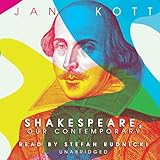
- Audible Audiobook
- Jan Kott (Author) - Stefan Rudnicki (Narrator)
- English (Publication Language)
- 12/16/2014 (Publication Date) - Skyboat Media, Inc. (Publisher)
What To Check First
- The “Great Mechanism”: Familiarize yourself with Kott’s concept of history as an impersonal, often brutal, force that shapes human actions and societal structures, a core tenet of his interpretation.
- 20th-Century Context: Understand that Kott’s readings are deeply informed by the post-World War II era, including existentialism and the experiences of totalitarianism and widespread violence.
- Machiavellian Influence: Recognize the pervasive impact of Machiavellian thought on Kott’s analysis of power, ambition, and the often amoral pragmatism of political actors.
- Focus on Tragedies and Histories: Note that Kott’s primary focus is on Shakespeare’s tragedies and history plays, using them to illustrate his theories of power and conflict, with less emphasis on the comedies.
- Contrarian Stance: Be prepared for an interpretation that deliberately challenges humanistic or romantic readings, foregrounding darker, more cynical, and politically charged aspects of the plays.
Step-by-Step Plan: Engaging with Shakespeare Our Contemporary by Jan Kott
1. Grasp the Central Thesis: Begin with the introduction to understand Kott’s primary argument: Shakespeare’s tragedies and histories reveal the “Great Mechanism” of history, mirroring the violence and political machinations that characterized the 20th century.
- Action: Identify Kott’s explicit connections between Shakespearean themes and contemporary political or social conditions.
- Look For: Kott’s conceptualization of power dynamics and human motivation as recurring, almost mechanical, forces.
- Mistake: Treating Kott’s work as mere historical commentary; his intent is to demonstrate the plays’ visceral relevance to modern anxieties.
2. Understand the “Theater of Cruelty”: Examine Kott’s interpretation of Shakespeare’s plays as a “Theater of Cruelty,” where violence and suffering are presented as fundamental expressions of human behavior, not merely plot devices.
- Action: Re-evaluate scenes from plays like Titus Andronicus or King Lear through this lens of raw, ritualistic violence.
- Look For: Kott’s emphasis on the sensory and shocking aspects of Shakespearean drama and their capacity to evoke a primal response.
- Mistake: Confusing Kott’s analytical description of theatrical representation with a moral judgment on Shakespeare or his audience.
3. Analyze Specific Play Interpretations: Engage with Kott’s detailed readings of key plays, such as Hamlet and Macbeth, focusing on his unique perspectives on their central conflicts and characters.
- Action: Compare Kott’s interpretation of Hamlet’s indecision or Macbeth’s ambition with other critical viewpoints.
- Look For: The textual evidence Kott employs to support his arguments about political assassination, moral decay, and the breakdown of order.
- Mistake: Accepting Kott’s interpretations as definitive; his work is a provocative argument, not absolute truth, and invites critical engagement.
4. Evaluate Historical Parallels: Assess the validity and impact of Kott’s extensive parallels drawn between Elizabethan England and the 20th century, particularly concerning political instability and the nature of power.
- Action: Research specific historical events or figures Kott references to understand the basis of his comparisons.
- Look For: The logical connections Kott establishes between historical contexts and Shakespearean dramatic content.
- Mistake: Overlooking potential anachronisms or oversimplifications in Kott’s historical mappings.
5. Deconstruct the “Grand Mechanism”: Delve deeper into Kott’s concept of the “Grand Mechanism” and how it functions to explain character behavior and plot development across various plays.
- Action: Identify how characters like Lear or Antony are depicted as subject to larger forces beyond their immediate control.
- Look For: Kott’s consistent application of this framework to demonstrate the cyclical nature of power, betrayal, and violence.
- Mistake: Viewing the “Grand Mechanism” as pure determinism; Kott often implies human complicity in perpetuating these cycles.
6. Consider Philosophical Underpinnings: Understand the influence of thinkers like Machiavelli and the existentialist movement on Kott’s worldview and his interpretation of Shakespearean characters’ motivations.
- Action: Reflect on how concepts like free will, determinism, and the absurd shape Kott’s readings of the plays.
- Look For: The underlying philosophical assumptions that drive Kott’s often bleak outlook on human nature and society.
- Mistake: Ignoring the philosophical framework, which is crucial to understanding the depth and often unsettling nature of Kott’s arguments.
7. Synthesize and Critique: Formulate your own informed opinion on the strengths and limitations of Kott’s interpretation and its lasting impact on Shakespearean scholarship.
- Action: Consider what new insights Kott offers and where his arguments might be challenged or fall short.
- Look For: The book’s contribution to understanding Shakespeare’s engagement with political power and historical context.
- Mistake: Dismissing the work entirely based on disagreement with its core thesis, rather than engaging with its intellectual rigor and provocative contributions.
Shakespeare Our Contemporary by Jan Kott: Strengths and Limitations
Strengths:
- Provocative Reinterpretation: Kott’s primary strength lies in his radical re-reading of Shakespeare through the lens of 20th-century political and social trauma. His argument that Shakespeare’s plays presciently captured the brutal realities of power, violence, and the “Great Mechanism” of history makes them feel intensely relevant to modern readers grappling with similar societal anxieties. For example, his analysis of Hamlet as a play steeped in the paranoia and political intrigue of assassination rings true in contemporary political discourse.
- Historical and Philosophical Rigor: The book is grounded in a deep understanding of both Elizabethan political thought, particularly Machiavellian principles, and post-war European intellectual currents like existentialism. This interdisciplinary approach provides a robust, if challenging, framework for interpreting Shakespeare’s enduring themes. His detailed examination of the historical context of Macbeth, for instance, illuminates the play’s exploration of regicide and usurpation in a particularly stark manner.
- Enduring Relevance: By connecting Shakespeare’s dramatic insights into human nature and power to the profound historical upheavals of the 20th century, Kott offers a compelling case for the plays’ continued significance. His work challenges readers to see Shakespeare not merely as a literary figure but as a profound commentator on the perennial struggles of humanity.
Limitations:
- Ideological Determinism and Cynicism: A significant limitation is Kott’s tendency towards ideological determinism. His pervasive focus on the “Great Mechanism” can reduce complex characters to mere products of historical forces, potentially diminishing their individual agency and psychological depth. For instance, his interpretation of King Lear’s madness as primarily a consequence of political failure risks overlooking the profound familial and existential dimensions of the tragedy.
- Narrow Focus on Violence and Power: While the emphasis on violence, power, and cruelty is central to Kott’s thesis, it can lead to an incomplete portrayal of Shakespeare’s vast thematic range. Readers seeking explorations of love, redemption, or the nuances of comedic genius might find his focus overly narrow. His engagement with the comedies, for example, is less developed and often filtered through the same lens of societal conflict.
- Scholarly Accessibility Barrier: The dense philosophical and historical allusions, combined with Kott’s often abstract theoretical language, can present a significant barrier to entry for readers unfamiliar with post-war European thought or advanced literary theory. The book demands a dedicated and knowledgeable reader to fully grasp its intricate arguments.
Common Myths
- Myth: Jan Kott’s Shakespeare Our Contemporary argues that Shakespeare was a conscious prophet of 20th-century horrors.
- Why it matters: This mischaracterizes Kott’s thesis as predictive rather than interpretive. Kott argues that Shakespeare’s profound understanding of human nature, power dynamics, and societal structures, forged in his own era, resonates deeply with the experiences and anxieties of the 20th century, making the plays seem prophetic.
- Fix: Understand Kott’s argument as revealing how Shakespeare’s dramatic insights into perennial human struggles—like ambition, betrayal, and the abuse of power—find potent echoes in the specific historical and political conditions of later eras, particularly the 20th century.
- Myth: The book is a straightforward literary analysis of Shakespeare’s plots and characters.
- Why it matters: This overlooks the fundamentally interdisciplinary and philosophical nature of Kott’s work. His approach is deeply rooted in history, political science, and existentialist philosophy, using Shakespeare as a case study for broader observations about human society and the nature of power.
- Fix: Recognize that Kott’s analysis is a sophisticated blend of literary criticism, historical contextualization, and philosophical inquiry. His readings are informed by his understanding of Machiavellianism and 20th-century political thought.
- Myth: Kott’s interpretation is solely about the grim and violent aspects of Shakespeare’s plays.
- **Why
Quick Comparison
| Option | Best for | Pros | Watch out |
|---|---|---|---|
| Quick Answer | General use | Shakespeare Our Contemporary by Jan Kott offers a radical reinterpretation of… | Mistake: Treating Kott’s work as mere historical commentary; his intent is to… |
| Who This Is For | General use | This work is essential for academics, literary scholars, and readers interest… | Mistake: Confusing Kott’s analytical description of theatrical representation… |
| What To Check First | General use | Those seeking traditional character studies, performance-focused criticism, o… | Mistake: Accepting Kott’s interpretations as definitive; his work is a provoc… |
| Step-by-Step Plan Engaging with Shakespeare Our Contemporary by Jan Kott | General use | Advanced readers, including university students and scholars, who are prepare… | Mistake: Overlooking potential anachronisms or oversimplifications in Kott’s… |
Decision Rules
- If reliability is your top priority for Shakespeare Our Contemporary by Jan Kott, choose the option with the strongest long-term track record and support.
- If value matters most, compare total ownership cost instead of headline price alone.
- If your use case is specific, prioritize fit-for-purpose features over generic ‘best overall’ claims.