James M. McPherson’s Battle Cry of Freedom: The Civil War
Quick Answer
- Battle Cry of Freedom by James M. McPherson is a comprehensive, Pulitzer Prize-winning single-volume history of the American Civil War, lauded for its authoritative scope and insightful analysis.
- It meticulously details the war’s origins, conduct, and consequences, integrating political, social, economic, and military dimensions into a cohesive narrative.
- This work is essential for readers seeking a deep, authoritative understanding of the conflict’s complexity and its lasting impact on American history.
Who This Is For
- Individuals who require a thorough, scholarly, yet accessible single-volume narrative of the American Civil War.
- Students, history enthusiasts, and general readers aiming for a profound grasp of the war’s causes, progression, and aftermath.
What to Check First
- Scope of Inquiry: Confirm your interest lies in a comprehensive overview of the entire Civil War era, from its roots to its conclusion, rather than a specialized study of a particular battle or figure.
- Authoritative Credibility: Verify James M. McPherson’s standing as a preeminent Civil War historian; his Pulitzer Prize serves as a strong indicator of his expertise.
- Prior Knowledge Baseline: Assess your existing familiarity with the Civil War period. While the book is structured for clarity, its depth benefits from a foundational understanding of antebellum America.
- Time Commitment: Be prepared for a substantial intellectual investment. This is an in-depth historical analysis, not a brief summary, requiring dedicated reading time.
Step-by-Step Plan: Engaging with Battle Cry of Freedom
1. Deconstruct Antebellum Tensions: Begin by thoroughly examining the initial chapters that elucidate the complex political, economic, and social fissures predating the war.
- Action: Dedicate focused attention to the sections detailing the institution of slavery, states’ rights debates, and sectional economic disparities.
- What to Look For: Clear articulation of how these intertwined factors created an irreconcilable divide between the North and the South.
- Mistake to Avoid: Glossing over the nuanced political and social context, which can lead to an oversimplified view of the war’s causes.
2. Analyze the Secession Trajectory: Carefully study the events and political machinations that directly precipitated the formation of the Confederacy.
- Action: Engage critically with the chapters covering the 1850s, the pivotal election of 1860, and the subsequent secession crisis.
- What to Look For: The precise sequence of events and the specific arguments employed by secessionist states.
- Mistake to Avoid: Underestimating the impact of failed political compromises, which were critical escalators of sectional conflict.
3. Follow Military Operations and Strategic Imperatives: Immerse yourself in the descriptions of major military engagements and the overarching strategies of both Union and Confederate forces.
- Action: Read the sections detailing key battles, the leadership of prominent commanders, and the logistical challenges faced by armies.
- What to Look For: The strategic objectives driving military actions and how battlefield outcomes influenced the war’s broader trajectory.
- Mistake to Avoid: Concentrating solely on tactical battle narratives without grasping the larger strategic goals and the consequences of command decisions.
4. Examine Home Front Realities and Societal Transformations: Investigate the profound impact of the war on civilians, economies, and societal structures in both the Union and the Confederacy.
- Action: Study the chapters addressing conscription, economic mobilization efforts, the evolving roles of women, and the experiences of enslaved populations.
- What to Look For: The significant societal shifts and transformations instigated by the conflict.
- Mistake to Avoid: Perceiving the war as exclusively a military phenomenon, thereby neglecting its pervasive influence on civilian life and societal norms.
5. Comprehend the Emancipation Process: Focus on the evolution of Union policy concerning slavery and the significance of emancipation as a war aim.
- Action: Read the chapters detailing the Emancipation Proclamation and its implementation.
- What to Look For: The political, military, and moral dimensions underpinning the move towards emancipation.
- Mistake to Avoid: Assuming emancipation was an immediate or universally supported objective from the war’s inception.
For an authoritative and comprehensive single-volume history of the American Civil War, James M. McPherson’s Battle Cry of Freedom is unparalleled. It masterfully weaves together the political, social, economic, and military aspects of the conflict.
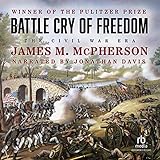
- Audible Audiobook
- James M. McPherson (Author) - Jonathan Davis (Narrator)
- English (Publication Language)
- 10/13/2020 (Publication Date) - Recorded Books (Publisher)
6. Grasp the War’s Conclusion and Immediate Aftermath: Understand the final campaigns, the terms of Confederate surrender, and the immediate post-war challenges that shaped Reconstruction.
- Action: Read the concluding chapters that describe the war’s end and its immediate consequences.
- What to Look For: The factors contributing to Union victory and the initial obstacles to national reunification.
- Mistake to Avoid: Believing that the war’s conclusion resolved all underlying issues, without acknowledging the extended period required for genuine reconciliation.
Battle Cry of Freedom by James M. McPherson: A Foundational Analysis
James M. McPherson’s Battle Cry of Freedom is widely recognized as a seminal work in Civil War historiography. It meticulously reconstructs the conflict not merely as a sequence of military engagements but as a profound national crisis stemming from deep-seated ideological, economic, and social divisions. The book’s signal strength lies in its capacity to integrate political developments, military campaigns, and individual human experiences into a cohesive and compelling narrative. Its Pulitzer Prize win attests to its status as a definitive account, offering essential foundational knowledge for anyone seeking to comprehend this critical period in American history.
BLOCKQUOTE_0
Thematic Depth in Battle Cry of Freedom by James M. McPherson
This seminal work delves into the multifaceted causes of the Civil War, moving beyond simplistic explanations to explore the complex interplay of slavery, states’ rights, economic divergence, and political failure. McPherson posits that while slavery was the central and irreconcilable issue, its existence fueled a host of other tensions that ultimately rendered conflict unavoidable.
- Slavery as the Core Issue: McPherson presents extensive evidence that slavery was the fundamental driver of secession and the war. He details how the expansion of slavery into new territories became a constant point of contention, intensifying political polarization.
- Economic Divergence: The book illustrates how the industrializing North and the agrarian, slave-based South developed increasingly distinct economic systems and interests, exacerbating sectional animosity.
- Political Failure and Compromise: McPherson meticulously chronicles the series of political compromises that ultimately proved insufficient to resolve fundamental disagreements, leading to a breakdown in national unity.
Common Mistakes
- Mistake: Focusing exclusively on military leaders and battles.
- Why it Matters: This approach omits the crucial political, social, and economic dynamics that shaped the war’s trajectory and outcome.
- Fix: Ensure you are actively reading and integrating the sections that address political decision-making, civilian life, and economic mobilization.
- Mistake: Underestimating the complexity of “states’ rights” arguments.
- Why it Matters: The concept of states’ rights was intrinsically linked to the defense of slavery. Failing to recognize this connection leads to a distorted understanding of Southern motivations.
- Fix: Pay close attention to McPherson’s explanations of the specific rights Southern states sought to defend, particularly concerning the institution of enslaved people.
- Mistake: Assuming emancipation was an immediate war aim for the Union.
- Why it Matters: The Union’s initial objective was the preservation of the nation, not necessarily the abolition of slavery. Emancipation evolved as both a strategic and moral imperative.
- Fix: Track the progression of Union policy regarding emancipation, noting the key turning points and debates that occurred.
- Mistake: Treating the North and South as monolithic entities.
- Why it Matters: Both regions harbored internal divisions, varied motivations, and diverse experiences of the war.
- Fix: Look for discussions of dissent, differing regional economies within the North and South, and the varied experiences of different social classes and racial groups.
Expert Tips
- Tip: Utilize the book’s detailed maps to orient yourself geographically.
- Actionable Step: Before delving into a chapter describing a specific campaign, locate the relevant maps to visualize troop movements and geographical challenges.
- Common Mistake to Avoid: Reading battle descriptions without spatial context, which can lead to confusion regarding the sequence and location of events.
- Tip: Maintain a separate timeline of key political events.
- Actionable Step: As you encounter elections, legislative acts, and secession declarations, record the dates and brief descriptions in a separate notebook or document.
- Common Mistake to Avoid: Losing track of the chronological order of political developments, which are essential for understanding cause and effect.
- Tip: Note McPherson’s strategic use of primary source quotes.
- Actionable Step: When McPherson incorporates a quote from a letter, diary, or speech, pause to consider what it reveals about the perspectives and emotions of the era.
- Common Mistake to Avoid: Skimming over quotes as mere historical embellishments, thereby missing opportunities for direct insight into the human dimension of the war.
Failure Mode Detection: Overwhelmed by Detail
A significant failure mode readers encounter with Battle Cry of Freedom is becoming overwhelmed by the sheer volume of detail and the intricate interconnectedness of events. This can lead to superficial comprehension rather than deep, nuanced understanding, often stemming from an attempt to rush through the text or neglecting to actively trace the causal links McPherson meticulously establishes.
To detect this failure mode early, ask yourself:
- Am I understanding the “why” behind the events described, or just the “what”?
- Do I feel lost when McPherson shifts between military, political, and social narratives?
- Am I able to connect specific events to the broader themes McPherson explores?
If the answer to these questions leans towards uncertainty, it indicates a need to slow
Quick Comparison
| Option | Best for | Pros | Watch out |
|---|---|---|---|
| Quick Answer | General use | <em>Battle Cry of Freedom by James M. McPherson</em> is a comprehensive, Pulitzer Pr… | Mistake to Avoid: Glossing over the nuanced political and social context, whi… |
| Who This Is For | General use | It meticulously details the war’s origins, conduct, and consequences, integra… | Mistake to Avoid: Underestimating the impact of failed political compromises,… |
| What to Check First | General use | This work is essential for readers seeking a deep, authoritative understandin… | Mistake to Avoid: Concentrating solely on tactical battle narratives without… |
| Step-by-Step Plan Engaging with Battle Cry of Freedom | General use | Individuals who require a thorough, scholarly, yet accessible single-volume n… | Mistake to Avoid: Perceiving the war as exclusively a military phenomenon, th… |
Decision Rules
- If reliability is your top priority for Battle Cry of Freedom by James M. McPherson, choose the option with the strongest long-term track record and support.
- If value matters most, compare total ownership cost instead of headline price alone.
- If your use case is specific, prioritize fit-for-purpose features over generic ‘best overall’ claims.