J. Kenji López-Alt’s The Food Lab: Culinary Science Explained
Quick Answer
- The Food Lab by J. Kenji López-Alt is a comprehensive culinary science guide that explains the “why” behind cooking techniques, offering data-driven insights for home cooks.
- It is ideal for those who enjoy understanding the scientific principles of cooking and are looking to improve their technique through experimentation.
- Readers seeking quick, foolproof recipes without detailed explanations may find its depth overwhelming.
Who This Is For
- Home cooks who are curious about the scientific principles behind cooking and want to understand why certain methods work.
- Individuals who enjoy detailed explanations, experimentation, and are willing to invest time in mastering techniques through a scientific lens.
What to Check First
- Your Cooking Goals: Are you looking for quick weeknight meals or are you interested in deeply understanding and mastering cooking techniques? The Food Lab excels at the latter.
- Your Patience for Detail: The book delves into precise measurements, temperature controls, and the molecular basis of cooking. If this level of detail is off-putting, other resources might be a better fit.
- Your Kitchen Equipment: While many recipes use standard equipment, some benefit from specific tools or precise temperature monitoring, which may require an initial inventory check.
- Your Library Space: This is a substantial volume, often exceeding 900 pages. Ensure you have adequate space for a reference book of this size.
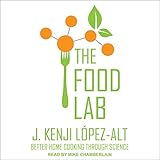
- Audible Audiobook
- J. Kenji Lopez-Alt (Author) - Mike Chamberlain (Narrator)
- English (Publication Language)
- 10/22/2019 (Publication Date) - Tantor Audio (Publisher)
Step-by-Step Plan for Engaging with The Food Lab by J. Kenji López-Alt
This plan outlines a structured approach to maximize understanding and application of the principles presented in The Food Lab by J. Kenji López-Alt.
1. Understand the Core Premise:
- Action: Read the introduction and any early chapters on fundamental cooking concepts (e.g., heat transfer, Maillard reaction).
- What to Look For: The author’s philosophy of scientific inquiry applied to cooking, emphasizing experimentation and understanding principles over rote memorization.
- Mistake to Avoid: Skipping the introductory material, which sets the stage for the book’s methodology.
2. Select a Foundational Technique:
- Action: Choose a basic technique that you frequently use or want to improve, such as searing meat, making eggs, or cooking pasta.
- What to Look For: Chapters dedicated to specific ingredients or cooking methods that offer multiple approaches and detailed explanations.
- Mistake to Avoid: Attempting to tackle overly complex techniques before grasping the simpler ones, which can lead to frustration.
3. Conduct a Controlled Experiment:
- Action: Follow one of the book’s comparative methods for your chosen technique, carefully measuring ingredients and temperatures as instructed.
- What to Look For: The clear presentation of variables and the resulting differences in outcome, supported by photographic evidence or descriptive text.
- Mistake to Avoid: Deviating from the recipe’s precise instructions during the initial experimental phase, which compromises the validity of the comparison.
4. Analyze the Results:
- Action: Taste and visually assess the outcome of your experiment, comparing it to the expected results described in the book.
- What to Look For: How the observed results align with the scientific explanations provided by López-Alt regarding factors like moisture, temperature, and chemical reactions.
- Mistake to Avoid: Dismissing unexpected results without re-examining the process or the book’s explanations, assuming an error in the book rather than the execution.
5. Integrate and Adapt:
- Action: Apply the principles learned from the experiment to your regular cooking, making informed adjustments based on your understanding.
- What to Look For: The ability to troubleshoot and adapt recipes based on ingredient variations or desired outcomes, now informed by scientific knowledge.
- Mistake to Avoid: Reverting to old habits without consciously applying the learned principles, negating the book’s educational value.
6. Expand to New Techniques:
- Action: Progress to more advanced techniques or different categories of food, following the same experimental and analytical approach.
- What to Look For: The interconnectedness of cooking principles across various dishes, reinforcing the foundational knowledge.
- Mistake to Avoid: Sticking only to familiar recipes, thereby limiting the breadth of your acquired culinary knowledge.
Common Myths About The Food Lab
- Myth: The Food Lab is just a collection of recipes with scientific explanations tacked on.
- Why it Matters: This misunderstands the book’s core purpose, which is to use science to drive recipe development and technique improvement.
- Fix: Approach the book with the mindset of learning principles first, then understanding how recipes are derived from those principles, rather than just looking for a specific dish.
- Myth: You need advanced culinary training or expensive equipment to use The Food Lab effectively.
- Why it Matters: This creates an unnecessary barrier to entry, discouraging potential readers.
- Fix: Recognize that López-Alt’s goal is to empower home cooks. While some experiments benefit from precision tools, the fundamental principles are applicable with standard kitchen equipment and a willingness to measure accurately.
- Myth: The detailed explanations in The Food Lab make cooking slower and more complicated.
- Why it Matters: This perception can lead readers to skim or ignore crucial information, missing the value.
- Fix: Understand that the upfront investment in reading and understanding the explanations leads to faster, more consistent, and more adaptable cooking in the long run. The complexity is in the understanding, not necessarily the execution once learned.
The Food Lab by J. Kenji López-Alt: Principles and Practice
This section delves into the practical application of the scientific principles elucidated in The Food Lab by J. Kenji López-Alt, highlighting key takeaways and potential pitfalls.
Understanding Heat Transfer for Better Searing
One of the most impactful areas covered is the science of heat transfer, particularly for achieving a perfect sear on meats. López-Alt meticulously breaks down how conduction, convection, and radiation interact to brown food. He contrasts methods like pan-searing with oven-finishing versus sous vide followed by searing.
BLOCKQUOTE_0
- Concrete Takeaway: For pan-searing steak, ensure your pan is sufficiently preheated (typically to around 400-450°F, though this varies by stovetop) and that the meat is dry. Moisture is the enemy of browning, as it absorbs heat and steams the surface instead of searing it.
- Potential Failure Mode: Overcrowding the pan. This lowers the pan’s temperature significantly, leading to steaming rather than searing, resulting in a grey, unappealing crust. The evidence for this is seen in comparative photos within the book, showing a sparsely populated pan achieving a deep brown crust while a crowded pan yields a pale, uneven result.
The Science of Emulsions and Sauces
The book dedicates significant attention to the creation of stable emulsions, such as mayonnaise and hollandaise. It explains the role of emulsifiers (like lecithin in egg yolks) and the critical balance of fat, liquid, and agitation.
- Concrete Takeaway: When making mayonnaise, add the oil very slowly in a thin, steady stream while whisking vigorously. This allows the emulsifier molecules to fully encapsulate the oil droplets.
- Potential Failure Mode: Adding oil too quickly. This overwhelms the emulsifier, leading to a broken sauce where the oil and liquid separate. Detecting this early involves observing the texture: a stable emulsion should be thick and homogenous. If it appears greasy or watery, it’s likely breaking.
Expert Tips for Mastering The Food Lab
- Tip 1: Embrace the Scientific Method in Your Kitchen.
- Actionable Step: When trying a new technique from the book, perform a side-by-side comparison of two methods (e.g., different ways to cook chicken breasts).
- Common Mistake to Avoid: Relying solely on one method without understanding why it works better than alternatives, thus missing the learning opportunity.
- Tip 2: Master the Tools of Precision.
- Actionable Step: Invest in and consistently use a reliable instant-read thermometer for meats and a kitchen scale for dry ingredients.
- Common Mistake to Avoid: Guessing measurements or relying solely on volume (cups) for dry ingredients, which can lead to inconsistent results due to variations in packing density.
- Tip 3: Understand the “Why” Behind Every Step.
- Actionable Step: Before executing a recipe step, briefly review the accompanying scientific explanation in the book.
- Common Mistake to Avoid: Mindlessly following recipe instructions without internalizing the underlying principles, which limits your ability to adapt or troubleshoot.
Quick Comparison
| Option | Best for | Pros | Watch out |
|---|---|---|---|
| Quick Answer | General use | The Food Lab by J. Kenji López-Alt is a comprehensive culinary science guide… | Mistake to Avoid: Skipping the introductory material, which sets the stage fo… |
| Who This Is For | General use | It is ideal for those who enjoy understanding the scientific principles of co… | Mistake to Avoid: Attempting to tackle overly complex techniques before grasp… |
| What to Check First | General use | Readers seeking quick, foolproof recipes without detailed explanations may fi… | Mistake to Avoid: Deviating from the recipe’s precise instructions during the… |
| Step-by-Step Plan for Engaging with The Food Lab by J Kenji López-Alt | General use | Home cooks who are curious about the scientific principles behind cooking and… | Mistake to Avoid: Dismissing unexpected results without re-examining the proc… |
Decision Rules
- If reliability is your top priority for The Food Lab by J. Kenji López-Alt, choose the option with the strongest long-term track record and support.
- If value matters most, compare total ownership cost instead of headline price alone.
- If your use case is specific, prioritize fit-for-purpose features over generic ‘best overall’ claims.
FAQ
- Q: Is The Food Lab suitable for beginner cooks?
- A: Yes, but with a caveat. While it explains fundamentals thoroughly, beginners should be prepared for a detailed, scientific approach rather than simple step-by-step instructions for quick meals. It’s best for beginners who are eager to learn the science behind cooking.
- Q: How much time should I realistically dedicate to cooking from The Food Lab?
- A: This varies greatly depending on the recipe and the reader’s experience. Some techniques, like mastering a perfect omelet, might take a few focused attempts. More complex dishes or detailed experiments can take several hours. The book encourages understanding, which may require more time initially than simply following a standard recipe.
- Q: What if my results don’t match the book’s?
- A: First, re-examine your execution. Did you measure precisely? Was your equipment at the correct temperature? Then, reread the scientific explanation to see if you missed a nuance. Finally, consider environmental factors (e