J. G. Ballard’s The Drowned World: A Dystopian Vision
The Drowned World by J. G. Ballard: Quick Answer
- The Drowned World by J. G. Ballard is a stark, atmospheric novel depicting a future Earth submerged by rising oceans and intense solar radiation, focusing on the psychological impact of environmental collapse.
- This book is best suited for readers who appreciate Ballard’s signature style of surrealism, psychological depth, and bleak, introspective narratives that explore themes of entropy and regression.
- Readers seeking conventional plot structures, optimistic outcomes, or action-driven narratives may find The Drowned World to be a less engaging experience.
Who This Is For
- Readers interested in speculative fiction that prioritizes internal psychological landscapes and thematic resonance over external action and technological solutions.
- Those who are familiar with and appreciate J. G. Ballard’s unique literary voice, characterized by its detached tone, dreamlike imagery, and focus on the subconscious.
What to Check First
Before immersing yourself in The Drowned World by J. G. Ballard, consider these critical elements:
- Ballard’s Stylistic Approach: Are you prepared for a narrative style that is often detached, observational, and rich in symbolic imagery rather than straightforward storytelling? Ballard’s strength lies in creating mood and exploring psychological states.
- Pacing and Plot: This novel is deliberately slow-paced. Its narrative unfolds through atmosphere and character introspection, rather than a series of escalating events. If you require a brisk plot, this may not be the best fit.
- Thematic Resonance: The core themes revolve around entropy, regression, the subconscious, and humanity’s passive acceptance of decay. If these concepts do not inherently interest you, the novel’s impact may be diminished.
- Environmental Determinism: While the novel depicts an environmental catastrophe, it is not a typical eco-thriller. Instead, it examines how the environment shapes and potentially subsumes human consciousness.
Step-by-Step Plan for Reading The Drowned World
1. Immerse Yourself in the Setting: Begin by absorbing Ballard’s descriptions of the flooded world and the pervasive solar radiation.
- What to look for: The palpable sense of heat, the stagnant water, the decaying urban architecture, and the oppressive stillness. These elements are crucial to the novel’s psychological impact.
- Mistake: Treating the environment as mere background. Ballard uses the setting as an active force that influences and mirrors the characters’ internal states.
2. Focus on Dr. Kerans’ Psyche: Pay close attention to the protagonist, Dr. Robert Kerans, and his initial mission in the submerged city of London.
- What to look for: Kerans’ growing detachment, his fascination with the drowned landscape, and the subtle shifts in his perception and priorities.
- Mistake: Expecting Kerans to be a conventional hero or an agent of change. He is an observer who becomes increasingly integrated into the world he is meant to study.
3. Track Psychological Regression: Observe how the extreme conditions affect the characters’ mental states and behavior.
- What to look for: Signs of lethargy, the erosion of social norms, the emergence of primal instincts, and the penetration of dreamlike or hallucinatory experiences.
- Mistake: Dismissing these psychological shifts as irrational or gratuitous. They are the primary drivers of the narrative and Ballard’s exploration of human response to collapse.
4. Analyze the Symbolism: Identify and interpret recurring motifs and symbols within the narrative.
- What to look for: The significance of overgrown vegetation, stagnant water, abandoned structures, and the recurring imagery of heat and light. These elements often represent deeper psychological or societal decay.
- Mistake: Interpreting symbols too literally. Ballard uses them to evoke emotional and subconscious associations, contributing to the novel’s dreamlike quality.
5. Examine Interpersonal Dynamics: Observe the interactions between the surviving characters, particularly Kerans, Beatrice, and the others.
- What to look for: The breakdown of established social hierarchies, the emergence of new, often primitive, forms of connection or conflict, and the influence of the environment on these relationships.
- Mistake: Anticipating standard character arcs or resolutions in their relationships. These interactions reflect the unraveling of civilization and the shift toward more basic human drives.
6. Contemplate the Ending: Reflect on the novel’s conclusion and its implications for the characters and the world.
- What to look for: The sense of acceptance of the new, drowned reality, the embrace of entropy, and the ultimate feeling of surrender to the overwhelming forces of nature.
- Mistake: Searching for a hopeful or redemptive message. Ballard’s vision here is profoundly melancholic, suggesting a cyclical process of destruction and transformation rather than a positive resolution.
For those seeking a stark and atmospheric dive into a future Earth submerged by rising oceans and intense solar radiation, J. G. Ballard’s The Drowned World is a must-read. It masterfully explores the psychological impact of environmental collapse.
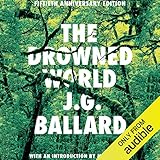
- Audible Audiobook
- J. G. Ballard (Author) - Julian Elfer (Narrator)
- English (Publication Language)
- 06/25/2013 (Publication Date) - Audible Studios (Publisher)
The Drowned World by J. G. Ballard: Themes and Analysis
J. G. Ballard’s The Drowned World stands as a potent and disquieting examination of humanity’s response to environmental collapse, delving deep into the psychological ramifications of a world succumbing to natural forces. Set in a future where rising oceans and intense solar radiation have rendered most of the planet uninhabitable, the novel presents a submerged London as the stage for a profound exploration of entropy, regression, and the human psyche’s capacity for adaptation, or perhaps, surrender. This is not a narrative of survival against the odds, but an introspective journey into the allure of decay and the subconscious’s primal connection to a world in ruin.
The central character, Dr. Robert Kerans, a biologist, embodies this complex relationship with the encroaching desolation. Tasked with assessing the ecological conditions of the flooded city, Kerans finds himself increasingly drawn to the very forces that have destroyed civilization. His initial scientific detachment gradually erodes, replaced by a profound fascination with the drowned world. Ballard masterfully employs the submerged cityscape not merely as a setting but as a powerful metaphor for the subconscious, where buried memories and primal urges resurface from the depths.
A crucial lens through which to view The Drowned World is the concept of “terminal regression.” This unique perspective suggests that faced with overwhelming environmental and societal collapse, humanity might not instinctively strive for reconstruction or survival, but rather regress towards a more primitive state, finding a strange solace or even ecstasy in the very forces of decay. This is the distinctive decision criterion for The Drowned World by J. G. Ballard: if your expectation is a story of human resilience and technological solutions to ecological crises, this novel will likely present a challenge. However, if you are intrigued by the psychological and philosophical dimensions of collapse, and the potential for a somber, unsettling beauty within destruction, then Ballard’s work offers a uniquely profound and memorable reading experience.
| Feature | Description | Reader Takeaway |
|---|---|---|
| <strong>Atmospheric Quality</strong> | Pervasive heat, stagnant waters, decaying architecture, dreamlike stillness, and a sense of temporal distortion. | Prepare for an intensely immersive and oppressive reading environment that prioritizes mood and sensory detail over rapid plot development. |
| <strong>Protagonist’s Arc</strong> | Dr. Kerans’ journey from detached observer to an individual increasingly captivated by and integrated into the drowned world. | Do not expect a traditional heroic trajectory. The focus is on internal psychological shifts and the protagonist’s surrender to environmental influence. |
| <strong>Narrative Pace</strong> | Deliberately slow and observational, driven by internal character states and thematic exploration rather than external events. | This novel requires patience. It is best appreciated for its thematic depth, symbolic resonance, and the gradual unfolding of its bleak vision. |
| <strong>Core Themes</strong> | Entropy, psychological regression, the subconscious, environmental determinism, and the passive embrace of decay. | The book challenges conventional notions of progress and human agency, offering a stark contemplation of humanity’s potential response to existential threats. |
Checklist for Reading The Drowned World
Before embarking on your journey into J. G. Ballard’s submerged world, consider these points to ensure it aligns with your reading preferences:
- [ ] Am I prepared for a narrative that unfolds at a deliberate, slow pace with minimal emphasis on action sequences?
- [ ] Do I appreciate literary works that prioritize atmosphere, mood, and psychological exploration over a tightly plotted storyline?
- [ ] Am I comfortable engaging with themes of decay, regression, and environmental catastrophe without expecting a hopeful or redemptive resolution?
- [ ] Do I find Ballard’s distinctive writing style—often detached, surreal, and rich in symbolic imagery—to be engaging?
- [ ] Am I open to a perspective that explores the potential for humanity to embrace or succumb to forces of destruction, rather than to fight them?
Common Mistakes
- Mistake: Expecting a conventional survival narrative with a clear protagonist fighting against the elements.
- Why it matters: This leads to disappointment as The Drowned World is more concerned with the psychological adaptation and regression of its characters in the face of overwhelming environmental change.
- Fix: Approach the novel as an exploration of the human psyche’s response to extreme conditions, where observation and internal shifts are more significant than external action.
- Mistake: Underestimating the environmental setting’s role.
- Why it matters: The flooded, solar-ravaged world is not merely a backdrop; it is an active, pervasive force that shapes the characters’ minds, their perceptions, and the novel’s thematic core.
- Fix: Pay close attention to Ballard’s detailed descriptions of the environment. These passages are integral to understanding the characters’ psychological states and the novel’s commentary on humanity’s relationship with nature.
- Mistake: Seeking straightforward moral judgments or heroic archetypes.
- Why it matters: Ballard presents characters who are complex, often morally ambiguous, reflecting the breakdown of societal norms and the emergence of more primal drives under duress.
- Fix: Embrace the ambiguity and lack of clear heroes. The novel is interested in observing and reflecting human behavior in extremis, rather than offering prescriptive moral lessons.
- Mistake: Dismissing the novel’s surreal or dreamlike elements as nonsensical or gratuitous.
- Why it matters: These elements are crucial to Ballard’s exploration of the subconscious mind, the erosion of rational thought under stress, and the penetration of primal instincts.
- Fix: Consider these surreal passages as symbolic representations of the characters’ inner turmoil, their latent desires, and their connection to a decaying, elemental world.
Decision Rules
- If your primary criterion for selecting The Drowned World by J. G. Ballard is thematic depth and psychological exploration, this novel is a strong candidate.
- If you prioritize narratives that offer a critical examination of environmental collapse and its impact on the human psyche, The Drowned World provides a unique and unsettling perspective.
- If you are seeking a fast-paced plot with a clear resolution, you may want to consider alternative titles, as this novel’s strengths lie elsewhere.
FAQ
Q: Is The Drowned World by J. G. Ballard considered a classic of its genre?
A: Yes, The Drowned World is widely regarded as a seminal work of ecological and psychological science fiction, influential for its prescient themes and distinctive literary style.
Q: What makes the reading experience of The Drowned World unique?
A: Its uniqueness stems from its slow, atmospheric pacing, its focus on the psychological impact of environmental disaster, and its exploration of themes like regression and the subconscious, rather than conventional plot mechanics.
Q: What are the primary themes explored in The Drowned World?
A: The novel’s central themes include environmental collapse, psychological regression, the subconscious mind, the allure of entropy and decay, and humanity’s potential passive acceptance of catastrophic change.
Q: Should I read The Drowned World if I am looking for a hopeful story about environmental recovery?
A: No, this novel does not offer a hopeful outlook on environmental recovery. Instead, it presents a bleak vision of humanity’s potential surrender to or integration with forces of decay and environmental transformation.