Ian McEwan’s The Children Act: A Moral Dilemma
Quick Answer
- The Children Act by Ian McEwan presents a complex legal and ethical scenario through the lens of a High Court judge.
- The novel excels in its nuanced exploration of faith, reason, and parental rights, but its central argument can feel somewhat didactic.
- Readers seeking a thought-provoking examination of deeply personal and societal conflicts will find it rewarding.
Who This Is For
- Readers interested in contemporary literary fiction that tackles significant ethical and legal questions.
- Those who appreciate character-driven narratives that delve into the internal struggles of professionals facing moral quandaries.
What to Check First
- Author’s Previous Works: Ian McEwan often explores the intersection of science, morality, and human nature. Familiarity with books like Saturday or Atonement can provide context for his thematic concerns.
- Central Conflict: The novel hinges on a specific legal case involving a minor’s refusal of a blood transfusion due to religious beliefs. Understanding this core conflict is crucial.
- Protagonist’s Position: Justice Fiona Maye, the protagonist, must make a life-altering decision. Her professional duty and personal life become deeply intertwined.
- Thematic Depth: The book engages with themes of secularism versus faith, the limits of law, and the nature of love and duty.
Step-by-Step Plan for Understanding The Children Act by Ian McEwan
1. Identify the Core Legal Case: Focus on the case of Adam Henry, a seventeen-year-old Jehovah’s Witness refusing a life-saving blood transfusion.
- What to look for: The specific medical necessity for the transfusion and Adam’s articulate reasons for refusal based on his religious faith.
- Mistake to avoid: Dismissing Adam’s religious convictions as simply irrational or a product of parental influence without fully considering his agency.
2. Analyze Justice Maye’s Dilemma: Examine Fiona Maye’s professional obligation to uphold the law and protect the child against her personal feelings and the complexities of the case.
- What to look for: Maye’s internal debate, her attempts to reconcile legal precedent with the specific human circumstances, and her personal life stressors.
- Mistake to avoid: Assuming Maye’s decision is purely a mechanical application of legal rules; her emotional and personal state significantly influences her judgment.
3. Explore the Philosophical Underpinnings: Understand the novel’s engagement with the clash between secular reason and religious faith.
- What to look for: How McEwan contrasts Maye’s rational, legalistic approach with the faith-based convictions of Adam and his family.
- Mistake to avoid: Seeing the conflict as a simple “good versus evil” dichotomy; McEwan presents nuanced arguments on both sides.
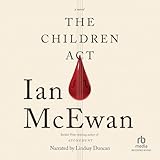
- Audible Audiobook
- Ian McEwan (Author) - Lindsay Duncan (Narrator)
- English (Publication Language)
- 09/09/2014 (Publication Date) - Recorded Books (Publisher)
4. Examine the Impact on Maye’s Personal Life: Observe how the stress and emotional toll of the case affect Fiona Maye’s marriage to her husband, Jack.
- What to look for: The parallel narrative of marital strain and how it mirrors or contrasts with the legal drama.
- Mistake to avoid: Treating Maye’s personal life as a mere subplot; it is intrinsically linked to her professional capacity and decision-making.
5. Consider the Novel’s Resolution: Reflect on the outcome of the case and its lasting implications for the characters involved.
- What to look for: The consequences of Maye’s judgment and how it shapes the future for Adam and for herself.
- Mistake to avoid: Expecting a neat or universally satisfying conclusion; McEwan often leaves readers with lingering questions.
6. Evaluate McEwan’s Narrative Style: Pay attention to McEwan’s precise prose and his method of revealing character through internal monologue and dialogue.
- What to look for: The controlled, almost clinical, tone that often accompanies moments of intense emotional or ethical crisis.
- Mistake to avoid: Underestimating the emotional weight carried by the seemingly detached narrative voice.
Common Myths About The Children Act
- Myth: The book is a dry legal procedural.
- Why it matters: This perception might deter readers who enjoy character-driven narratives and ethical exploration.
- Fix: Recognize that while law is central, the novel prioritizes the human drama and the internal lives of its characters, particularly Justice Maye. The legal framework serves to illuminate profound personal and philosophical issues.
- Myth: The novel offers a definitive answer to the conflict between faith and secular law.
- Why it matters: Such an expectation might lead to disappointment if the reader seeks a clear-cut moral victory.
- Fix: Understand that McEwan deliberately explores the complexities and ambiguities. The book’s strength lies in posing difficult questions rather than providing easy answers.
- Myth: Adam Henry is merely a pawn in a legal battle.
- Why it matters: This view diminishes the character’s agency and the novel’s exploration of adolescent autonomy and belief.
- Fix: Pay close attention to Adam’s articulate statements and his internal reasoning. McEwan works to present him as a young man with deeply held convictions, not just a victim of circumstance.
Quick Comparison
| Option | Best for | Pros | Watch out |
|---|---|---|---|
| Quick Answer | General use | The Children Act by Ian McEwan presents a complex legal and ethical scenari… | Mistake to avoid: Dismissing Adam’s religious convictions as simply irrationa… |
| Who This Is For | General use | The novel excels in its nuanced exploration of faith, reason, and parental ri… | Mistake to avoid: Assuming Maye’s decision is purely a mechanical application… |
| What to Check First | General use | Readers seeking a thought-provoking examination of deeply personal and societ… | Mistake to avoid: Seeing the conflict as a simple “good versus evil” dichotom… |
| Step-by-Step Plan for Understanding The Children Act by Ian McEwan | General use | Readers interested in contemporary literary fiction that tackles significant… | Mistake to avoid: Treating Maye’s personal life as a mere subplot; it is intr… |
Decision Rules
- If reliability is your top priority for The Children Act by Ian McEwan, choose the option with the strongest long-term track record and support.
- If value matters most, compare total ownership cost instead of headline price alone.
- If your use case is specific, prioritize fit-for-purpose features over generic ‘best overall’ claims.
FAQ
Q1: Is The Children Act a difficult read?
A1: The prose is precise and accessible, but the subject matter is emotionally and intellectually challenging. Readers should be prepared for a thoughtful, rather than a fast-paced, experience.
Q2: What is the primary decision criterion that might change a reader’s recommendation for The Children Act?
A2: A crucial decision criterion is the reader’s tolerance for ambiguity and unresolved moral tension. If a reader requires clear-cut resolutions and definitive moral pronouncements, this novel might prove frustrating. Conversely, those who appreciate literature that lingers and prompts introspection will find it highly rewarding.
Q3: How does Justice Maye’s personal life impact her professional judgment?
A3: Maye’s marital difficulties create a parallel emotional landscape that influences her perspective. The strain in her personal life makes her more attuned to the complexities of human relationships and the potential for loneliness, which can, in turn, affect her empathy and her approach to the legal case.
Q4: Does the book offer a critique of the legal system?
A4: Yes, it implicitly critiques the limitations of the legal system in fully grasping or accommodating deeply personal faith and complex human emotions. While upholding the law, Maye grapples with its inherent constraints in dealing with situations that transcend purely rational or empirical considerations.
BLOCKQUOTE_0
Who May Skip This Book
- Readers looking for light, escapist fiction.
- Those who prefer plot-driven narratives with straightforward resolutions.
Strengths of The Children Act by Ian McEwan
- Nuanced Characterization: Justice Fiona Maye is a compellingly drawn character, her internal conflicts rendered with psychological acuity.
- Intellectual Depth: The novel engages seriously with profound questions of law, ethics, religion, and the nature of belief, offering no easy answers.
- Masterful Prose: McEwan’s writing is precise, elegant, and controlled, creating a compelling atmosphere.
Limitations of The Children Act
- Didactic Tendencies: At times, the novel’s exploration of themes can feel didactic, with arguments presented perhaps too explicitly through dialogue or internal monologue.
- Pacing: While deliberate, the pacing can feel slow for readers accustomed to more plot-driven novels. The focus is heavily on internal reflection and ethical debate.
Reading Context and Comparison
The Children Act by Ian McEwan is best approached as a philosophical novel wrapped in a legal drama. It shares thematic DNA with works that explore the intersection of science, reason, and faith, such as C.S. Lewis’s allegories or more contemporary novels grappling with belief systems. However, McEwan’s characteristic focus on precise psychological realism and his often-unflinching examination of moral compromise set it apart. For readers who appreciated the intellectual rigor and ethical dilemmas in novels like Kazuo Ishiguro’s The Remains of the Day or Julian Barnes’s The Sense of an Ending, The Children Act offers a similarly contemplative and challenging experience.
Expert Tips for Engaging with The Children Act
- Tip 1: Empathize with Multiple Perspectives.
- Actionable Step: Actively try to understand the motivations and beliefs of all key characters, including Adam, his parents, and Justice Maye, even when their views clash.
- Common Mistake to Avoid: Immediately siding with one character or viewpoint and dismissing the others as inherently wrong.
- Tip 2: Recognize the Symbolic Weight of Music.
- Actionable Step: Pay attention to the passages where music, particularly Bach, is discussed or experienced. Consider its role in Maye’s life and its potential symbolic meaning in the context of order, reason, and emotion.
- Common Mistake to Avoid: Skimming over these musical interludes as mere background detail, thereby missing a layer of thematic resonance.
- Tip 3: Consider the Author’s Intent Regarding Ambiguity.
- Actionable Step: Embrace the novel’s lack of definitive answers. Reflect on why McEwan might have chosen to leave certain outcomes open to interpretation.
- Common Mistake to Avoid: Becoming frustrated by the unresolved elements and expecting a tidy, conclusive ending. The power of the novel lies in its exploration of persistent questions.