Ian McEwan’s Enduring Love: A Novel Analysis
This analysis delves into Ian McEwan’s Enduring Love, examining its thematic depth, narrative structure, and potential reader reception. It aims to provide a nuanced understanding for those interested in literary analysis and the complexities of human relationships as depicted in contemporary fiction.
Enduring Love by Ian McEwan: Quick Answer
- Enduring Love by Ian McEwan is a novel that explores the profound and often destructive nature of obsession, love, and the human need for connection, framed by a near-fatal accident.
- The novel excels in its psychological acuity and McEwan’s signature prose, but some readers may find its philosophical tangents and character motivations challenging.
- It is best suited for readers who appreciate character-driven narratives that grapple with existential questions and the darker aspects of human psychology.
Who This Is For
- Readers interested in exploring the psychological underpinnings of love, obsession, and trauma.
- Those who appreciate literary fiction that blends philosophical inquiry with compelling narrative.
What to Check First
- The Novel’s Central Premise: Understand that the narrative hinges on a ballooning accident and its aftermath, serving as a catalyst for exploring complex interpersonal dynamics.
- McEwan’s Stylistic Tendencies: Be prepared for McEwan’s precise, often clinical, prose and his inclination to dissect characters’ internal states.
- Thematic Focus: Recognize that the novel is less about a straightforward romance and more about the varied, and sometimes distorted, forms that love and connection can take.
- Narrative Structure: Note that the story is told from multiple perspectives, primarily Joe Rose, but also incorporates elements of a scientific treatise and other characters’ viewpoints.
Step-by-Step Plan for Understanding Enduring Love
1. Engage with the Opening Incident: Observe how the hot air balloon incident serves as the narrative’s inciting event.
- Action: Read the initial chapters carefully, paying attention to the physical and emotional impact of the accident on Joe and Clarissa.
- What to Look For: The immediate psychological shock, the sense of shared vulnerability, and the nascent bond formed under duress.
- Mistake: Underestimating the significance of this event as the structural and thematic anchor for the entire novel.
2. Analyze the Character of Jed Parry: Track Jed’s descent into obsession and his twisted interpretation of love.
- Action: Examine Jed’s internal monologues and his interactions with Joe and Clarissa.
- What to Look For: The manifestation of his delusion, his religious justifications for his actions, and his unwavering conviction.
- Mistake: Dismissing Jed as a simple antagonist; his psychological complexity is central to the novel’s exploration of obsession.
3. Deconstruct Joe Rose’s Perspective: Understand Joe’s internal struggles and his attempts to rationalize and control his life.
- Action: Focus on Joe’s narration, his scientific inclinations, and his anxieties.
- What to Look For: His attempts to maintain order, his intellectualization of emotions, and his growing fear.
- Mistake: Accepting Joe’s narrative as entirely objective; his biases and fears shape his perception.
4. Evaluate the Theme of “Enduring Love”: Consider the various forms of love presented and how they endure or falter.
- Action: Identify instances of romantic love, familial love, and the obsessive “love” Jed claims to feel.
- What to Look For: The contrast between genuine connection and destructive fixation, and the novel’s questioning of what constitutes true enduring love.
- Mistake: Limiting the definition of “enduring love” to romantic relationships; the novel expands this concept significantly.
For those looking to dive into Ian McEwan’s exploration of obsession and human connection, his novel Enduring Love is a compelling choice.
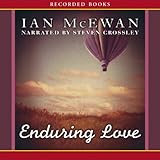
- Audible Audiobook
- Ian McEwan (Author) - Steven Crossley (Narrator)
- English (Publication Language)
- 03/11/2004 (Publication Date) - Recorded Books (Publisher)
5. Examine McEwan’s Use of Scientific Discourse: Note how scientific explanations are integrated into the narrative.
- Action: Pay attention to the passages discussing probability, genetics, and human behavior.
- What to Look For: How these scientific frameworks attempt to explain or control the irrational forces at play in the characters’ lives.
- Mistake: Viewing these scientific digressions as mere academic filler; they are integral to McEwan’s exploration of order versus chaos.
6. Assess the Climax and Resolution: Understand the novel’s conclusion and its implications for the characters.
- Action: Read the final chapters, observing the confrontation and its aftermath.
- What to Look For: The lasting impact of the events on Joe, Clarissa, and the broader question of whether true connection can be rebuilt.
- Mistake: Expecting a neatly resolved or conventionally happy ending; McEwan’s conclusions are often more complex and unsettling.
Understanding Enduring Love by Ian McEwan
This section addresses common reader misconceptions and offers a contrarian view on certain aspects of Enduring Love.
Common Myths
- Myth 1: Enduring Love is primarily a romantic thriller.
- Why it matters: This framing can lead to disappointment if readers expect a fast-paced plot driven solely by suspense and romance.
- Correction: While suspense is present, the novel is more accurately described as a psychological drama that uses a high-stakes situation to explore themes of obsession, scientific rationalization, and the complex nature of human connection. The “thriller” elements serve the deeper thematic concerns.
- Myth 2: Jed Parry is a purely evil character, a stock villain.
- Why it matters: Such a view simplifies the novel’s psychological depth and McEwan’s nuanced portrayal of disturbed individuals.
- Correction: McEwan meticulously crafts Jed’s internal world, revealing the warped logic and profound loneliness that fuel his actions. While his behavior is reprehensible, understanding his psychological framework is crucial to the novel’s exploration of how distorted beliefs can manifest.
Expert Tips for Analyzing Enduring Love
This section provides practical advice for readers engaging with the novel, focusing on specific analytical approaches.
- Tip 1: Track the Narrative Voice Shifts.
- Actionable Step: Keep a log of whose perspective is dominant in each section and note how the narrative voice changes.
- Common Mistake: Assuming Joe Rose’s perspective is the sole or most reliable lens through which to view the events. McEwan intentionally uses multiple voices to create a more complex and multifaceted understanding of the characters and their motivations.
- Tip 2: Interrogate the “Scientific” Elements.
- Actionable Step: When scientific concepts are introduced, consider their function within the narrative – do they explain, control, or obscure the emotional reality?
- Common Mistake: Treating the scientific explanations as literal truth or as mere authorial exposition. McEwan often uses scientific language to highlight the limitations of rationality when confronting irrational human behavior and profound emotional experiences.
- Tip 3: Map the Evolution of Obsession.
- Actionable Step: Visually map Jed Parry’s obsession, noting its progression from initial fixation to its all-consuming nature.
- Common Mistake: Focusing solely on Jed’s actions without delving into the psychological mechanisms McEwan portrays that enable such an extreme fixation to take root and persist.
BLOCKQUOTE_0
Decision Rules
- If reliability is your top priority for Enduring Love by Ian McEwan, choose the option with the strongest long-term track record and support.
- If value matters most, compare total ownership cost instead of headline price alone.
- If your use case is specific, prioritize fit-for-purpose features over generic ‘best overall’ claims.
FAQ
- Q: Is Enduring Love a happy or uplifting book?
- A: Enduring Love is not typically considered an uplifting book. While it explores the human need for connection, it does so through the lens of trauma, obsession, and psychological distress, offering a complex and often unsettling portrayal of relationships.
- Q: What is the primary theme of Enduring Love by Ian McEwan?
- A: The primary theme is the multifaceted and often dangerous nature of love and connection, particularly how obsession can distort these fundamental human drives, and the struggle to maintain order and rationality in the face of overwhelming emotional forces.
- Q: How does the hot air balloon accident impact the characters?
- A: The accident serves as a catalyst, forcing characters into proximity and shared trauma. It triggers deep-seated anxieties and vulnerabilities, particularly in Joe, and becomes the focal point for Jed Parry’s obsessive fixation, fundamentally altering the lives of all involved.
| Character | Primary Motivation | Key Relationship Dynamic | Narrative Function |
|---|---|---|---|
| Joe Rose | Maintaining control, seeking understanding | Strained romantic, fearful of obsession | Protagonist, narrator, intellectual counterpoint to chaos |
| Clarissa Mellon | Seeking genuine connection, stability | Complex romantic, threatened by external forces | Love interest, voice of reason, emotional anchor |
| Jed Parry | Proving his “love,” seeking validation | Obsessive, delusional, predatory | Antagonist, embodiment of distorted human connection |
| Mrs. Henderson | Grief, seeking solace | Maternal, protective of Jed | Catalyst for Jed’s actions, thematic exploration of loss |
| Professor Zoltan | Scientific inquiry, detached observation | Observational, analytical | Provides scientific framework, contrasts with emotional chaos |